[1]
[1]
Editor’s note: The following is an excerpt from “I Am Going [2], second edition” by Daniel L. Akin, released by B&H Publishing (June 2026).
After Jesus rose from the dead, he appeared to his disciples and said, to them:
“All authority has been given to Me in heaven and on earth. Go, therefore, and make disciples of all nations, baptizing them in the name of the Father and of the Son and of the Holy Spirit, teaching them to observe everything I have commanded you. And remember, I am with you always, to the end of the age.” (Matt. 28:18–20).
In this passage (popularly called the Great Commission), which represents Jesus’ parting words to his followers, he instructs them to make disciples of all nations. How is this relevant to us today? It is relevant in that it encapsulates our mission! God intends for his people to make disciples of every nation including our own. His command to make disciples was not just for his first century disciples. It is for all his disciples, including you and me!
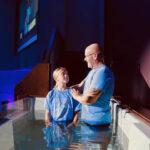
How do we make disciples of the nations? We do so by baptizing them in the name of the Father, Son, and Spirit, and by teaching them all of Jesus’ words. Our mission is to teach people the saving words of God and to baptize them into local communities of believers – churches! – that will equip them to bring the whole of their lives into line with God’s intentions for them.
What gives us confidence that we can do this, especially when many people will oppose us because of our message about Jesus’ salvation? Our confidence is that Jesus is with us always, accompanying us as we make disciples, and that he will be with us “even to the end of the age.” That last promise is a big one. He’ll be with us until he returns again to defeat his enemies and purge the heavens and earth of sin and its consequences. In other words, when the dust settles, he’ll still be standing. And because we belong to him, we’ll still be standing with him forever and ever.
The thing that is so “great” about the Great Commission is that it encompasses all of the other commandments and commissions. When we teach people “everything” Christ commands, we are teaching them everything the Bible teaches. Every word of Scripture is a word of Christ.
Words and Actions
Have you ever heard the phrase, “Actions speak louder than words”? What about the phrase, “You might be the only Bible your neighbor will ever read”? Or, “Talk is cheap”?
It’s true that we can act a long time before we speak, but words are just as important as action. God created the world in the beginning with words. Practically speaking, we obey the Great Commission using both words and actions. Words are important because, as Paul asked in Romans 10:14, how can a person trust in Christ without ever having heard about him? Words are necessary! Our actions are important also because, as Paul said to the Corinthians, “Therefore, whether you eat or drink, or whatever you do, do everything for God’s glory” (1 Corinthians 10:31). Actions are important because they should be an evidence of our own salvation and should be a preview of what life will be like one day in the new heavens and new earth, when all of our actions will be in conformity with God’s will.
 [3]
[3]Consider the analogy of a hub and wheel, such as those found on old-timey covered wagons. Both the hub and the wheel are important. The hub is the center of the wheel and it holds the whole wheel together. If the hub is removed, the wheel collapses. Conversely, if the wheel is removed, the hub gets little or no traction.
In this analogy, the hub of Christian mission is Gospel words, while the wheel is Gospel-motivated and Gospel-centered actions. The hub is essential because without it, the wheel collapses. This was Paul’s point when he posed the rhetorical question: how could a person believe in Christ without hearing about Him? This is why our mission is to speak words about Christ as often as we can and in as attractive of a way as we can (1 Peter 3:15).
The wheel is also essential. If the wheel is removed, the covered wagon would get little or no traction. This was Paul’s point when he said that we should glorify God in everything we do. Why would we want our words to be shaped by Christ, but not our actions? Would we ever say that we wanted to speak the Gospel to our neighbor, but also at the same time steal the money in our neighbor’s savings account and treat his family poorly? Of course not. When Gospel words are not accompanied by Gospel-shaped lives, our words will often have little or no traction. They will fall on deaf ears.
We could describe our mission, like Israel’s, as being five-directional. God wants us to:
- direct our worship upward to him, allowing him to make us more like his Son Jesus;
- look inward at our family lives and church lives, seeking to love one another in a way that reflects God’s love for us and for the world;
- point backward to God’s creational design for the world, a design in which humanity had a right relationship with him, with each other, and with the created world;
- live in such a way that our lives point forward to the time when Jesus returns to renew and restore the world into a new heavens and earth, the type of lives that serve as a preview of that coming Kingdom; and
- focus outward on the nations, seeking to attract them to Christ so that they will experience the salvation he offers.
Our mission is upward, inward, backward, forward, and outward.
 [4]
[4]