[1]
[1]ORLANDO (BP) – Pastors examined conflict, suffering and finishing well during the second session of the SBC Pastors’ Conference June 8 in Orlando. The session featured sermons from Edgar Aponte and Heath Lambert and a panel discussion led by Ken Whitten, national director of pastoral leadership at the North American Mission Board, with Steve Dighton, Ted Traylor and Bryant Wright.
Edgar Aponte
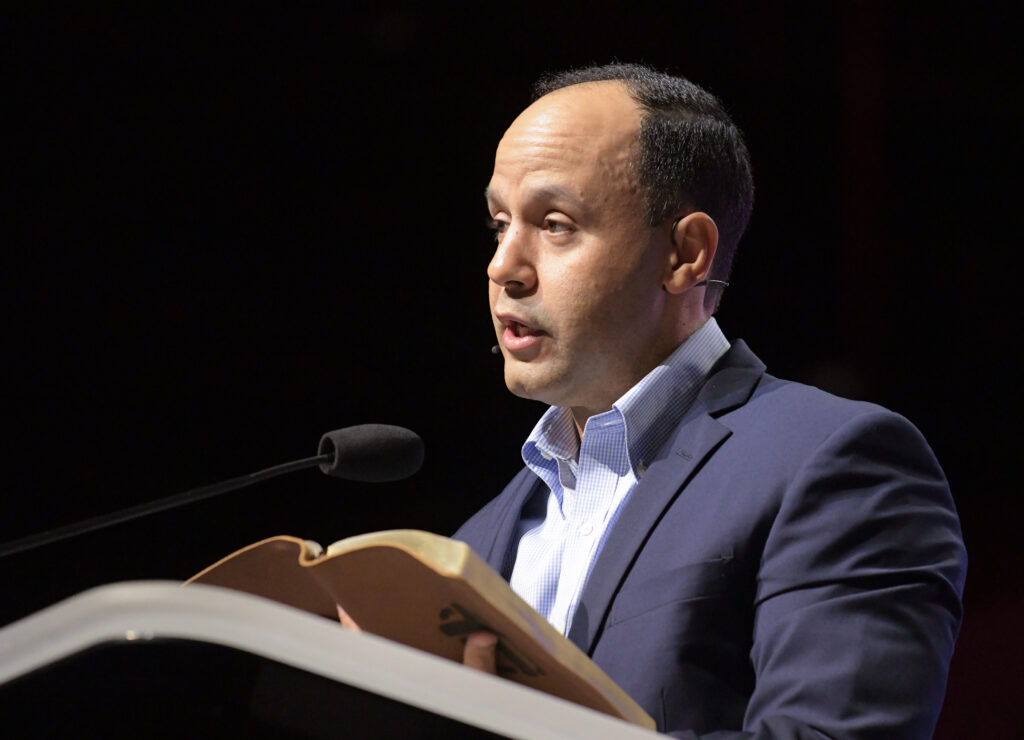
In his segment, Edgar Aponte, senior pastor of Idlewild Baptist Church, Lutz, Florida, stressed Christians must protect Gospel unity for the sake of Gospel advancement. But, he acknowledged, where there is power, there is tension.
He asserted Christians must learn how to disagree without dividing, stand firm without being rigid, and keep the Gospel central to everything they do.Drawing from Acts 15:36-16:5, he shared three practical ways to handle the inevitable conflict.
First, do not let conflict or disagreement hinder Gospel advancement. Gospel ministry will include “sharp disagreement” (Acts 15:39), Aponte said, explaining how Paul and Barnabas, two godly believers and good friends who had worked together for 12 years, disagreed about taking John Mark with them.
“Two godly and good people can disagree,” Aponte noted, explaining their issue was not theological or moral. It was a relational conflict and an issue of wisdom.
“Not all conflicts are sinful. Sometimes faithful men see things differently,” shared Aponte, noting conflict can be an opportunity for growth, as was the case in Acts 15, where the gospel was spread because the believers parted ways.
Aponte stressed, “We must avoid the division that stops the mission.”
He also noted the power of second chances, explaining Paul and Barnabas separated because of John Mark, but in Colossians 4:10, Paul is commending Mark to the church, and in 2 Timothy, the last letter Paul wrote, Paul asks for John Mark to be brought to him because “he is useful to me for ministry” (2 Timothy 4:11).
Second, be willing to lay down your preferences and freedoms to win the nations to Jesus.
Even though Paul previously defended that circumcision was required, he asked the young Timothy, whose mother was a Jew and father was a Greek, to be circumcised (Acts 16).
The issue was not his salvation but his fitness for mission, said Aponte, explaining Timothy would work with both Gentiles and Jews, and it was important not to offend them.
He would be circumcised “for the sake of the Gospel among the Jewish people, not for salvation or personal character, but avoiding future problems,” he said, adding the obvious: “We must have skin in the game.”
He asserted, “Those most divisive are those who are least invested.”
Pointing to long effort of the International Mission Board to engage the nations, he added, “We have a huge stewardship. We need to preserve such a sacred effort. If you don’t have skin in the game, you won’t be willing to sacrifice for the Gospel.”
Sacrifice, he said, means laying down one’s freedoms and ministry preferences for the sake of unity in the Gospel.
Finally, refuse isolation and advance the Gospel together! Aponte said protecting the Gospel and advancing the mission is not something Christians were meant to do alone.
Though Satan’s goal is to isolate pastors, Paul doesn’t do ministry alone, he said. He brought along others, and he entrusted the gospel to the next generation.
“If your ministry depends on you alone, it will end with you,” he stressed. “There will be tensions, but we must keep the gospel central to we do, and we must keep the nations before us.”
Heath Lambert

Heath Lambert, senior pastor of First Baptist Church, Jacksonville, Florida, recounted how he inherited a mess – decades of decaying facilities, a burgeoning staff, and $9 million ministry commitments the church couldn’t afford – when he took on the pastorate at First Baptist Church of Jacksonville. All at the same time he was in “terrible pain” and had to endure seven surgeries to relieve pressure on a nerve in his brain.
Within this context, he examined suffering through the lens of 1 Corinthians 1:3-11, a passage that speaks about affliction in ministry. From this passage, he unpacked three reasons for suffering in ministry.
First, pastors must suffer so that they can learn to trust, he told attendees. He pointed to the apostle Paul’s personal experience of “affliction in Asia” in 2 Corinthians 1:8 as explained in Acts 19. Even though the Word of the Lord was prevailing and spreading, a man named Demetrius opposed Paul and incited a mob against him because of his stance against idols.
Paul was not whining, Lambert said. “He tells you why it happened, so that we would not trust in ourselves but in God who raises the dead!”
He cautioned that ministry success brings the temptation to believe that it is about you and what you are doing. “God does not want you to be a fool,” so He sends affliction, which leads to despair, he said. Despair destroys boasting.
“There is something far worse than ministry suffering,” he continued. “That is the spiritual poison of believing you are good, that you can do this without the Lord.”
He added, “The Lord is kind to you when He breaks you, so you remember that He is your only hope.”
Second, pastors must suffer so they can learn to care. In 2 Corinthians 1:4, Paul said God comforts us to comfort those who are in any kind of affliction.
In other words, “you cannot receive the comfort of Christ unless you suffer,” Lambert explained. “It is our job to be wounded so that we can get the comfort of God and take it to the people God has called us to serve.”
The temptation, he said, is to become bitter and angry against those who cause trouble in the church. He urged instead that pastors be like Paul, who was being critiqued as “weak” and “of no account” (2 Corinthians 10:10), but did not withhold affection from them.
“Our job is to respond in comfort. Your ability to do this determines whether you are a true pastor or not – even when the people we care for are making us suffer.”
Third, pastors must suffer so that they can learn to preach. It is common, Lambert said, for people to not like what is being preached. Pastors are tempted to pull back and start preaching what the people want to hear.
He urged instead to be like Paul who told the truth and preached with “many tears” and “anguished heart” (2 Corinthians 1:4).
“When you preach and you get acclaim, it is easy to preach. When you preach the Word and instead of acclaim, you get affliction, then you are real,” he said. “The reality is no one knows what it is to be a faithful preacher of the Word until they’ve been burned as a preacher.”
Panel discussion
During a panel discussion, Whitten asked panelists about finishing well in ministry. Traylor, pastor of Olive Baptist Church, Pensacola, Florida, said to never forget where one comes from, pointing to how Solomon fell astray because he forgot his original beginnings.
Wright, founder and chairman of Right from the Heart Ministries, and former senior pastor of Johnson Ferry Baptist Church in Marietta, Georgia, stressed the importance of time alone with God everyday as well as a weekly sabbath.
“You don’t finish well at the end of your life, you finish well every day of your life,” Whitten agreed. “If you messed up in ministry, can you still finish well. You may not finish perfect, but you can finish well.”
All the panelists urged pastors to be the unique person that God has called them to be.
“I have to understand who I am and my personality and leadership styles. We all have models in the ministry, but pretty soon we have to hone up and say, ‘I can’t be that guy!’” said Dighton, founding pastor of Lenexa (Kansas) Baptist Church.
Shannon Baker is director of communications for the Baptist Resource Network of Pennsylvania/South Jersey and editor of the Network’s weekly newsletter, BRN United.
 [2]
[2]