[1]
[1]WASHINGTON (BP) – A growing number of U.S. adults think Christianity should be the nation’s official religion, Pew Research Center said May 14, but most Americans still disagree with the notion.
Instead, a plurality said the country should be run with Christian values absent a national religion.
Pew released the results in advance of the May 17 Rededicate 250 event [2] in Washington, billed as an effort to rededicate the U.S. as “one nation under God.”
Only 17 percent of U.S. adults polled in April think the U.S. should be a Christian nation, up from 13 percent in 2024. Conversely, 43 percent say the government should promote Christian moral values absent a religious proclamation, while 38 percent say the government should neither promote Christian values nor adopt an official religion.
Results show a partisan divide, with substantially more Republicans and GOP-leaning Independents – 27 percent – favoring Christianity as the national religion, up 6 percentage points from 2024, compared to 8 percent of Democrat or Democratic-leaning adults.
The April 6-12 survey of 3,592 U.S. adults from Pew’s American Trends Panel gauged how Americans feel about religion’s influence in government and public life, including knowledge and perceptions of Christian nationalism.
“A growing minority of U.S. adults say religion is gaining influence in American life,” Pew said of its findings. “And more than half say religion plays a positive role in society.”
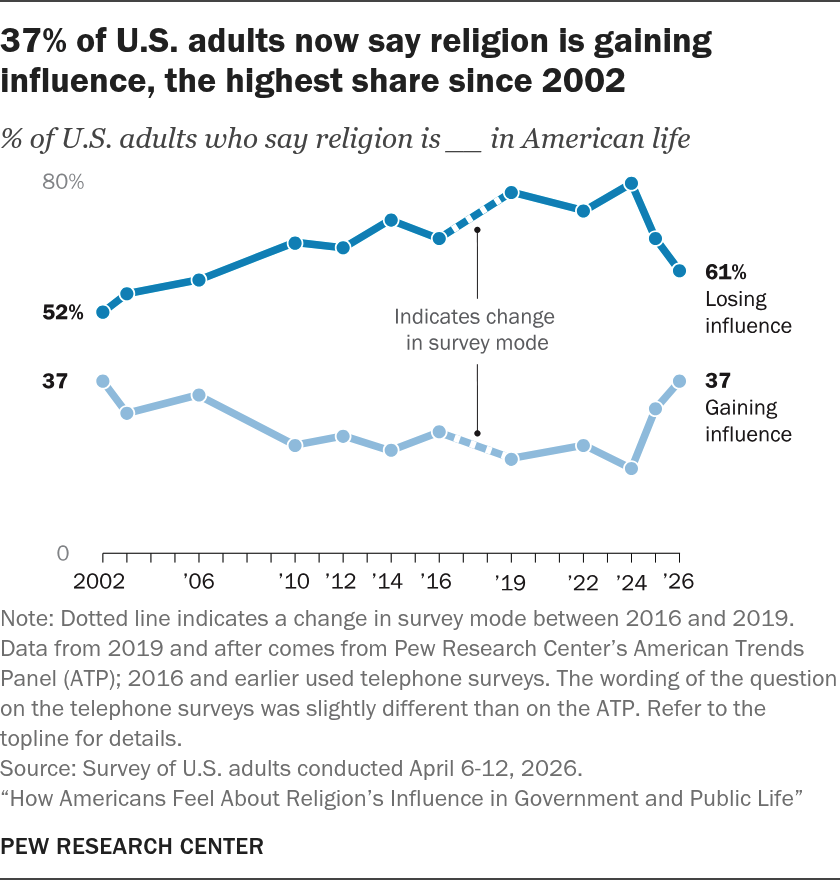
More than a third of those polled, 37 percent, said religion is gaining influence in American life, the highest portion since 2002 and a 19-percentage-point increase in the past two years. Most Americans, 61 percent, say religion is losing influence, an increase over the 52 percent who said so in 2002.
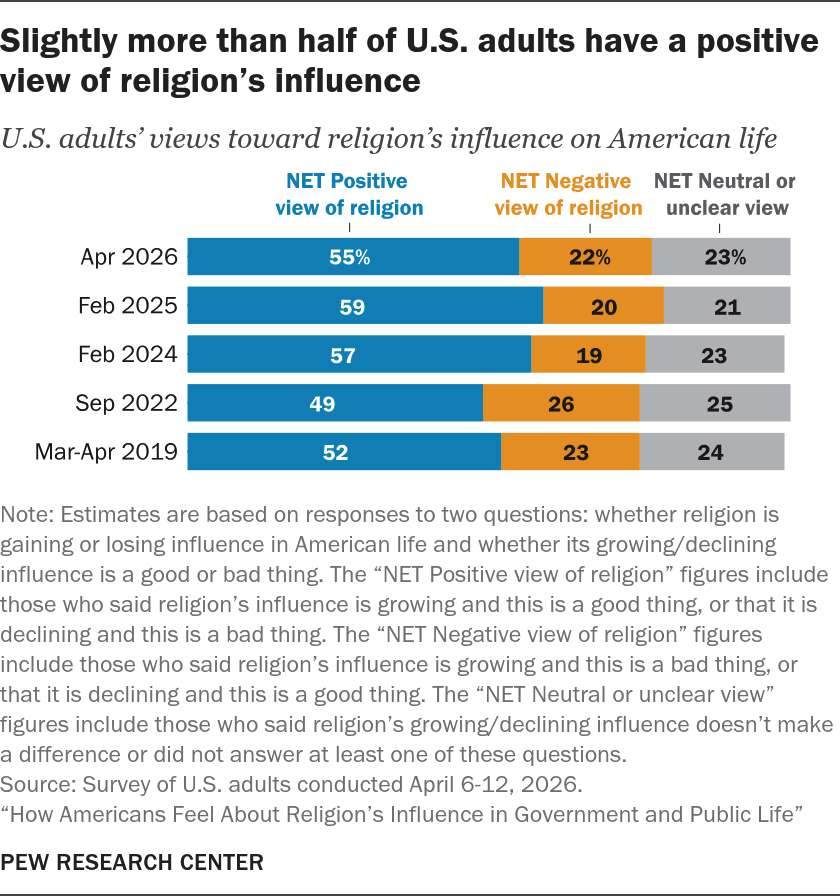
Most of those polled, 55 percent, expressed a positive view of religion’s role in American life; saying either that religion’s influence is growing and this is a good thing (21 percent) or that its influence is declining and this is a bad thing (34 percent).
But the positive view of religion’s impact is higher among religious groups, with white evangelical Protestants topping the chart at 87 percent, followed by Black Protestants at 69 percent, with Catholics and white nonevangelical Protestants each polling 65 percent.
 [3]
[3]Most Americans, 54, believe the government should enforce the separation of church and state, Pew said, a percentage that has remained constant the past four years.
Christian nationalism
Pew’s exploration of beliefs related to Christian nationalism did not define the term, but asked whether respondents had ever heard of the term and whether they view the term positively or negatively.
Otherwise, Merriam-Webster defines Christian nationalism as “an ideology calling for a government that incorporates or endorses aspects of Christian religion (as by making decisions, laws, policies, etc., in accordance with Christian beliefs, by engaging in government promotion of Christianity, or by legally enforcing Christian doctrine).
Familiarity with the term has grown 14 percentage points in the past two years since Pew last asked, researchers said, with 59 percent of Americans having heard or read at least a little about Christian nationalism. But 40 percent of Americans said they’ve never heard of the term, and 11 percent said they had not heard enough to express an opinion.
“On balance, sentiment toward Christian nationalism remains more negative than positive,” Pew said in releasing the study. “Today, 31 percent of U.S. adults say they have an unfavorable view of Christian nationalism (up 6 percentage points since 2024), while 10 percent view it favorably (up 5 points).”
Pew summarizes its findings here [4]. Poll results have an overall margin of error of plus or minus 1.9 percentage points.
 [5]
[5]