 [1]
[1]BRENTWOOD, Tenn. — The faith of Generation Z frequently draws them to church on Sunday but often fails to shape their lives during the week.
Lifeway Research’s State of Discipleship [2] highlighted eight signposts [3] that measure characteristics evident in believers who are progressing in spiritual maturity. On a scale of 0-100, the average U.S. Protestant churchgoer scored 68.1 across all signposts. New generational analysis [4] revealed the four adult generations scored similarly: Gen Z (65.6), millennials (68.5), Generation X (67.6) and baby boomers and older (67.6).
“Young churchgoers who identify as Christians in any of the Protestant traditions agree with many of the beliefs and go along with the practices of the faith but often with less surrender and less discernment of theological details,” said Scott McConnell, executive director of Lifeway Research.
Younger churchgoers outpace their older counterparts in specific signposts, including sharing Christ [5] and building relationships [6]. Gen Z churchgoers also attend church more frequently than others in the congregation. However, Gen Z significantly trails other generations in the signposts of exercising faith [7] and living unashamed [8]. They also have the lowest levels of agreement with key theological beliefs.
“My biggest concern for Gen Z is not that they are disconnected from the church; our research shows that Gen Z is deeply involved. The greater concern is that they are not being deeply formed,” said Chuck Peters, director of NextGen ministries at Lifeway.
The various age groups within a church need each other, said Chad Higgins, Lifeway’s senior manager of church equipping. Older churchgoers should see this as an opportunity, he said. “I pray that we, as believers, do not fall into the cultural trap of generational finger-pointing but instead lean in and build meaningful relationships with this younger generation.”
 [9]
[9]Gen Z demonstrates their faith
Younger U.S. Protestant churchgoers are among the most likely to show up to worship services and serve in leadership positions within their congregations.
While the median churchgoer in each generation attends four worship services each month, the average Gen Z churchgoer attends a worship service at their church 6.2 times a month, compared to 4.8 times for millennials, 5.1 for Gen X and 4.5 for baby boomers and older. This implies that while the typical Gen Z churchgoer attends at a similar frequency to other generations, there is a portion of young adults who attend at much higher rates.
Not only are Gen Zers attending worship services more frequently, but they also attend small groups at their churches more than any other age range. Those 28 and younger attend an average of five times a month compared to 3.7 among millennials, 2.7 among Gen X and 2.5 among baby boomers and older.
“Each younger generation has been less likely to attend church and less likely to identify as a Christian,” McConnell said. “Among those in Gen Z who do attend church, it is common for them to make it more than a part-time commitment. They are present at multiple activities or services during the week.”
Young adult churchgoers aren’t simply showing up; they’re also serving. They are among the most likely to say they have regular responsibilities at their church (36 percent).
 [10]
[10]In the past six months, they are also the most likely or among the most likely to have served someone who they knew could not repay them (6.5 times), memorized a Bible verse (6.3), fed the hungry (6.0), visited the sick or home-bound (4.9), fasted (4.8) and invited an unchurched person to church (4.2 times).
Within the past year, Gen Z is also among the most likely to say they have read a book, in addition to the Bible, about increasing their spiritual growth (76 percent), read a commentary or book teaching more about what’s in the Bible (72 percent), participated in a Bible study group that included personal study outside the group meeting (67 percent), regularly used and followed a Bible reading plan (66 percent), attended a conference or retreat to invest in their spiritual growth (58 percent) and attended a Bible study not associated with their church (56 percent).
In addition, Gen Z churchgoers are among the most likely to say they study the Bible every day (22 percent), similar to millennials (18 percent) and more than Gen X (14 percent) and boomers (15 percent).
Gen Z shares their faith
Gen Z churchgoers are often actively looking to form relationships within their churches and communities and leverage those for evangelism and discipleship.
In the sharing Christ signpost, Gen Z (63.7) and millennials (62.6) score higher than both Gen X (57.7) and baby boomers and older (46.0).
In the past six months, the average Gen Z has shared their faith story with someone 6.7 times, compared to 2.7 times for those 61 and older.
Around 2 in 3 U.S. Protestant churchgoers 28 and younger (64 percent) intentionally build friendships with non-Christians so they can share Christ with them. Only 1 in 3 churchgoers 61 and older (33 percent) say the same.
This evangelistic intentionality is part of how most Gen Z churchgoers live their daily lives. Two in 3 (66 percent) say they seek opportunities to speak out about Jesus during their normal activities. Less than half of baby boomer churchgoers (46 percent) agree.
Gen Z churchgoers are also more likely than any other generation to say they have participated in a mission trip to another country (39 percent) and among the most likely to have participated in one in the United States (46 percent).
The different generations can learn from and encourage each other in evangelism and discipleship, according to Higgins, who recently oversaw the development of DisciplesPath [11], a resource to help with congregational discipleship. “As older generations, we have a biblical responsibility to encourage and strengthen our younger brothers and sisters in Christ,” he said. “They need our wisdom, and we need their zeal.”
Young adults also score among the highest in the building relationships signpost (68.8).
Seven in 10 Gen Z churchgoers (71 percent) say they intentionally spend time with other believers to help them grow in their faith, compared to 46 percent of boomers. Most young adult churchgoers (56 percent) say they have been discipled or mentored one-on-one by a more spiritually mature Christian, meeting at least once a month for several months. Most (53 percent) also say they have discipled someone else in that same way. That is not the case with other generations.
Still, warning signs exist for the discipleship of Gen Z. “Statistically speaking, they’re attending church, connecting in small groups and serving as much or more than other generations,” said Peters, who oversees Lifeway Students [12] and Lifeway Kids [13]. “But there is a significant gap in theological understanding, spiritual confidence and obedience to God.”
Gen Z questions their faith
Younger churchgoers are often more likely to struggle with doubts about their faith and have misgivings about theological beliefs at the core of Christianity.
Gen Z scores lower (51.4) than any other generation in the exercising faith signpost.
U.S. Protestant churchgoers 28 and younger are the most likely to say they typically doubt God is involved when things happen in life they can’t explain (47 percent), that during difficult circumstances, they sometimes doubt God loves them and will provide for them (46 percent) and they sometimes doubt God can change the lives of non-Christians they know (45 percent).
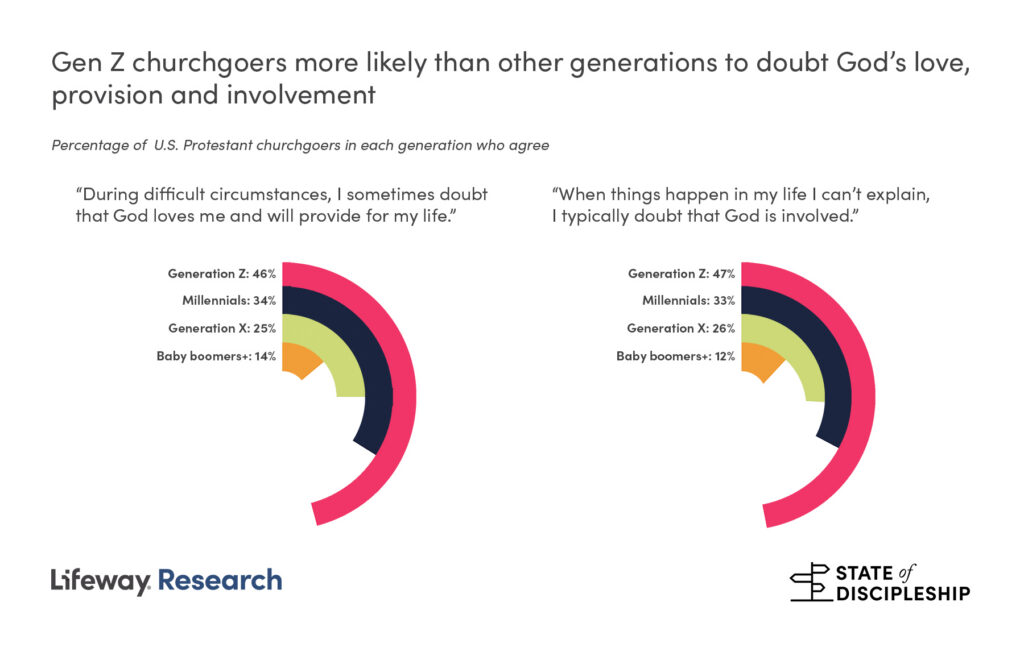
With their higher likelihood of doubting, Gen Z churchgoers are also by far the most likely to say they hesitate to share with Christian friends about their own doubts and spiritual struggles (53 percent).
“While young adult churchgoers have strong participation, they also have high levels of doubts about God,” McConnell said. “It can be easy for church leaders to assume young people who are present are all in when they may still be deciding if their heart is willing to rest in Jesus Christ alone.”
Young adult churchgoers also struggle with Christianity’s claims of exclusivity. They are among the most likely to say the God of the Bible is no different than the gods or spiritual beings depicted by other world religions (49 percent).
This may explain why Gen Z is among the most likely to say that if a person is sincerely seeking God, they can obtain eternal life through religions other than Christianity (54 percent). They are also the age group of churchgoers least likely to say only those who trust in Jesus Christ alone as their Savior receive God’s free gift of eternal salvation (76 percent).
Specifically, when given three options for eternal life, Gen Z churchgoers are the most likely to say they believe they will go to heaven because God loves all people and will not let any of them perish (25 percent). They are among the most likely to say they will go to heaven because they have tried their best to be a good person and live a good life (23 percent). And they are the least likely to believe they will go to heaven because they have confessed their sins and accepted Jesus Christ as their Savior (49 percent).
Theologically, Gen Z churchgoers are the most likely to believe Jesus was a sinner just like us (42 percent). They are also among the least likely to accept that there is one true God who exists in three Persons (79 percent), Jesus died on the cross and was physically resurrected from the dead (75 percent) and the Holy Spirit is at work in every believer teaching, convicting of sin and guiding (74 percent).
“They have a genuine interest in the things of God,” said Peters, “but they come into the church (and too frequently leave it) biblically illiterate.”
Gen Z doesn’t live out their faith
As they wrestle with theological doubts, Gen Z churchgoers also struggle with theological application. Their generation is the least likely to believe the fruit of the Spirit, outlined in Galatians 5, is evidence of a genuine relationship with God (75 percent).
U.S. Protestant churchgoers 28 and younger are among the most likely to say they don’t think about God throughout many activities (36 percent). That may be evident in the fact that they are the generation least likely to say they can worship God whenever and wherever (80 percent) and they must have God’s help to say no to worldly desires (66 percent). They are also among the least likely to say they have developed significant relationships with people at their church (70 percent) and are hospitable toward strangers (71 percent).
They are among the most likely to say reading and studying the Bible has not made a significant difference in the way they live their life (43 percent) and among the least likely to say they want to learn and be reminded of truths in the Bible (79 percent).
“Gen Z sees the world in a way that’s fundamentally different from previous generations,” said Peters, “and that difference is evident in this data. While they are drawn to attend church, their decisions and life choices are largely driven by the secular worldview that permeates their lives, which often overrides biblical values.”
Prayer is also a specific struggle for Gen Z churchgoers. They are the least likely to say they set aside time for any kind of prayer every day (35 percent). They are also among the least likely to pray for the spiritual status of those they know are not Christians (20 percent). Around 2 in 3 (67 percent) say they find themselves praying at spur-of-the-moment times throughout the day, the lowest of the churchgoing generations.
“I don’t see this as a failure of the church but as an opportunity for the church,” said Peters. “Young adults need to know that being a Christian isn’t about intellectual assent; it’s about finding, knowing and following Jesus in relationship. It’s about finding a new identity – their true identity – in Christ.”
Gen Z doesn’t see the authority of their faith
Despite all their interest in reading and studying the Bible on their own and in groups, Gen Z churchgoers don’t always trust what Scripture says when making decisions in their lives.
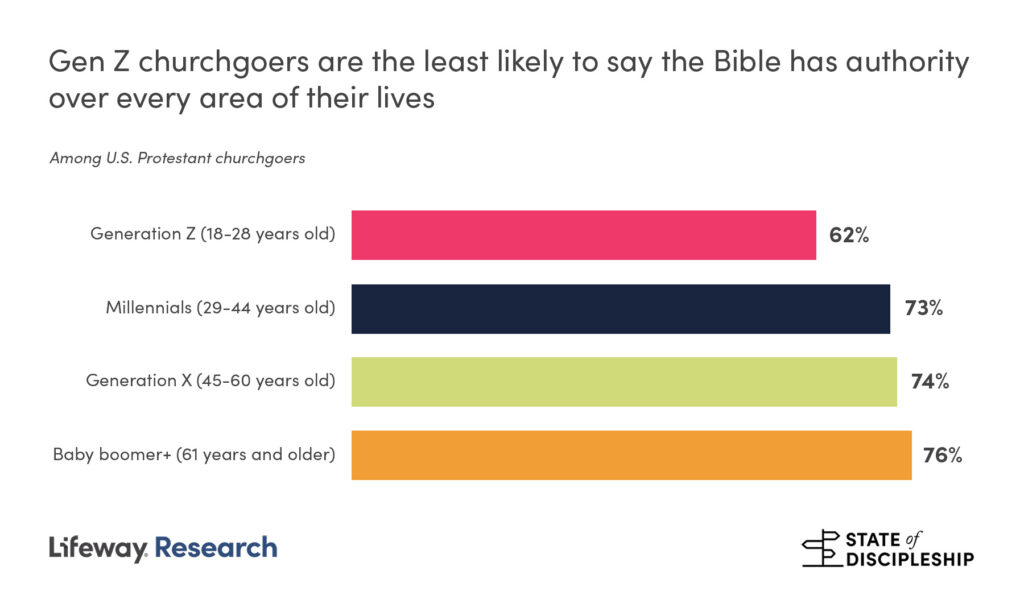
Most U.S. Protestant churchgoers 28 and younger (52 percent) say when they realize they have to make a choice between their way and God’s way, they usually choose their way. That’s by far the highest percentage among all the generations.
“We must be intentional about creating space in our church buildings, communities and lives, where we can encourage Gen Z Christians to live out their faith,” said Higgins, “first by modeling it, then by sharing the experience with them and finally by releasing them to do it on their own.”
Gen Z churchgoers are among the least likely to say they take steps to fix their attitude when they realize it does not please God (74 percent), they follow their pastor’s teaching from the Bible (75 percent), when they don’t like something the Bible teaches, they trust God’s way is best (71 percent), they forgive others regardless of whether that person asks for forgiveness (71 percent), the Bible is the written Word of God and is totally accurate in all that it teaches (69 percent) and the Bible has authority over every area of my life (62 percent).
While most younger churchgoers believe those statements, there is still significant room for growth compared to older churchgoers.
“The church needs to take informed action to change this trajectory among Gen Z,” said Peters. “We need to reach them in relationship, lead them to discover their new identity in Christ and teach them the fundamental, foundational doctrines of faith through trustworthy teaching and deep discipleship to better form resilient, rooted and resolute followers of Jesus who see life through a biblical lens and live unashamedly for God.”
He said this can’t happen in isolation. It can only be communicated in the context of connection. “We need to invest in earning their trust and gaining their respect so we can have a meaningful influence in their lives.”
For more information, view the complete report [14] and visit LifewayResearch.com/Discipleship [2].
Methodology
The online survey of 2,130 Protestant churchgoers was conducted March 19-26, 2025, using a national pre-recruited panel. Respondents were screened to include those who identified as Protestant/non-denominational and attend religious services at least once a month. Respondents could complete the survey in English or Spanish. Quotas and slight weights were used to balance gender, age, region, ethnicity, education and denominational affiliation. The completed sample is 2,130 surveys. The sample provides 95 percent confidence that the sampling error from the panel does not exceed plus or minus 2.21 percent. This margin of error accounts for the effect of weighting. Margins of error are higher in sub-groups.
Additional analysis was done to compare age groups. The data collection for the survey occurred in 2025. Therefore, the generations are defined by those within the following age ranges:
- Generation Z: 18 to 28 years old
- Millennials: 29 to 44 years old
- Generation X: 45 to 60 years old
- Baby boomers and above: 61 years and older
 [15]
[15]Related posts:
 SBC DIGEST: IMB 2021 stats; First baptism among people group; Lifeway, B&H Español awards
  Greear, LifeWay launch ‘Ask Me Anything’ podcast
  Bible Study: Be ready for His return
  FIRST-PERSON: Nearly dead for camp cred, but totally worth it
  India church hosts 700 kids for VBS despite upheaval
  Pastors identify modern-day idols, comfort tops list
  Sills files defamation suit against SBC, Lyell, others
  2025 State of Theology report shows encouraging, concerning signs