[1]
[1]PHILADELPHIA (BP) – Parents are open to Scripture engagement, but are stymied by challenges including work/ family balance, fatigue and financial provision, the American Bible Society (ABS) said in its latest release from the 2026 State of the Bible.
Churches can help by recognizing and addressing the impacts of these challenges upon the 80 million adults actively parenting children and teens, ABS said in Chapter 2, focused on “Parenting with the Bible.”
“Church leaders and fellow Christians need to intentionally invest in parents during this demanding season of life,” John Plake, ABS chief innovation officer and State of the Bible editor-in-chief, said in releasing the findings. “With support from their church, these caregivers can establish life-giving rhythms of prayer and Scripture engagement with their children, and in their own personal discipleship.”
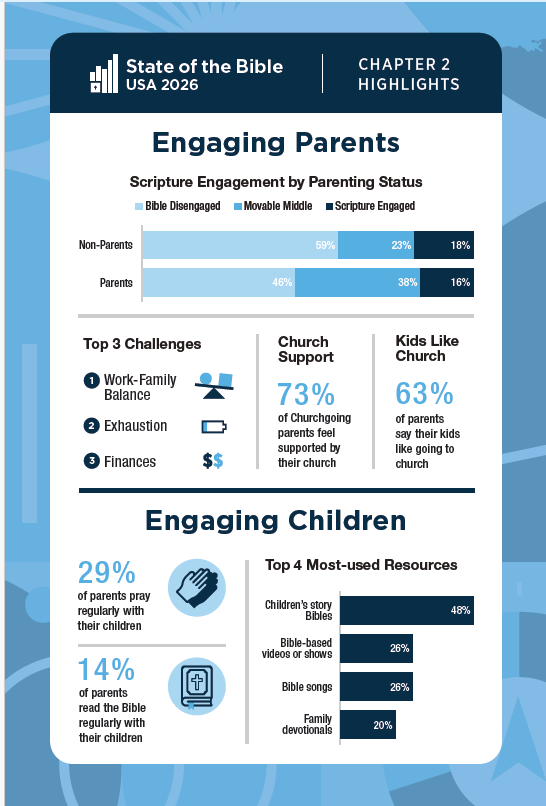
In the study conducted Jan. 8-27 among 2,649 U.S. adults, pluralities pointed to managing a work-life balance as their greatest challenge as parents, including 49 percent of millennials, 44 percent of Gen X and 37 percent of adult Gen Z. Top challenges include fatigue or exhaustion, tagged by 35 percent of millennials, 27 percent of Gen. Z and 14 percent of Gen X; family financial needs, cited by 30 percent of Gen Z, 29 percent of Gen X, and 27 percent of millennials; and providing guidance and wise counsel to children, a challenge of 29 percent of Gen X, 23 percent of millennials and 10 percent of Gen Z.
“Parents are carrying a heavy load,” Plake said, “and all of us in the Church can help them carry it.”
Most parents who attend church at least twice annually feel supported by their church, ABS said, including 91 percent Evangelical Protestants, 80 percent of historically Black Protestants, 69 percent of Catholics and 59 percent of Mainline Protestants. Among all groups combined, 73 percent describe their churches as supportive.
While at least 63 percent of parents in all age groups describe themselves as Christians, ABS found that few of them meet researchers’ criteria to be described as scripture engaged. Only 16 percent of parents are scripture-engaged, ABS reported, meaning they scored 100 or higher on the Bible engagement scale, ranging from 115 or higher for Bible centered and 100 for Bible engagement. Lowest on the scale are the Bible disengaged, scoring 70 or less, and comprising 46 percent of parents.
Minorities of parents read Scripture daily and pray daily with their children, 16 percent and 5 percent respectively; while 29 percent pray daily or often, and 14 percent read the Bible daily or often. Most rarely (50 percent) or never (62 percent) engage in the spiritual disciplines with their children, ABS said.
“As we would expect, practicing Christians are far above the national average in frequency of both prayer (72 percent at least ‘often’) and Bible reading (45 percent) with their children,” researchers wrote. “This group is regular in church attendance and considers their faith very important in their lives. It only makes sense that they would share that with their kids in a similar way.”
Despite their challenges, parents score higher than non-parents in several human flourishing categories, particularly life satisfaction, meaning and purpose, and close social relationships; while parent and non-parents score the same in mental and physical health, and non-parents surpass parents in character and virtue, and financial and material stability.
The findings are based on a nationally representative survey designed by ABS and fielded by NORC at the University of Chicago, using NORC’s AmeriSpeak panel. Respondents included adults from all 50 states and D.C.
Download Chapter 2 here [2], and access a related podcast here [3]. In its 16th year, State of the Bible will release additional chapters monthly through November, focused on topics including artificial intelligence, the supernatural, and calling and purpose.
 [4]
[4]