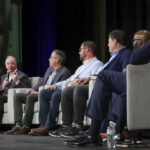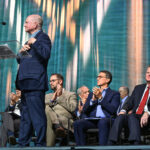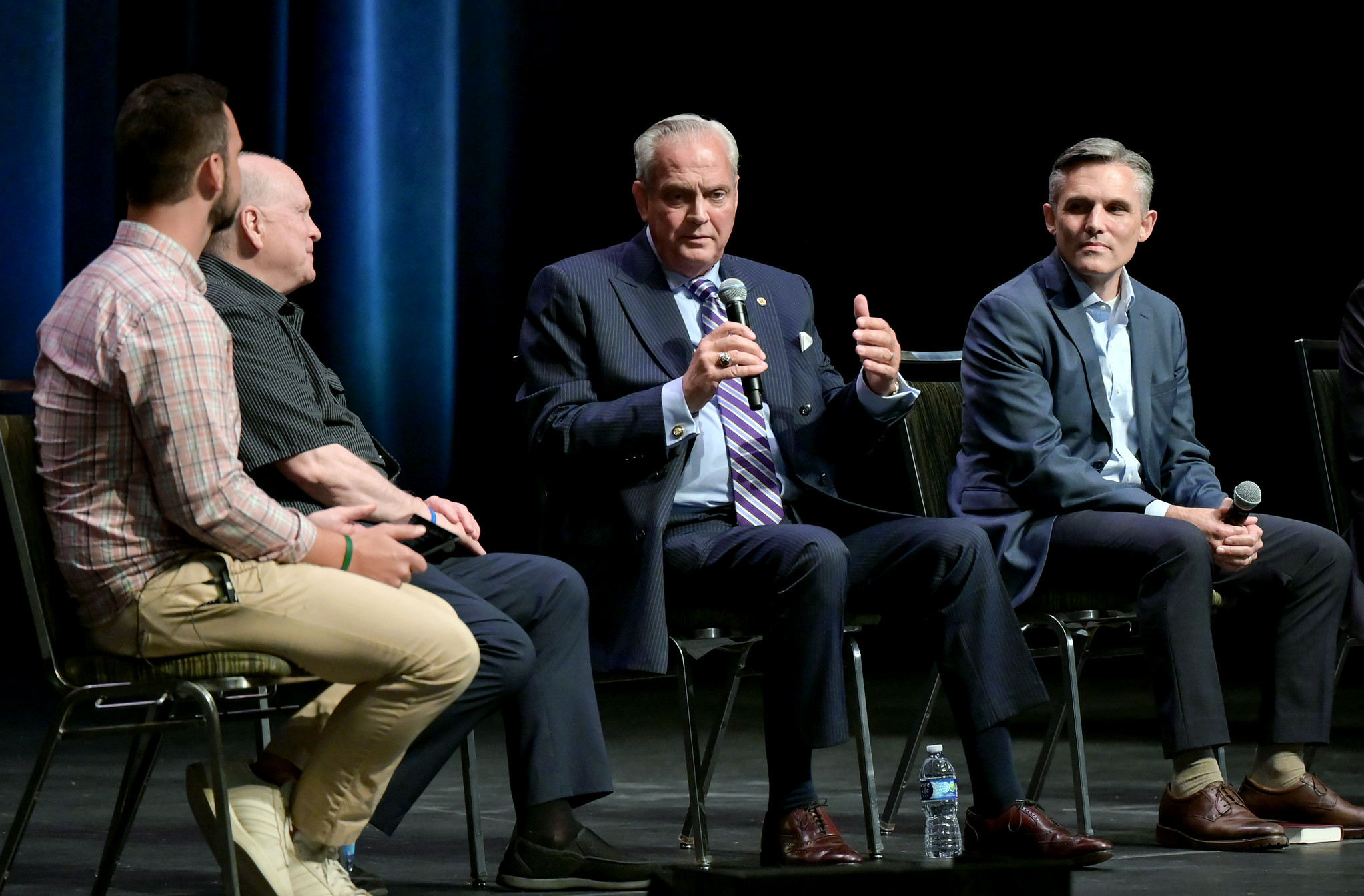

ORLANDO (BP)- Following a time of heartfelt a cappella singing of hymns, a capacity crowd filled a nearly 2,650-seat Chapin Theater in the Orange County Convention Center to hear a “State of the SBC” panel discussion presented by 9 Marks at the Southern Baptist Convention Annual Meeting in Orlando on June 9 at 9 p.m.
9 Marks provides resources and support to “help pastors build healthy churches.” Jonathan Leeman is president, and Mark Dever, who was absent due to health concerns, is president emeritus.
Seminary presidents Jason Allen, Danny Akin and Albert Mohler headlined the panel, along with Leeman and Aaron Menikoff, pastor of Mount Vernon Baptist Church in Sandy Springs, Georgia. Ben Lacey, pastor of Trinity River Baptist Church in Fort Worth, Texas, served as emcee.
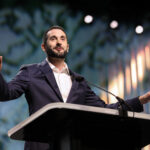
Much of the focus was on Mohler’s so-called “Truth and Unity Amendment” that he had introduced that day to messengers at the 2026 SBC Annual Meeting. The amendment, which messengers approved June 10, would add to Article III of the SBC Constitution language that a church is in friendly cooperation with the Southern Baptist Convention if it “does not act to affirm, appoint or endorse a woman serving in the office or function of a pastor/elder/overseer, specifically preaching to the assembled congregation.”
Messengers approved the amendment by the required two-thirds supermajority, but to be adopted it must be approved by messengers at next year’s annual meeting as well.
Mohler, president of Southern Baptist Theological Seminary in Louisville, Kentucky, explained the rationale for the amendment. “It’s based on 1689 language, in terms of Baptist confessions, where the pastor office is an elder/overseer, it’s defined in terms of both office and function.” Recent amendment attempts were limited to just the office, he said.

“What is the one function, even confessionally identified, which exists exclusively with the pastor/elder/overseer?” Mohler asked. “Preaching to the gathered assembly.”
He continued, “in other words, women can counsel (but there is a pastoral counseling biblical counseling function that’s unique to the pastor but that’s very hard to define). We don’t believe women can’t teach or share the Gospel.”
He wanted the amendment to pass legal scrutiny. “So that means that the entirety of the office is restricted to men as qualified by Scripture. And the function is our key concern.”
Mohler added, “If this amendment is adopted by the supermajority that’s needed tomorrow, and if it’s adopted the next year, we become one of the first denominations in American history to say this much.”
And because it is a constitutional amendment, he said, that means it is something that is fundamental to every action or policy of the entire denomination.
Recalling the impact of former changes to the constitution regarding LGBTQ issues, Mohler said amending the constitution allows Southern Baptists to say, “We are going to answer it constitutionally.”

The earlier changes in 1991 were so effective, it has not been an issue on the SBC floor for 30 years, he said. “I think that is massive, massive gain. I think not getting it is massive, is massive risk.”
To help those in the room, the panel discussed the purpose and format of the Southern Baptist Convention’s annual meeting. Describing the work of the typical two-day convention, Allen, president of Midwestern Baptist Theological Seminary in Kansas City, Missouri, said messengers process business, approve budgets, make and review motions, bring resolutions, and receive reports from the seminaries, mission boards, and other entities about accomplishments and future plans, as well as inspire and stimulate missions and ministry.
It’s also a flea market and family reunion” from the exhibit hall and events, he joked.
“We processed major business today, received significant reports, undertook weighty deliberations,” said Allen. “But the spirit of the room was not acrimonious. It wasn’t even feisty. It was generally warm and engaged and interested, and, frankly, committed to our collective work.”
That hasn’t always been the case, explained Akin, president of Southeastern Baptist Theological Seminary in Wake Forest, North Carolina, recounting the extreme conditions in the 1985 convention, when 45,000 Southern Baptists in Dallas literally fought against each other.
“It was not a fracturing; it was an all-out theological and spiritual war. But praise God, the bulk of Southern Baptists, even then, believed the Bible, and were willing to put everything on the line to defend the Bible.”
Expressing appreciation for the spirit of this year’s annual meeting, the panelists agreed that although both presidential candidates were godly men, there still seems to be “fracture lines” within the Convention, some saying between liberal, moderate or hyper conservative.
Leeman said he believed it was not so much between left and right.
“I’d say it’s between confessionalism, or kind of confessionalism, and pragmatism,” he said, adding: “I don’t think there’s much liberalism in our convention. … I think that the kind of pragmatic side of things are genuinely, sincerely conservative in their conviction.”
The challenge, he said, is that “pragmatism often gives birth eventually to liberalism.”
Mohler pointed to when theological liberalism gained control of most of the mainland Protestant nominations in the first decades of the 20th century. The conservative response was in two major forms: fundamentalism and evangelicalism.
“The evangelical movement came saying, ‘We want to maintain all the theological fidelity of the fundamentalists, but we want to have engagement,’” Mohler explained, saying evangelicals played the “inside game” while fundamentals played the “outside game” (distrusting the evangelicals and being critical of things they saw in evangelicalism.)
Today’s perceived distinctions are much less divisive, he said, noting there was a day when he and Akin had to fire hundreds of faculty members who were misaligned from the Bible.
Allen said he sees not “fractures,” but different “flavors” within Southern Baptist life.
“Convictions are deeply held,” Allen said. “Philosophies of ministry are deeply held. [There are] different interests, different things we’re working towards, but I don’t really see those as fractures or fissures in our fellowship.”
The fractures come from a relatively small, but loud agenda-driven group, the panelists agreed.
Overall, there is “an enormous sense of unity and togetherness and focus and wanting to get on with the mission and the ministry assigned to us and doing so in a biblical faithful way,” Allen said.
Mohler agreed, “I agree with Willy Rice [elected SBC president]. He said today [June 9], we ought to always be willing to listen. I think that’s wise, and we ought to be willing to consider the possibility that those that disagree with us could be at least insightful, and maybe even right. … We should be willing to do that, because we learn from one another, and we will then serve one another and serve our convention better.”
Casey continued with another question. “We obviously want to say no female pastors. But at the same time, do we have to figure out how do we continue to raise up faithful men who will teach others?”
All three seminary presidents expressed excitement about the growing numbers of young men who were pursuing pastoral ministry in their seminaries. But Akin cautioned, “We’re not the ones that God uses to call young men into the ministry. That’s the job of the churches.”
Affirming that “an army” of young men was coming to seminary, Mohler said, “It used to be that we had to get sweet students and harden them doctrinally. They’re coming hardened now. And it is because the cultural pressures and the ecclesial disasters have, I think, impressed upon them, and they know exactly what they’re getting into.”
He added, “They come from fewer places, but there are more of them,” pointing to churches, like Capitol Bible Church, who are “pastor engines,” cultivating pastors from within their congregations.
Notwithstanding, the presidents acknowledged a missing gap of pastors. Mohler shared the median age of the pastor in 1993 was 41, and these days, it’s 53. “So, they’re just getting older, and there’s this young. There’s this gap, right?”
Akin answered, “There’s no question that there’s a huge gap. It’s almost like we lost a generation.”
But he encourages churches to be the “incubators” where men are called. “Then you may send them to us [seminaries] to be trained, and we’re glad and delighted to do that, but it really does go back to the local church.”
He added, “But I think there’s a renewed sense of importance, even urgency, for the need to raise up a new generation of strong, godly men, with character and Christlikeness, that will stand for and speak the truth in love.”
Shannon Baker is director of communications for the Baptist Resource Network of Pennsylvania/South Jersey and editor of the Network’s weekly newsletter, BRN United.