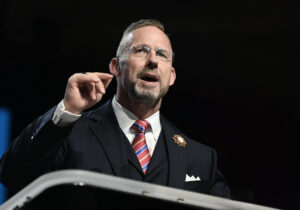
CHARLESTON, S.C.(BP)–David Beasley does not try to hide his faith. As the governor of South Carolina, the 40-year-old Beasley made it clear when he was elected he was bringing his Christian faith to the statehouse.
While encouraging other Christians to involvement in civic affairs, Beasley said neither liberal nor conservative doctrine within government will save America, in remarks during the annual seminar of the Southern Baptist Ethics & Religious Liberty Commission March 2.
“The key is not just changing laws, because laws don’t always change the society. The only way you change society is by changing hearts,” said Beasley, touted as a rising young star in the national Republican Party. “I have never found government too effective at changing hearts — we have laws against rape; people rape. We have laws against murder; people murder.
“And I know what changes hearts,” Beasley continued, in remarks at the seminar held in Citadel Square Baptist Church in Charleston, S.C. “The same person that changed my heart.”
Instead of crafting programs that strengthened the family, Beasley said government in recent decades designed apparently well-intentioned programs that “tore apart” the family. “Here was government, an ordained institution of God, trying to break apart another institution of God,” Beasley said, noting the “church was sitting back on the sideline not being salt and light.”
At times sounding like a politician on a campaign swing, Beasley, midway through his four-year term as governor, said despite opposition he stuck to his plans because he knew “biblically based programs would work.”
“In South Carolina, we changed our approach because we wanted to strengthen families,” Beasley said, sharing details of his state’s welfare reform package designed to “put families first.” Government should “empower families, not overpower families,” he said.
Citing his track record on welfare reform in the state as evidence of biblical principles impacting public policy, Beasley said, “I wanted to change the welfare system not because I hate the poor and the needy but because I have compassion, true compassion, for the poor and needy. I wanted to create a program that would empower them to be self-sufficient and independent and not dependent on government, so that the government would no longer be their god.”
Beasley spotlighted a 60 percent welfare caseload drop, saying families who were getting welfare checks are now getting paychecks.
“Government isn’t the answer to all of our problems,” Beasley said. “The state should allow families to do what God wants for them, not what the government wants for them,” he said, pointing out South Carolina has cut taxes, strengthened the criminal justice system and was the first state in the union to pass a ban on the partial-birth abortion procedure.
“Church can’t do the work of the state and the state can’t do the work of the church,” Beasley said, explaining that does not mean citizens and government officials should not integrate God’s perspectives into their life and works.
“It is time in America that we have political leaders who don’t take a poll to make a political decision,” said Beasley, who was both hailed and jeered last year for his decision to order the Stars and Bars, commonly as the Confederate flag, to be removed from atop the state capitol building in Columbia.
Leadership must consist of more than rhetoric, the governor insisted, saying good government is result of the practical application of faith-based policy.
In a democracy, Christians have “an obligation” to be involved, Beasley said.
Locked in a battle over the introduction of video poker in South Carolina, Beasley noted two months ago, with poll numbers showing strong statewide support for the gambling devices, political pundits predicted the gaming industry would have its way in the state.
Yet as a result of intense pressure from the “faith community” and local business leaders, the lower house of the state legislature recently approved a bill to rid the state of video poker, said Beasley, reserving special praise the executive director of the South Carolina Baptist Convention, Carlisle Driggers, for his work in turning the tide against the machines. The state’s Senate has not yet voted on the measure.
Video poker is costly to the state, Beasley contended, rather than fattening its coffers, as video poker manufacturers contend. The governor agreed the machines would bring more jobs to the state, “more judges, more law enforcement, more bankruptcy officials, more social workers … .,” his remarks drowned by applause.
To those frustrated that change is not occurring fast enough, Beasley said, “We didn’t get into this problem in America overnight and we are not going to get out of it overnight.
“Be salt and be light and be involved,” Beasley urged. “We can turn this country around, but it’s is going to take a lot of prayers, then you have to get up off your knees and be out there as salt and light.
“The president needs your prayers; the governor needs your prayers; the Congress needs your prayers,” he added.