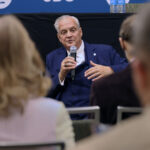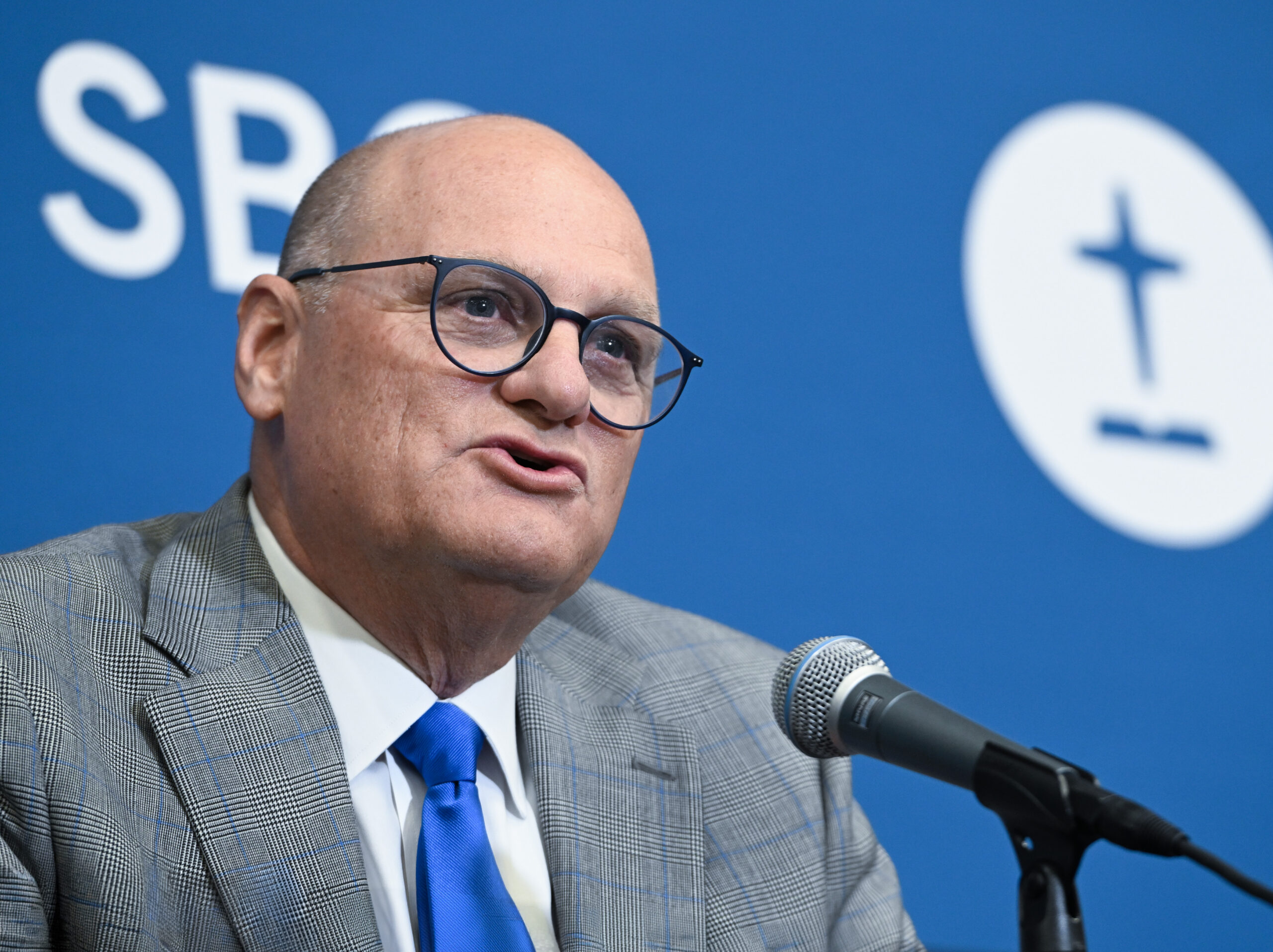

ORLANDO (BP) – Emphasizing his role as president to be one of representing churches, not an entity or committee, newly-elected Southern Baptist Convention President Willy Rice addressed several topics at a press conference Wednesday afternoon (June 10) immediately following the final gavel at the SBC Annual Meeting.
“I’m very humbled and honored, obviously, to be elected to this position, and I think it’s been a good two days for Southern Baptists,” the pastor of Calvary Church in Clearwater said in his opening statements. “I think that anyone who may be concerned about a leftward undertow, a woke riptide in the SBC, I think we leave Orlando with that firmly dispelled.
“The Southern Baptist Convention is not eroding [or] equivocating. The Southern Baptist Convention is enduring. … We are convictional, cheerful Baptists who are grateful for our Baptist heritage, confident and what we believe. And I think we reaffirmed that this week with a couple of decisions.”
One of those decisions was an initial two-thirds vote of affirmation for the so-called Truth and Unity Amendment, which would amend the SBC Constitution regarding the role and function of pastor. It is not a “tightening” of Southern Baptist convictions, Rice said, but a “re-articulation” of them.
“This is who Baptist people have been historically,” he said. “We articulated it in the Baptist Faith and Message 2000, and even that wasn’t a new statement. It was just an articulation of what we thought Baptists have always believed. It comes down to biblical authority [and] we just think that when the Bible speaks on those offices [in the church], it speaks with authority.”
The SBC president should represent the churches, he emphasized, as a model of the way the Convention operates. Rice promised to do just that.
“The Southern Baptist Convention is best when it is led by local churches and pastors,” he said. “I think everyone says that, but over time, institutions drift toward maintenance and preservation. It’s important that pastors and churches lead.
“Baptists are a local church people. We’re not top-down. We’re not run out of Nashville, Louisville, Wake Forest, Atlanta or anywhere else. We’re independent, autonomous churches.”
Southern Baptist polity places pastors and laypeople on entity boards. Rice, a former North American Mission Board trustee, responded to a question over calls for transparency.
“I’ve defended trustees. The ones I knew and had the privilege of working with were good men and women,” he said. “[At NAMB], there was never a time when I felt like information was not being given to me.
“But since that time, I’ve heard concerns. I look back and think I could’ve asked more questions [as a trustee]. I could’ve probed a little bit deeper. Now, questions keep coming up about transparency. … If you ignore the whispers, eventually you’re going to deal with the roars.”
One question referenced advocates for sexual abuse survivors now stating a lack of assurance at the SBC’s direction on that subject.
“I’ll say that people, sometimes, who purport to speak for all survivors, don’t speak for all survivors,” said Rice. “There are activists who, this is their platform, and I understand that. …But over my 42 years [in ministry], I’m sure I’ve pastored hundreds of people who suffer from sexual abuse. And I can assure you [that] many of the ones I’ve spoken to would say that some of the self-proclaimed prominent voices don’t speak for them.”
He went on to say that some within the Southern Baptist movement to address sexual abuse claims did so for their own benefit.
“We did have problems in this movement. It absolutely was weaponized, just like the Me Too movement in the secular culture. … That’s what tends to happen in social justice movements. They tend to overreach and then come back to a kind of tempered middle. I think that did happen in the Southern Baptist Convention. … I think there were some political vendettas. I think there was some personal ambition at stake. I think there were people who were angry and wanted to take out their anger out on the Southern Baptist Convention.”
Southern Baptists are going to join others around the world in a few years to recognize 2,000 years since the Resurrection and proclamation of the Great Commission. In making efforts to “get the Gospel to the nations,” he added, there are also “institutional, structural issues that need to be addressed” in the SBC. It’s OK to do both.
“You don’t want the challenging issues of the day to keep you from seeing the mission, but you don’t want to focus on the mission so that you ignore the challenges that you need to address, because ultimately the mission will be imperiled if the institution suffers. As president, there will be no greater joy for me than to talk about the Great Commission task.”
Recognizing the Great Commission’s impact on the world will, indeed, be a worldwide event.
“There’s going to be international celebrations about that,” Rice said. “I want to see Southern Baptists think about a Great Commission push, a generational effort to advance the cause of Christ by and around that 2,000th anniversary of the Great Commission.
“I would love for every Southern Baptist to be talking about that within the year or next two years.”