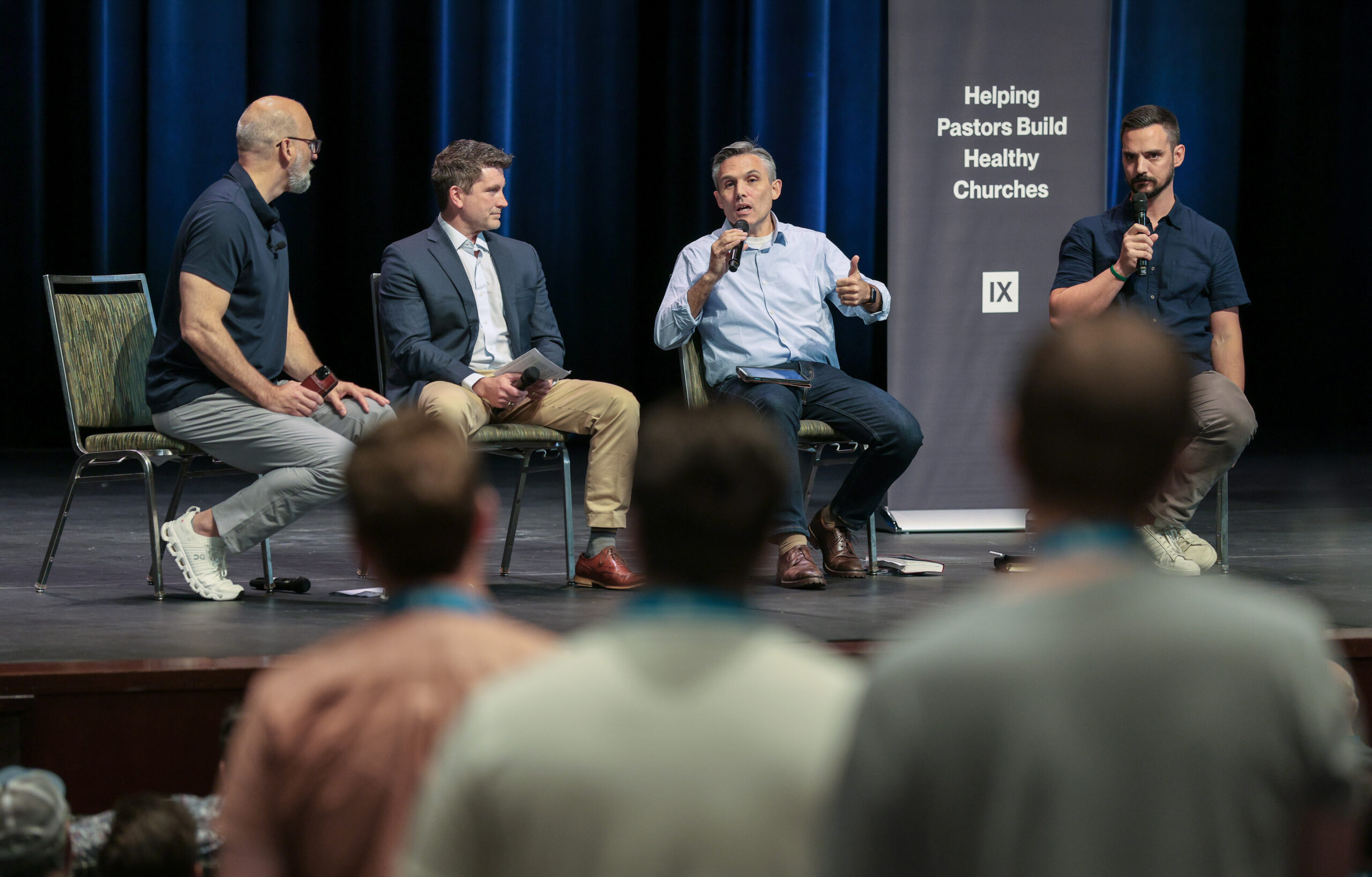

ORLANDO (BP) – Open communion, spontaneous baptisms and taking the Lord’s Supper to shut-ins all are inconsistent with a biblical doctrine of the Church, said panelists at a 9 Marks at 9 event June 8 in conjunction with the Southern Baptist Convention Annual Meeting in Orlando.
Some ideas advocated by the panel “I trust you will happily embrace,” said Jonathan Leeman, a panelist and president of 9 Marks, a ministry focused on helping pastors build healthy churches. “Others you might struggle with, and friends, I want to say that’s OK.”
It is healthy “for us as Christians to have open, forthright conversations both on the easy topics as well as on the difficult topics,” he said, “so that we can sharpen one another and so that we can learn to live and love in unity even amidst our disagreement.”
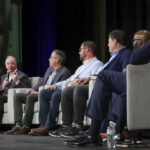
Joining Leeman on the panel were Greg Gilbert, pastor of Third Avenue Baptist Church in Louisville, Ky.; Aaron Menikoff, pastor of Mount Vernon Baptist Church in Sandy Springs, Ga.; and Ben Lacey, pastor of Trinity River Baptist Church in Fort Worth, Texas.
Notably absent from the event was 9 Marks founder Mark Dever, who was recovering at home from cardiac arrhythmia, Leeman said.
“Praise God, he’s moving toward full recovery,” Leeman said.

At the 9 Marks event, panelists presented 12 propositions on “getting the ordinances and membership right.” They offered a brief defense of each proposition and gave time for questions and answers. Among the propositions:
- Churches should not receive unbaptized people as members – no “open membership.”
“Baptism and church membership are not as easily separated as the open membership position assumes,” Gilbert said. “Every serious Christian tradition, ours and all the others, agrees that baptism precedes membership in the church.”
- Churches should adopt neither an “open” nor a “closed” position on fencing the Lord’s Table but a “close” position, receiving both their own members and baptized members of other Gospel-preaching churches.
Open communion, which offers the elements to all professing believers, “makes the Supper all about the individual,” Lacey said. Closed communion, which admits only members of one local church, “makes the Supper all about the individual church.” Close communion “makes the Supper all about the Church of Christ across space and time.”
- Careful examination and conversation should precede baptism, meaning that “spontaneous baptisms,” which depend heavily on the subjective sense of the participant, are typically unwise, pastorally careless and a source of false assurance and nominalism.
“My quarrel is not with congregations who pray for the baptismal waters to stir week in and week out,” Menikoff said. “But God has given the church the duty to test the reality, the veracity of the faith of the new believer. … It’s best to wait and examine the fruit of the faith of the new believer before baptism.”
- The primary location for planting, nurturing, incubating, disciplining the seed of faith in a child’s life begins in the home (with church assisting), with the baton being passed to church (with parents assisting) when the child reaches a natural but culturally-sensitive age of functional independence, meaning, the widespread practice of child baptism is a seedbed of premature assurance and nominalism.
“Baptism should align with the transfer of spiritual authority from parents to church,” Leeman said. “So long as a child remains under parental spiritual authority, the church assists. When that baton passes, the church leads and the parents assist. Baptism marks that transition.”
- Churches should not take the Lord’s Supper to shut-ins, nor celebrate it at weddings, Bible studies, youth camps, the family dinner table or other non-gathered-church occasions.
“We have brought some of our American individualism into the Lord’s Supper,” Menikoff said. The Lord’s Supper “is not fundamentally a symbol of my personal discipleship. It’s a sign the Lord has saved me and united me to His people, the Church of the living God … If you want to take the Lord’s Supper to a shut-in, maybe offer to drive that shut-in from her house” to the church’s regular gathering.

- Baptism and the Supper should ordinarily be administered by an elder, not a parent or best friend.
“Baptism and the Lord’s Supper are not personal acts. Nor are they family acts. They are church acts. They are the primary means by which the church formally identifies itself and its members,” Gilbert said. The person administering an ordinance “is acting as a representative of the whole church. That’s why elders are usually the appropriate administrators.”
Discussing the particulars of ecclesiology may seem to some like theological hair splitting. But Lacey said that is far from reality.
“It seems persnickety, but what’s at stake is the witness of Christ ultimately,” Lacey said. Accepting church practices contrary to Scripture is tantamount to saying “that Jesus is no longer the Lord of the conscience.”