
Editor’s note: Sunday, Feb. 22, is Racial Reconciliation Sunday in the Southern Baptist Convention.
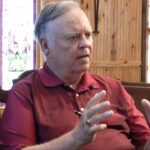
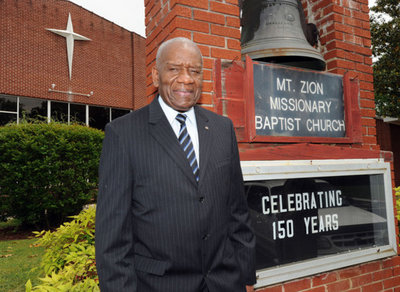
CARTERSVILLE, Ga (BP) – At 6-foot-4, Ed Rhodes is used to people looking up to him. Yet, beyond his physical presence there is much more to this 82-year-old retired Baptist preacher from Cartersville, Ga. There’s a presence that transcends the barriers of race, age, politics, prejudice, socioeconomics, education and seemingly time itself.
Rhodes began his journey in Arcadia, La., on April 5, 1943. Asked about his conversion, he replied in precise detail, “It was on the Thursday, before the fourth Sunday, July 1955 at 2:30 in the afternoon in Louisiana.” That spiritual journey has carried him through military service, a career in law enforcement and years of pastoral ministry.
Rhodes joined the Air Force in 1962. Following training in Texas he was stationed at Allison Air Force Base in Fairbanks, Alaska. He served in law enforcement during his enlistment, leading to his next career choice. In the meantime, he returned to Louisiana to marry his wife, Mattie Jean Hemphill, in June 1966.
Before his enlistment was complete, he explained, “I had already attended the Alaska State troopers training program. The Air Force had a program where in your last six months of service, you could go and work on a job that you might be interested in pursuing.
“I met several of the state troopers in and around the Fairbanks area, they would come out when I was getting off work. They’d pick me up at the Air Force barracks and we’d go out on the road. One of them said to me, ‘We’ve never had a black state trooper. How would you like to be the first?’ I got discharged one day in August, and the next I was on the road as state trooper.”
During his time in the service in Fairbanks, he joined Mount Zion Baptist Church – a Southern Baptist church planted by another African American, former Air Force member William B. Lyons. The church ordained Rhodes as a deacon in 1966.
“I was there (Fairbanks) until 1971, then I was transferred to Anchorage,” Rhodes said. “My pastor had already been called to a church in Anchorage. Needless to say, I joined his church.
“We worked together there and he (William B. Lyons) became the first black president of a Southern Baptist state convention. I was involved with Southern Baptist programs and became the head of the Brotherhood for the Chugach Baptist Association.”
During those years, Rhodes continued to rise through the ranks of law enforcement, becoming the public relations director for the Alaska State Patrol in 1973 and later a field commander for an area covering 68,000 square miles. In 1982 he left the state patrol to become the assistant deputy director of the Anchorage Police Department.
But God had other plans.
Rhodes knew God was calling him to the ministry. He said God had given him three signs, yet he was hesitant to share that call. After the first experience he related going to church the next Sunday and, “It was like my feet were nailed to the floor and I couldn’t.”
When he finally shared his call with the church, he then had to tell his boss.
“When I told the mayor I had to resign because there was a call on my life, he said, ‘You can’t quit! You’re too young, you make too much money!’ I said, ‘Mr. Mayor, you don’t understand.’
“I took my retirement and contacted Dr. Emmanuel McCall, who was Black Church liaison with the Southern Baptist Home Mission Board (now North American Mission Board).”
Rhodes and McCall had become friends through McCall’s several trips to Alaska to preach revivals. Rhodes told McCall he wanted to go to seminary.
“Dr. McCall said, ‘Let me do the homework and I’ll check and see.’ He called me back and said they have a program where you can get $600 this semester. About three weeks later, he called back and said, ‘Are you sitting down?’ I said, yes, sir. He said, ‘I just came from a meeting at the Home Mission Board. They just voted to give you $6,000 for whatever school you want to go to and however you want to use it.’”
Following a pastorate in Marietta, Ga., Rhodes moved to Cartersville in 1995 and became the pastor of the historic Mount Zion Baptist Church where he served for 23 years before retiring in 2018.
He led the church to support missions, telling them, “I want 10 percent of everything to go back out that we bring in. The chairman of the finance committee, about three years down the road said, ‘Pastor, Mount Zion has more money now than they’ve ever had!’ So that’s what we’ve done, and the church has been more than blessed.”

David Franklin, associational mission strategist of the Bartow County Association, described Ed Rhodes this way: “He killed a charging grizzly bear in Alaska that was coming after him. … He is the most respected pastor in our county. He knows who he is and has a Biblical worldview and lets the Word of God dictate. Because of his presence, we had a season in Bartow County of exceptional race relationships. It wasn’t just black, white, it was across denominational lines.”
In 2018, in recognition of his work, the Georgia State Senate presented Rhodes with a Legislative Citation. It specifically honored and recognized his life’s work in racial reconciliation, building bridges across race and denominational lines and mentoring younger pastors.
When asked what he would say to a 22-year-old version of himself, Rhodes said, “I would tell him to learn how to pray and stay close to the Lord and forget about popularity. To be known for rightly dividing the Word of Truth and adhering to what they’ll say to the Lord.”