
LAVA HOT SPRINGS, Idaho – When you’ve been planting churches and strategizing about starting churches for almost 30 years, you learn a thing or two.
Richard Dugger has been involved in starting churches for the last 27 years in Idaho, Canada and India. Today, he’s the catalytic consultant for Reach Idaho, a nonprofit incorporated in 2025 with a goal of starting “at least one strong, evangelistic, SBC-connected church in every village, every town, every city in Idaho that does not have an evangelical presence today.”

“We have had 39 churches started in Idaho over the last 12 years,” Dugger continued. “There are currently eight active church plants in Idaho; another five are anticipated by the end of 2026.”
Dugger talked with Baptist Press about what it takes to be an effective church planter in Idaho, including involving southern churches in ministry outside their area, and what it means to have a cross-cultural (every place is different) strategy for planting a strong, healthy church.
Starting small
Historically, in the Bible Belt, churches have been able to develop plant teams either from a single church or a combination of several associational churches, such as five churches in an association that each recruit 10 families to start a needed new work.
“That’s generally not an option in the West,” Dugger said. “We would love to have a stronger ‘team’ approach, but it’s usually a church planter and his wife, plus their kids if they have any. They arrive at a destination where they don’t know anyone and most often don’t even have any contacts. They’re expected to engage the individuals (their new community) they meet by holding a Bible study in their homes or at a neutral location, like a coffee shop.
“That’s step 1 in forming a core team of people interested in starting a church,” Dugger continued. “Once about a dozen adults are meeting in a Bible study, the church planter starts a second Bible study, and then a third. You might have 60 people in all three Bible studies, too many to fit into one house, so to launch the church, the church planter needs to find a meeting place.”
Church planters need to be entrepreneurs, people who have the ability to start something from nothing, but two traits are even more important for a church planter, Dugger said: an unwavering commitment to God and to his family.
Planters and their wives need to walk through life as partners, the strategist said. “Keep focused on building a strong family, and by God’s grace, your marriage will be strong, and your kids will love the Lord.”
Part of that partnership is the ability of the planter, his wife and his children to adapt comfortably to a cross-cultural setting for a lifetime of ministry.
“That’s especially true in the West,” Dugger said. The cultural norms of the South are dramatically different from those of the Mountain West. “In the South, it’s football, food and family,” Dugger said. “In Idaho, it’s predominantly a western lifestyle: horses, hunting, fishing, hiking and winter sports.”
In his ministry with Reach Idaho, Dugger travels to churches, associations and state conventions in the Bible Belt to encourage partnerships.
“The first goal is to get them to look over Idaho. When they come, they see the difference, the lostness here. They can tell the difference between the evangelical churches here and the overwhelming presence of the Mormons.” Dugger said. “We are the most unreached area in North America; our evangelical presence is at best 5.7 percent.”
Boise, Idaho’s largest city with 238,000 residents, has 11 Southern Baptist churches and ministries with an SBC ID number. The other three largest cities, all near Boise in southwest Idaho – Meridian, Nampa and Caldwell – together have a population of about 567,000 and 28 Southern Baptist churches and ministries.
The majority of pastors who come on a vision tour of Idaho, “connect with us on some level,” Dugger said. “We have a number of churches and associations engaged, but we need more. Because Idaho is so wide open and so unreached, we need an endless supply of partners willing to engage with us. An infinite number.
“It’s not like we’d turn anyone away,” the strategist grinned.
The process
“When they come out [to Idaho] and look, and engage at some level of ministry – perhaps a short-term mission trip or a partnership with a church – I ask them, ‘Is there someone in your church that God may be calling to ministry?’”
Those would-be planters are identified, trained and mentored, and “it all begins with active discernment by a local pastor,” Dugger said.
In addition to encouraging Bible Belt pastors to “come see” Idaho and to develop new leaders, Dugger works to connect those pastors with pastors in Idaho.
“We have pastors all over Idaho who would benefit from someone coming alongside them, encouraging them spiritually and personally,” Dugger said. “The two pastors could then work collaboratively to identify a nearby town that needs a Southern Baptist church. In a perfect world, someone from that church would be the planter, but if not, Reach Idaho will work to find one who says, ‘I’ve got a heart for that town,’ and connect them to the sending church.
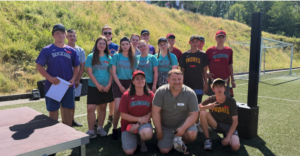
Because Idaho is at the top of the list of unreached states, Dugger encourages recent high school graduates, college students, and recent college graduates to minister in Idaho for a summer or a year, to develop ministry skills, and to see if God is calling them into ministry by serving as an intern or apprentice at one of Idaho’s healthy churches.
“What we want them to experience is something positive for them and their ministry calling going forward,” Dugger said. “We have a solid track record of those who participate, returning to engage in ministry, if not in Idaho, somewhere in the Mountain West.”
Reach Idaho has developed “a very specific curriculum” for these students to ensure they are not just used by the church but that they grow in their ministry knowledge and skills.
Bottom line, Dugger said, “We need more non-Idaho churches, partners, and the next generation of leaders engaging in Idaho. What Reach Idaho is attempting for the Lord is a Kingdom effort. Our staff, our churches, our growing partner base, all working together for the Lord’s glory and His church.”