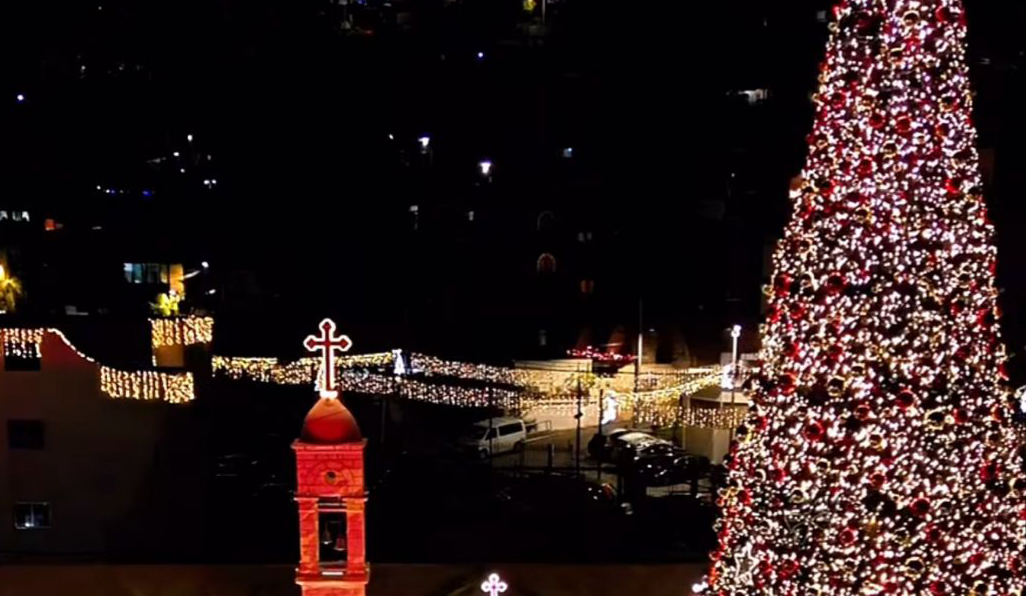

NAZARETH, Israel (BP) – Yasmeen Mazzawi, an Arab Christian who attended Nazareth Baptist School as a teenager, observed an unexpected joy as Christmas returned to her hometown of Nazareth for the first time since the start of the Israel-Hamas War.
She was looking forward to a public hymn sing in downtown Nazareth Dec. 11 after speaking with Baptist Press, as well as the public Christmas tree lighting Dec. 14.
“It’s going to be a very big show in Nazareth. Every day we have events and celebrations. And I used to say in previous interviews that I have hope that things will get better and I can see the light at the end of the road,” she said. “And now I can live this, and I can feel it, and people are very happy. The atmosphere is much more positive than it was.”

A peace plan has cleared the way for Christians and others to openly enjoy Christmas lights and festivities in Israel’s major cities.
Mazzawi, a young professional who volunteers as a paramedic with Magen David Adom (MDA), Israel’s national emergency medical services, describes the mood of Nazareth as “joy and hope together.
“What we see today in Nazareth,” she said, “we haven’t seen it for a while. Two years ago, last year as well, we couldn’t celebrate.”
But for the 500 or so Christians who remain in Gaza, Palestinian Pastor Hannah Massad described a more reserved yet reverent mood, with efforts to redeem the merriment of the season especially for children.
Most Gazan Christians remain sheltered in the remnants of the local Latin and Greek Orthodox church campuses, with a few families sheltering in the more severely damaged Gaza Baptist Church, Massad told Baptist Press.

“Christmas celebrations will largely take place inside the church walls. The Latin Church will celebrate on Dec. 25, as in Western traditions, while the Greek Orthodox community will celebrate on Jan. 7,” he said. “In both cases, the community will gather to pray, worship and support one another, finding hope and comfort in the meaning of the holiday despite challenging circumstances.”
About 70 percent of homes and apartments in Gaza have been damaged or destroyed, Massad said.
“On top of that, the situation across Gaza remains unstable,” he said, “making it difficult or risky for many families to go back (to the remnants of their homes).”
Gaza Baptist Church, which had dwindled to about 50 active members before the war, functions as a church on wheels, Massad said. The building is heavily damaged on the fourth and fifth floors where worship was previously held.
“Despite the damage, about 45 people from the wider community continue to use the church building, and some of them have even set up tents on the surrounding church property,” he said.
Gaza Baptist worships online Sunday mornings, connecting a small group of Christians in Gaza with Gaza Baptist members and other Christians worldwide.
Massad pastored Gaza Baptist Church for more than a decade before founding Christian Mission to Gaza, a non-profit outreach that continues to minister as Gaza suffers a grave humanitarian crisis marked by famine, homelessness and a lack of other necessities including healthcare.
In addition to hot meals, Christian Mission to Gaza donated a “generous stipend,” Massad said, to 210 Christian families there, is distributing $40 clothing vouchers to the 500 Christians to help them endure the winter. The ministry will give enough money to about 200 Christian families there to cover basic needs and help some repair their homes, Massad said.
The mission will distribute about 1,300 Christmas gifts, including Christian materials, to children between the ages of 5 and 17 across Gaza and the West Bank, he said, as well as to Iraqi Christian and Syrian refugees in Jordan.
“These presents are one way the community can celebrate Christmas in Gaza and bring joy to children during a difficult time,” Massad said. “Even amid destruction and uncertainty, the spirit of Christmas endures, offering hope and encouragement to Gaza’s Christian community.”
In Nazareth, Christians, Arabs, Jews and Muslims come from across Israel to celebrate the season despite differing religious beliefs, Mazzawi said.
“I think whoever comes and visits the Christmas markets in Nazareth can feel this love and hope and the values that we as Christians share, definitely through performances, hymns” and the decorations, she said. “I can definitely say that you can feel this love. These beautiful events and performances … really share the message of our religion and of our beliefs. And I think that this is the beauty of the whole (celebration).”
Mazzawi worships at the Catholic Church in Nazareth and throughout the war has shared the comfort of Jesus with injured soldiers and others she has treated as a paramedic.
Both Hamas and Israel have accused the other side of violating the terms of a fragile ceasefire the U.S. brokered in October. Israel Defense Forces reportedly killed Hamas leader Ra’ad Sa’ad in an airstrike that Hamas termed a violation of the ceasefire. Sa’ad headed the Weapons Production Headquarters of Hamas’ Military Wing and, Israel has said, helped plan the Oct. 7, 2023, massacre.
Despite violence that continues sporadically in the ceasefire, Mazzawi expresses hope that Christians and others in Gaza can fully experience the peace of Christmas.
“War is never good for any side. And despite religion, color, gender, whatever, I think that war is bad,” she said. “We go to the church and we pray. We pray for everyone to stay safe and people all over the world. We pray for the war to end. And we really hope that the war ends and people stay safe.
“I can only say that there is hope. And that’s what I believe.”
Related posts:
 Hamas surprise attack out of Gaza stuns Israel, leaves hundreds dead
  Churches pray for peace in Israel, members stranded in region
  Trump urges leaders to put ‘old feuds’ aside as he calls for a new era of harmony in the Middle East
  Ukrainian Orthodox join Baptists in Dec. 25 Christmas, dropping Jan. 7 holiday
  The Ball Brothers sing and serve in Ukraine
  After hostages and prisoners freed, complex issues remain
  Ukrainian evangelicals call on U.S., global community for prayer Aug. 24
  Southern Baptists in Israel urge prayer for safety, quick, ‘miraculous’ peace in the Middle East