
BRENTWOOD, Tenn. — If discipleship were a test, the average churchgoer would pass – but not by much.
In the second half of the State of Discipleship study, Lifeway Research studied churchgoers’ levels of discipleship by asking dozens of questions related to Christian doctrine and practice. Analysis of their answers reveals eight characteristics that are consistently present in the lives of believers who are progressing in their spiritual maturity.
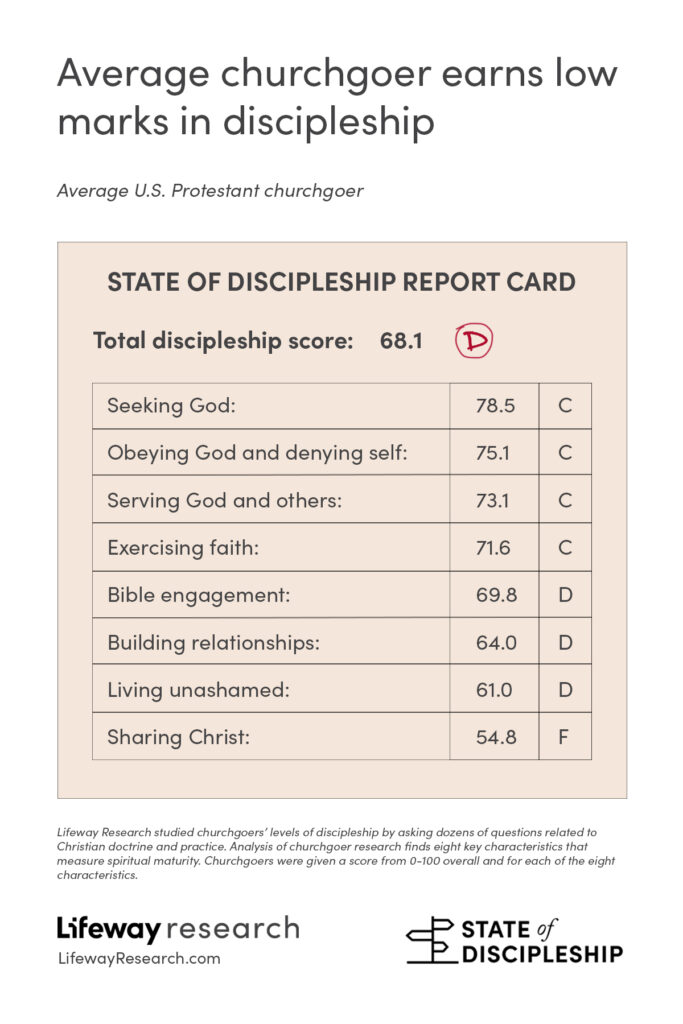
Churchgoers were given a score from 0-100 overall for each of the eight characteristics of discipleship. The average total score is 68.1, with some factors topping near 80 while others languish in the 50s.
Pastors recognize the need for improvement among those attending their churches. Earlier, as part of the State of Discipleship study, Lifeway Research asked U.S. Protestant pastors their perspectives on helping their congregants grow in their faith. Half of pastors (52 percent) are satisfied with discipleship and spiritual formation in their churches, but only 8 percent strongly agree.
“Pastors know their congregations can follow Christ more closely, but they often don’t know the specifics of what areas of people’s lives don’t align with what the Bible calls us to,” said Scott McConnell, executive director of Lifeway Research. “This research provides a national snapshot of these details.”
Signposts scores
Analysis of churchgoer research finds eight key signposts that measure spiritual maturity – Bible engagement, obeying God and denying self, serving God and others, sharing Christ, exercising faith, seeking God, building relationships and living unashamed.
The average churchgoer scores the highest in seeking God (78.5), followed by obeying God and denying self (75.1), serving God and others (73.1), exercising faith (71.6), Bible engagement (69.8), building relationships (64.0) and living unashamed (61.0). The lowest score is in sharing Christ, where the average churchgoer reaches 54.8.

“Scripture is clear that all fall short of the glory of God (Romans 3:23), and objective spiritual measures will always show that,” McConnell said. “But the Bible also says members of the body of Christ will be ‘growing into maturity with a stature measured by Christ’s fullness,’ (Ephesians 4:13b CSB). These biblical questions set up healthy conversations around how local churches can promote growth in each of these areas.”
Additional Lifeway Research releases throughout 2026 will further explore each signpost and other aspects of the State of Discipleship among churchgoers.
Average churchgoer
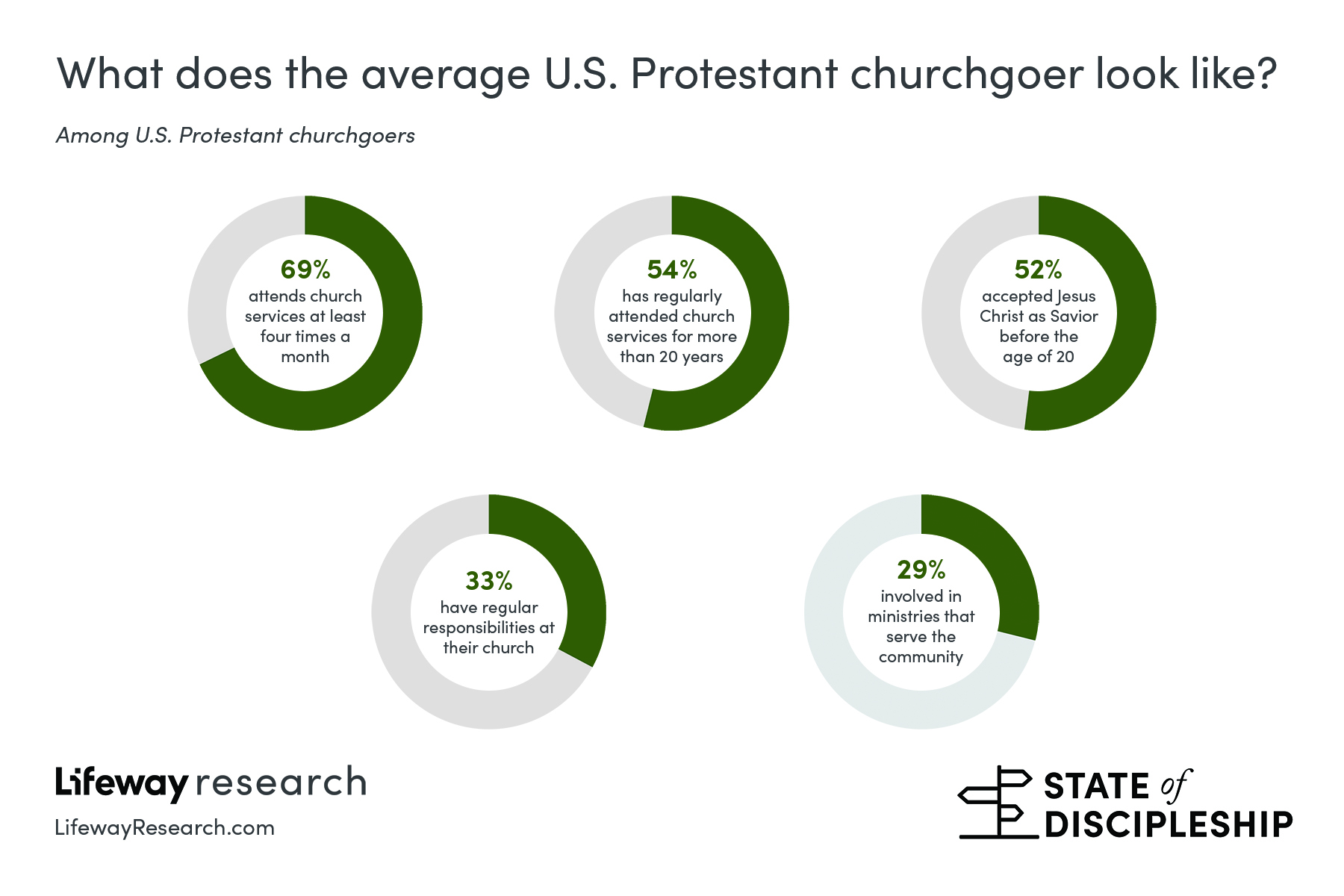
The average U.S. Protestant churchgoer who says they have accepted Jesus Christ as Savior says they made the decision before age 20. Three in 10 (29 percent) say they did so by the age of 12. Almost a quarter (23 percent) say the decision happened during their teen years, while 14 percent place it in their 20s and 7 percent in their 30s. Another 10 percent say the decision occurred after they turned 40, and 17 percent aren’t sure.
Most churchgoers (54 percent) have been regularly attending church services for more than 20 years. The average churchgoer has attended 30 years total and 12 years at their current congregation.
In a typical month, the average churchgoer attends a worship service at their church more than four times (4.9). More than 2 in 5 (43 percent) say they attend four times, while 25 percent say they attend five or more services.
Around 3 in 10 (29 percent) say they are currently involved in ministries or projects that serve people in the community not affiliated with their church, while 33 percent have regular responsibilities at their church.
Of those with church duties, half (50 percent) say that includes teaching or facilitating a Bible study, and 46 percent say it includes leading a ministry such as youth, worship or a food pantry. Overall, 16 percent of all Protestant churchgoers teach a Bible study group and 15 percent lead a ministry.
On average, churchgoers say they give 9 percent of their annual income to their local church and 4 percent to other non-profit charitable causes or organizations. Only 15 percent say they don’t give any to their congregation, while 39 percent decline donations to other non-profits.
“Church leaders may be able to observe these types of churchgoer participation – at least collectively. And these can be helpful progress markers to encourage serving and reaching the next generation. But the State of Discipleship will also reveal insights into many aspects of following Christ that require self-evaluation from individuals,” McConnell said.
For more information, view the complete report and visit LifewayResearch.com/Discipleship.
Methodology
The online survey of 2,130 Protestant churchgoers was conducted March 19-26, 2025, using a national pre-recruited panel. Respondents were screened to include those who identified as Protestant/non-denominational and attend religious services at least once a month. Respondents could complete the survey in English or Spanish. Quotas and slight weights were used to balance gender, age, region, ethnicity, education, and denominational affiliation. The completed sample is 2,130 surveys. The sample provides 95 percent confidence that the sampling error from the panel does not exceed plus or minus 2.21 percent. This margin of error accounts for the effect of weighting. Margins of error are higher in sub-groups.
Related posts:
 SBC DIGEST: IMB 2021 stats; First baptism among people group; Lifeway, B&H Español awards
  Workplace chaplaincy can be a place for healing, growth
  Tony and Lauren Dungy: On faith and family, football and race, winning and losing
  Lifeway conference encourages women to lead with confidence from the Lord
  Bible Study: Be ready for His return
  Sills files defamation suit against SBC, Lyell, others
  Greear, LifeWay launch ‘Ask Me Anything’ podcast
  FIRST-PERSON: A pivot foot for the Gospel