Aftershocks keep Japan’s disaster survivors on edge
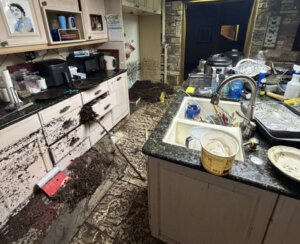
ISHINOMAKI, Japan (BP)--Things appeared to be getting better in Hirasuka Kiiko's neighborhood on the outer edge of Japan's tsunami disaster zone. Cleanup crews hauled off mounds of debris blocking the entrance to her home. They even towed the pile of cars deposited in her driveway by the March 11 tsunami. Her children shoveled out the mud and muck left in the ground floor of her two-story house. When electricity finally returned to her neighborhood April 7, Kiiko slept inside for the first time in a month. She'd been too scared to stay by herself in the dark, not to mention the threat of another earthquake. On her first night back home, she stayed on the second floor, "just in case another tsunami hits." The water level reached more than halfway up the front door, so the top floor seemed safest. The middle-aged Japanese woman couldn't contain her excitement about the next day. Utility workers promised the community their water would be turned on. She went to bed dreaming about taking a hot bath and washing clothes, something she's been unable to do since the earthquake and tsunami. Then, at 11:36 p.m., a 7.6-magnitude aftershock rocked the area. A low rumble built to a dull roar. The shaking lasted less than two minutes but felt like eternity. Everything in Kiiko's house moved straight up and down, a sign the quake's epicenter was directly below the region. An eery silence descended as more than 1 million people were, once again, without electricity. Kiiko picked up her thin futon mattress and the pile of blankets. She felt her way down the stairs in the dark and joined her neighbors outside in the cold. No one got much sleep as aftershocks continued to ripple through the area.
Food, water, ‘mud-out’ top Japan needs
ALPHARETTA, Ga. (BP)--The sight of Japanese citizens surviving on a can of tuna, one piece of bread and a serving of noodles a day doled out by the government dismayed John Hayes.
Japan relief makes ‘God-sized’ impact
TOKYO (BP)--Yongala and her husband Junkichi couldn't believe their eyes. Their 145-year-old family business was swept away in a moment by the March 11 tsunami that struck Ishinomaki, Japan -- hard on the heels of a massive earthquake.
Japan teams enter disaster zone, find no radiation
TOKYO (BP)--It took six days for Southern Baptist disaster relief specialists from Alabama and South Carolina to gain access to Japan's tsunami- and earthquake-stricken Tohoku prefecture.
It only took a few minutes, however, for them to understand the intense fears surrounding the nuclear crisis and how it affects disaster response.  Hardly anyone was at the Tokyo airport when John Hayes of Birmingham, Ala., and Eddie Pettit of Sunset, S.C., arrived March 19. With no traffic, the bus trip into town took only an hour that Saturday, a ride that normally takes two or more. Even the busiest crosswalk in the country only mustered 15 to 20 people. Normally this corner is a sea of hundreds dressed in black business suits, jockeying for space to cross the street.
Despite living more than 200 miles from the failing Fukushima nuclear plant, Tokyo residents stayed home, creating a "ghost town" atmosphere. In a city of nearly 13 million people, most venture out only to purchase bottled water and toilet paper.
"The fear of radiation is really the biggest obstacle in responding to Japan's disaster," Pettit admits. "It's not only affected the Japanese but it's dominated the media and created fear throughout the world.
"We have to convince the people in the States that it's safe to work here," he adds. "I want Southern Baptists to know that the radiation scare is a lot worse in the States than it is here now."
Tokyo and surrounding areas are slowly coming back to life three weeks after the nightmare began. People are venturing back to work and restaurants reopening. The fear, though, is still hidden just below the surface. It comes out in simple things like wondering if the fruit or vegetables you buy came from Fukushima or if the tap water has radiation contamination.
The possibility of radiation is always at the back of people's minds, especially when members of Tokyo Baptist Church sit around a table to talk with Hayes and Pettit on ways to launch a disaster relief ministry amid Japan's triple disaster.
Hardly anyone was at the Tokyo airport when John Hayes of Birmingham, Ala., and Eddie Pettit of Sunset, S.C., arrived March 19. With no traffic, the bus trip into town took only an hour that Saturday, a ride that normally takes two or more. Even the busiest crosswalk in the country only mustered 15 to 20 people. Normally this corner is a sea of hundreds dressed in black business suits, jockeying for space to cross the street.
Despite living more than 200 miles from the failing Fukushima nuclear plant, Tokyo residents stayed home, creating a "ghost town" atmosphere. In a city of nearly 13 million people, most venture out only to purchase bottled water and toilet paper.
"The fear of radiation is really the biggest obstacle in responding to Japan's disaster," Pettit admits. "It's not only affected the Japanese but it's dominated the media and created fear throughout the world.
"We have to convince the people in the States that it's safe to work here," he adds. "I want Southern Baptists to know that the radiation scare is a lot worse in the States than it is here now."
Tokyo and surrounding areas are slowly coming back to life three weeks after the nightmare began. People are venturing back to work and restaurants reopening. The fear, though, is still hidden just below the surface. It comes out in simple things like wondering if the fruit or vegetables you buy came from Fukushima or if the tap water has radiation contamination.
The possibility of radiation is always at the back of people's minds, especially when members of Tokyo Baptist Church sit around a table to talk with Hayes and Pettit on ways to launch a disaster relief ministry amid Japan's triple disaster.
‘Not done weeping yet,’ missionary in Japan says
ISHINOMAKI, Japan (BP)--"Disaster" says it all. Southern Baptist missionaries and volunteers finally distributed relief goods in Ishinomaki, Japan, this week after two weeks of attempting to gain access to the quake-stricken areas. Power outages, gas rationing, an escalating nuclear crisis and relocation of International Mission Board personnel hampered earlier attempts. Ishinomaki -- a small city of around 120,000 people -- was devastated March 11 by the 9.0-magnitude earthquake and ensuing tsunami. Officials estimate that more than 18,000 people died and thousands more are missing along Japan's northeastern coast. The 11-member team spent two days distributing relief goods at multiple locations throughout the city, including an apartment complex, a nursing home and a bus station. Everywhere they went, they found grateful Japanese, eager for someone to listen to their stories. International Mission Board missionary Jared Jones helped one man shovel debris from his home. The day before, the man received a call from local officials to identify his wife's body. The man -- a Buddhist -- talked with Jones about how his wife often encouraged him to read the Bible. The couple had been married 40 years. "He just needed somebody to listen to him," Jones said. Missionary Ed Jordan had a similar experience. Jordan, who works with the deaf, was distributing goods in a bus station when a colleague asked for help. One of the victims was a deaf woman who was unable to communicate with the hearing volunteers. When Jordan talked with her in sign language about her family and her home, the woman was thrilled. "If she shook my hand once, she shook it a dozen times," Jordan said.
In quake-torn Japan, a baptism is celebrated
TOKYO (BP)--Excitement and happiness fill the air. Smiles and laughter abound and, for some, tears of joy. One week after the onset of Japan's triple disaster, everyone is ready for something to celebrate. For a small group of Japanese Christians, it was a double baptism. When Shinichi Saito bobs up out of the water, everyone breaks out in applause. The new believer immediately reaches out to missionary Mark Busby with a radiating smile. It's hard to tell who is happier -- Busby or Shinichi Saito. No one was sure this day would ever take place for Saito and his wife Yoshiko. The baptism was originally scheduled March 12 but didn't happen because of the March 11 earthquake and tsunami. Busby met with the Saitos to reschedule and quickly realized the couple was not going to be deterred by earthquake, tsunami or even the threat of nuclear disaster. Even though Shinichi Saito's government job kept him busy with disaster response, the couple's first question was, "When can we be baptized?" They did not want to wait any longer. The baptism was rescheduled for the following week. Then the nuclear crisis forced International Mission Board leadership to order the relocation of missionaries to the southern part of Japan March 19 -- the day the baptism was to be held. "We were pretty disappointed that we were not able to baptize them last week. Then, we were told that we had to be out of Tokyo today and relocate down south," Busby recounted. "I thought that might mean we couldn't be here today. I was discouraged and prayed, asking that we'd be able to do it." The Saitos were adamant about being baptized, so it was scheduled just before the Busby family's departure. "It's the only day I could do it," Shinichi Saito said of the urgency he felt. "If we didn't do it today, I don't know if I could be spiritually prepared in my heart for all that my work duties demand in the midst of this disaster."
Japan missionaries relocate, vow to return
TOKYO (BP)--Suitcases and backpacks sit neatly lined up, waiting to be loaded in the vans. International Mission Board missionaries in Tokyo shuffle nervously and make jokes in an effort to cope with their relocation orders.
Japanese layman undertakes evacuation effort, buses 31 from danger zone
SOMA, Japan (BP)--Just 30 miles from Fukushima Daiichi's troubled nuclear plant, anyone in the town of Soma who could evacuate did. But thousands still remain, squeezed into a high school gymnasium serving as a makeshift shelter.
Japan disaster initial response under way
TOKYO (BP)--The Southern Baptist relief effort in Japan is moving forward in spite of uncertainties about the ongoing nuclear crisis in the northeastern part of the country.
Disaster pushes Japanese beyond secular thinking
TOKYO (BP)--Thousands of the little wooden prayer tablets rattle softly in the cold, spring breeze, a symphony of soft clattering that drifts out from the Shinto shrine. Images and characters burned on one side of the tablet symbolize hope. On the other side, carefully handwritten prayers and wishes are written to the deities of the Meiji Jingu Shrine. Not surprisingly, the "prayer wall" focuses on Japan's triple disaster -- a 9.0-magnitude earthquake, a tsunami and nuclear crisis. "My sister is missing. Please bring her back." "Prayers for the victims." "These disasters will not destroy us. Be strong." One young Japanese woman spends 15 minutes writing her request in perfect characters. She stuffs her prayer, "… protect my family from nuclear radiation …," in a waist-high box. Don't try to estimate the number of these requests -- people just keep stuffing whether there is room or not. "I do not normally come here to pray," the young woman explains, "but given the disasters, I am not sure what else to do." Proud of their secular society, most Japanese are not religious. But in a time of crisis, International Mission Board missionary Gary Fujino says they tend to fall back on an old Japanese expression, "The god that you depend on in times of crisis." "What that means is when things are bad, you will go to the temple and shrine because nothing you've tried thus far worked," Fujino explains. He notes that, once the crisis is over, no one goes back to the temple or shrine. Thousands of prayer tablets hung in one-day testify that the crisis in Japan continues to grow and people are trying to find ways to cope. The Fukushima Daiichi nuclear site has been rated a 5 on a 7-point international scale for atomic incidents, just two levels lower than the Ukraine's 1986 Chernobyl disaster. The head of the UN's nuclear watchdog warns that stabilizing the plant is a race against time. In Japan's disaster-ravaged northeast, 6,405 people are confirmed dead and about 10,200 are listed missing.