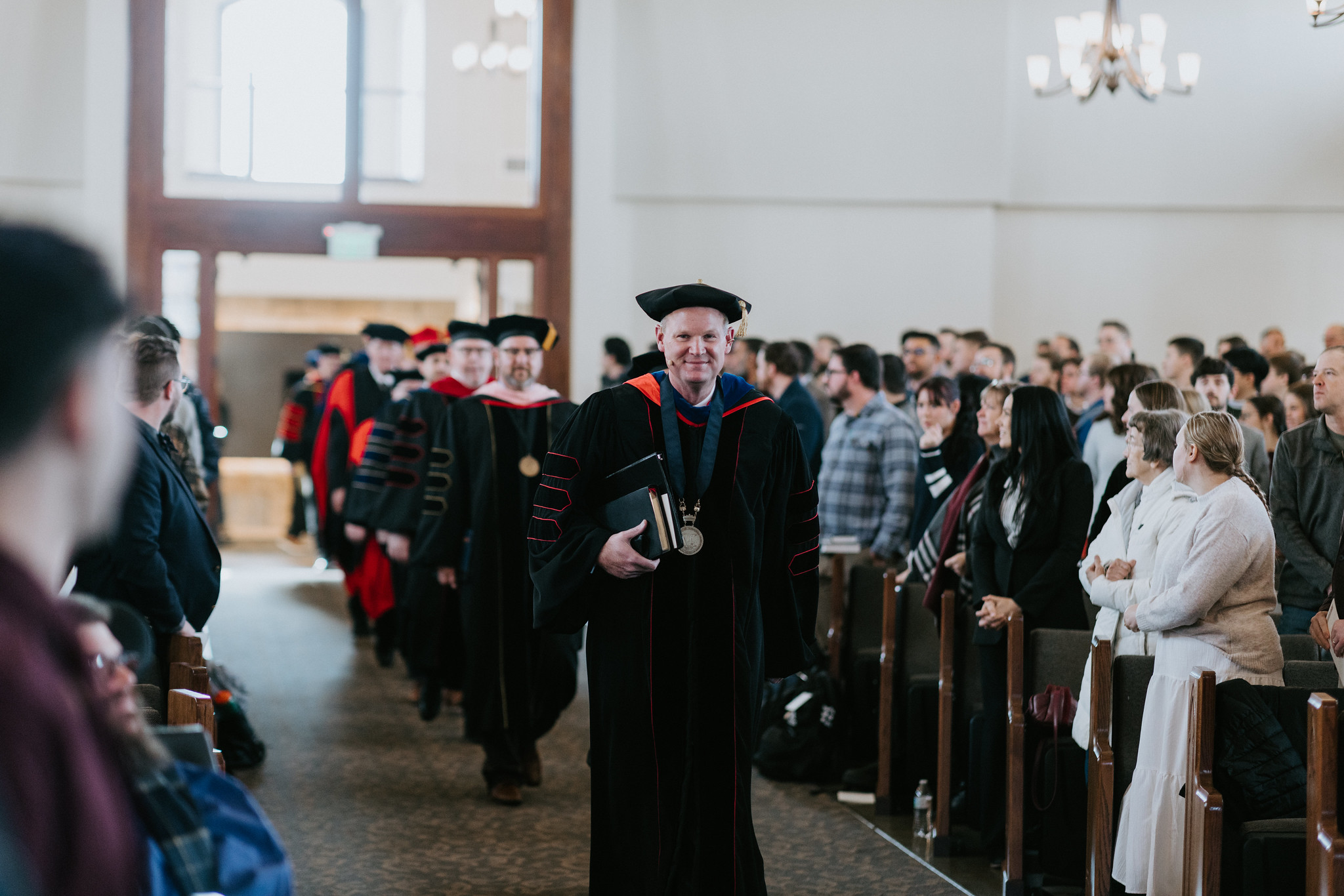

KANSAS CITY, Mo. – Midwestern Seminary marked the beginning of the Spring 2026 semester with its Spring Convocation on Jan. 20. The event included an address by President Jason Allen and the signing of the Articles of Faith by three recently elected faculty members.
Allen opened the convocation with a public reading of Ephesians 4:11-16 before leading the seminary community in prayer, calling the semester to be approached “with hopefulness” and “a sense of stewardship – precious stewardship entrusted to us.” He prayed that the institution’s work would be “marked by faithfulness from start to finish.”
Allen’s address drew from 2 Timothy 2:2 and focused on “Theological Education as Denominational Stewardship: What It Means to Be a Southern Baptist Institution.”
He began by providing a brief history of Southern Baptist theological education. Since its beginnings, Southern Baptist seminaries have maintained a close, symbiotic relationship with the churches they serve. Allen emphasized that Midwestern Seminary exists as a denominational institution, dedicated to serving the churches and people of the Southern Baptist Convention.
“We labor under the mandate of Ephesians 4 and in light of Christ’s promise to build His Church in Matthew 16,” Allen said. “We are a denominational seminary, positioned to serve the churches, not a divinity school embedded in a university.”
Allen continued, emphasizing the seminary’s enduring commitment to preparing faithful leaders for churches: “For us in this generation, we are grateful to speak and stand with resolute hearts, stating formally, clearly and conscientiously our dedication to Southern Baptist churches and the confessional expectations this institution upholds.”
He went on to say that to be a Southern Baptist seminary is to be a pre-committed institution – doctrinally, spiritually, missiologically, financially and cooperatively.
Allen then turned his attention to 2 Timothy 2:2, which he said encapsulates what theological education aspires to be and what Midwestern Seminary seeks to do.

His first point focused on what we teach: sound doctrine.
In this passage, Paul emphasizes Timothy’s fundamental responsibility as a teacher, calling him to remember what he had been taught.
“This institution is a confessional institution,” Allen said. “So as Paul’s charge to Timothy begins with a concern of content, to be a Southern Baptist institution means our first and foremost concern is a concern of content – what we believe and what we teach. Students come in with belief, and here, they get to see it blossom. Here, we fortify them in the great truths of the faith.”
Second, Allen focused on how we teach in the presence of many witnesses.
He emphasized that while Midwestern Seminary’s work begins with conveying content, it must not end there. Teaching, he said, also involves the personal pursuit of holiness and life-on-life discipleship. While tools such as artificial intelligence can replicate content, Allen noted that they cannot produce the spiritual growth and sanctification that come through prayer, reflection and mentorship.
Third, Allen stated that theological education requires faithfully entrusting these things.
“We are stewarding an entrustment: the Gospel, the Great Commission, the whole counsel of God, our confessional commitments, our Baptist distinctives, our denominational heritage, our financial stewardship and all the rest,” he said. “This is our turn.”
Allen urged the seminary community to recognize both the privilege and urgency of this stewardship. “This is your season to learn, grow and be shaped – ours to teach, mentor and serve. It’s a stewardship that is passing and will be taken away if we prove unfaithful.”
Allen’s fourth point addressed who we teach.
Drawing from Paul’s instruction to entrust sound teaching “to faithful men,” Allen emphasized that the heart of Midwestern Seminary’s calling is the preparation of pastors for the churches, while also affirming the institution’s commitment to equipping men and women for a wide range of ministry and vocational callings.
His final point focused on “the end to which we teach.”
The goal, Allen said, is not merely the transmission of knowledge but the faithful multiplication of truth for the sake of future generations.
“Take what you received. Cherish it. Know it. Articulate it. Preach it,” Allen said. “Find others who will be similarly faithful, take this deposit, this entrustment, invest it in them, and do it in such a way that they will be able to teach others. It would be a tragedy for the Gospel to remain bottled up.”
In addition to Allen’s convocation address, three newly elected faculty members signed the institution’s Articles of Faith: Leslie Umstattd, associate professor of Christian education and ministry to women; James Kragenbring, associate professor of business and Christian studies; and Ronni Kurtz, assistant professor of systematic theology.
Midwestern Seminary’s Articles of Faith include The Baptist Faith and Message 2000, the Chicago Statement on Biblical Inerrancy, the Danvers Statement on Biblical Manhood and Womanhood, and the Nashville Statement on Biblical Sexuality.
The convocation service concluded with a benediction given by John Meade, professor of Old Testament.
To watch the convocation service online, click here.
Related posts:
 MBTS Year in Review: 10 years For the Church
  FROM THE SEMINARIES: Dockery, at SBTS, sees evangelical/Southern Baptist benefit; SEBTS names 4 new faculty members; MBTS journal looks at ‘Biblical Theology and Missions’
  Allen addresses joy in life and ministry, installs Whitney as chair at MBTS convocation
  MBTS rededicates Spurgeon Library, fills endowed chairs at spring trustee meeting
  Midwestern sends 167 December grads into ministry
  MBTS Year in Review: Training leaders, serving the Church
  For the Church lunch focuses on 100 years of BF&M
  FROM THE SEMINARIES: Akin addresses Critical Race Theory; SEBTS introduces teacher licensure track; Spurgeon College, NAMB announce urban missions experience