
NASHVILLE (BP) – Evan Lenow heard the calls in recent years to abolish or defund the Ethics & Religious Liberty Commission. And it broke his heart.
Lenow had been familiar with the ERLC’s work for years before becoming president on June 1. He arrived at the post after serving as the director of Christian Leadership, director of Church and Minister Relations and chair of the Christian Studies Department for Mississippi College, recently renamed Mississippi Christian University. Before that, he was an associate professor of ethics at Southwestern Seminary and director of the Land Center for Cultural Engagement. For the last 14 years, he has contributed pieces to the ERLC Research Institute.
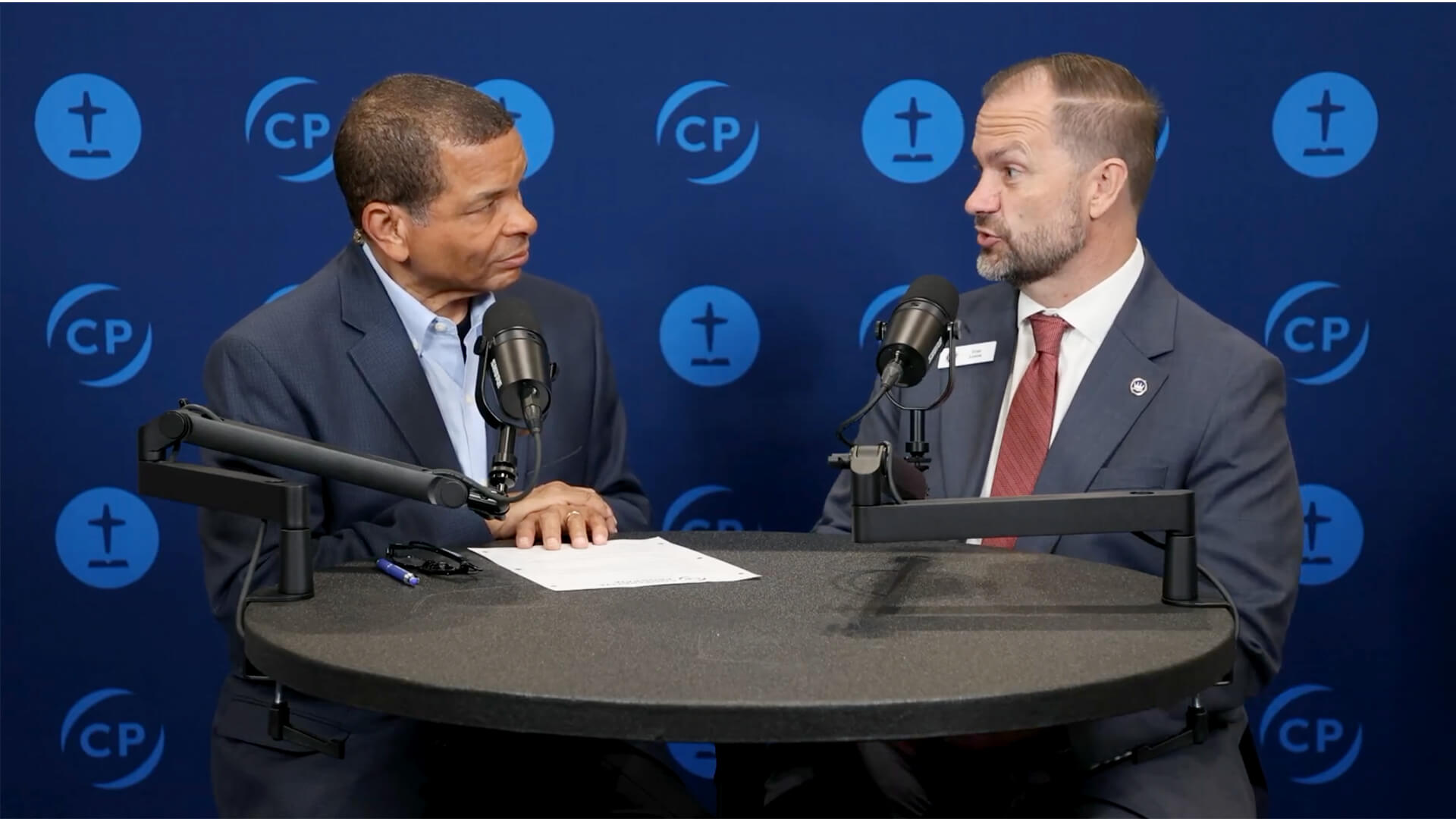
“I recognize that the work of the ERLC is important. Our churches today are facing more and more difficult questions in their communities that need to be addressed,” Lenow told Lawrence Smith during the SBC Annual Meeting in Orlando as part of the Better Together series.
That background and his work in the local church made clear to him the importance of the ERLC’s place in helping Southern Baptists respond to cultural issues within a biblical framework.
“A lot of times … you don’t see those [situations] until you’re on the field,” he said. “All of a sudden, you say, ‘I wasn’t prepared to deal with this particular question.’
“That’s where the ERLC steps in [and] can provide resources, training and preparation for pastors and churches to address some of the most difficult moral questions in their day.”
As the interview took place in the Exhibit Hall, Smith mentioned the ERLC booth’s close proximity and Lenow’s time spent there.
“The first thing I want to do is build relationships with pastors, churches and key convention leaders,” he said. “Beyond that, I want to be able to show our churches a return on their investment. They’re investing in us through the Cooperative Program, and I want to show them what we can provide.”
The ERLC will rely on three key sources for stances on issues, Lenow noted – the Bible, the Baptist Faith and Message and resolutions adopted by Southern Baptists. Those primary issue platforms are life, religious liberty, marriage and family and human dignity.
“We need to connect the dots back to the churches for our public policy advocacy,” he said.
By law, the ERLC isn’t a lobby group. That doesn’t limit the entity as an advocate, though, in meeting with elected officials and coalition partners to speak on behalf of positions that Southern Baptists care about, Lenow explained.
The ERLC has one of the smallest Cooperative Program allocations – 1.64 percent. And yet, 99 percent of its budget comes from CP gifts.
“We’re able to do a lot with [it]. So, I like to think we have a very efficient staff,” said Lenow.
Still, there are similar groups in D.C. with budgets in the tens and hundreds of millions, he added. In turn, those groups will have more resources.
“But we’re making the most use of the money that’s been entrusted to us by the churches of the Southern Baptist Convention,” he said. “To advocate on their behalf, to be a voice for them in Washington [and] to be a resource for them from every corner of the Southern Baptist Convention and to help them address these issues of moral concern in their communities.”