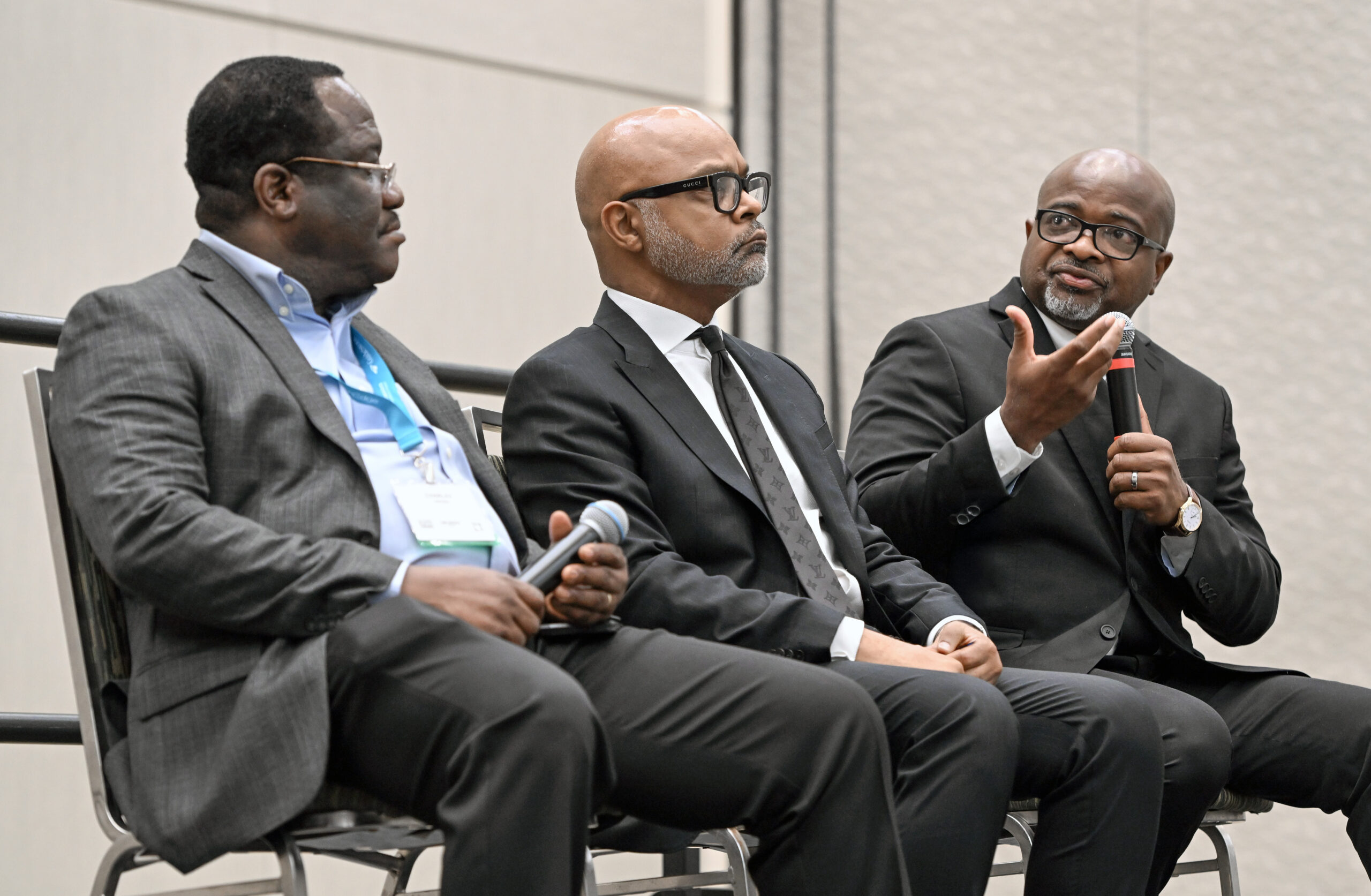

ORLANDO, Fla. (BP) – The primary goal of Christian immigrants in the U.S. is to spread the Gospel amid darkness, a panel of Haitian, Ghanaian and African American Southern Baptist pastors affirmed June 8, encouraging Southern Baptists to advocate for the just treatment of immigrants here.
“Every person of faith sees himself or herself as a missionary of God,” panelist Charles Owusu said at the discussion held during the Southern Baptist Convention Black Collective George Liele Missions Banquet in the Orange County Convention Center. “Wherever we find ourselves, we look for opportunities to spread the Gospel.
“Being an immigrant does not necessarily mean that we have come to take away something that belongs to this country,” said Owusu, founding pastor of Word of Life Baptist Church in Lithia Springs, Ga., and president of the SBC Ghanaian Fellowship. “If anything at all, it is to take away the darkness and shine the light of the Gospel in this country.”
Keny Felix, president of the SBC National Haitian Fellowship, and Greg Perkins, ending his tenure as president of the National African American Fellowship of the SBC, joined Owusu in the panel moderated by Jawane Hilton, NAAF director of advocacy.
The panel preceded messengers’ anticipated consideration June 10 of a resolution titled “On Immigration, Human Dignity, and the Rule of Law,” printed on pages 18-19 of the Tuesday, June 9, SBC Daily Bulletin, also accessible on the SBC Annual Meeting app under messenger information.
Felix, senior pastor of Bethel Evangelical Baptist Church in Miami and a Haitian immigrant since age 7, has advocated extensively for the continuation of Temporary Protected Status (TPS) impacting 1.3 million immigrants, including about 350,000 Haitians.

Felix was among those who advocated for bringing the resolution to the Convention, he said, himself called to action in response to the current treatment of immigrants in the U.S., many of whom are among Bethel’s congregation. As national governmental leaders began to impose polices that Felix said “seemed to be based on racial prejudice rather than true law and order,” it appeared to him that Southern Baptists were being largely silent.
“We felt that we needed to stand and speak up and advocate for those who sometimes are not able to do this. We thought this gave us the opportunity and the responsibility to speak for the vulnerable,” Felix said on the panel, addressing the multiethnic audience the banquet and panel attracted. “And so this resolution embraces the inherent dignity of every immigrant. This resolution embraces that we want law and order, we need secure borders, but we also need to engage in policies and develop policies that are fair and that reflect justice.”
Felix is disturbed by the federal government’s assertion that it is safe for Haitian immigrants to return to their homeland, while at the same time the U.S. State Department maintains a Level 4: Do Not Travel advisory for Haiti that reads, “Do not travel to Haiti due to kidnapping, crime, terrorist activity, civil unrest, and limited health care.” Haiti has been in a state of emergency since March 2024, and non-emergency U.S. government employees and their family members were pulled out of the country in July 2023.
“We saw that it was unjust for the administration to declare that Haiti was safe enough … even when the airport in the national city could not be opened, even when 80 percent of the capital city is overrun by gangs and 1.2 million people have been displaced internally,” Felix said. “We don’t call that safe, we call that a humanitarian crisis.
“For the Church to stay silent in the midst of it was as if we were committing 350,000 people back to sudden death.”
The majority of immigrants holding TPS are from Venezuela, about 650,000, with sizable populations from El Salvador, Ukraine and Honduras, with others from Afghanistan, Burma, Cameroon, Ethiopia, Lebanon, Nepal, Nicaragua, Somalia, Sudan, South Sudan, Syria and Yemen, according to numbers compiled by Congress.

“The resolution just embraces the inherent value and calls on the church to, one, support and continue to meet individuals at their point of need while advocating for just policies that govern us as a nation,” Felix said.
Perkins, lead pastor of The View Church in Menifee, Calif., described immigration and the treatment of immigrants as a Gospel issue.
“I will contend that the reason why we are gathered here today is to help the broader SBC family and broader society in which we seek to bring the light of the Gospel (see that) you cannot be focused on being Gospel-centered when you are fearful that your son or daughter will be snatched on their way home,” Perkins said. “And that is a ploy of the enemy.
“The enemy’s desire is to distract us in any way possible to prevent the Gospel from going forward.”
He encouraged messengers to support the resolution on immigration, which among eight operative clauses states, “we exhort government to take particular care of children and families, insisting upon respect for the God-given worth and dignity of every person and the religious liberty of churches to minister freely,” and “we encourage Southern Baptist churches to strengthen faithful Gospel ministry among immigrants and refugees, and seek one another’s good through shared civic values, practical service, and Christ-centered community as we proclaim the Gospel to people from every tribe, tongue, and nation.”
As Owusu put it, “faith motivates us to carry on with the Gospel wherever we are. No matter what brought us here, our primary goal is to make sure that everyone has the opportunity to do that.”