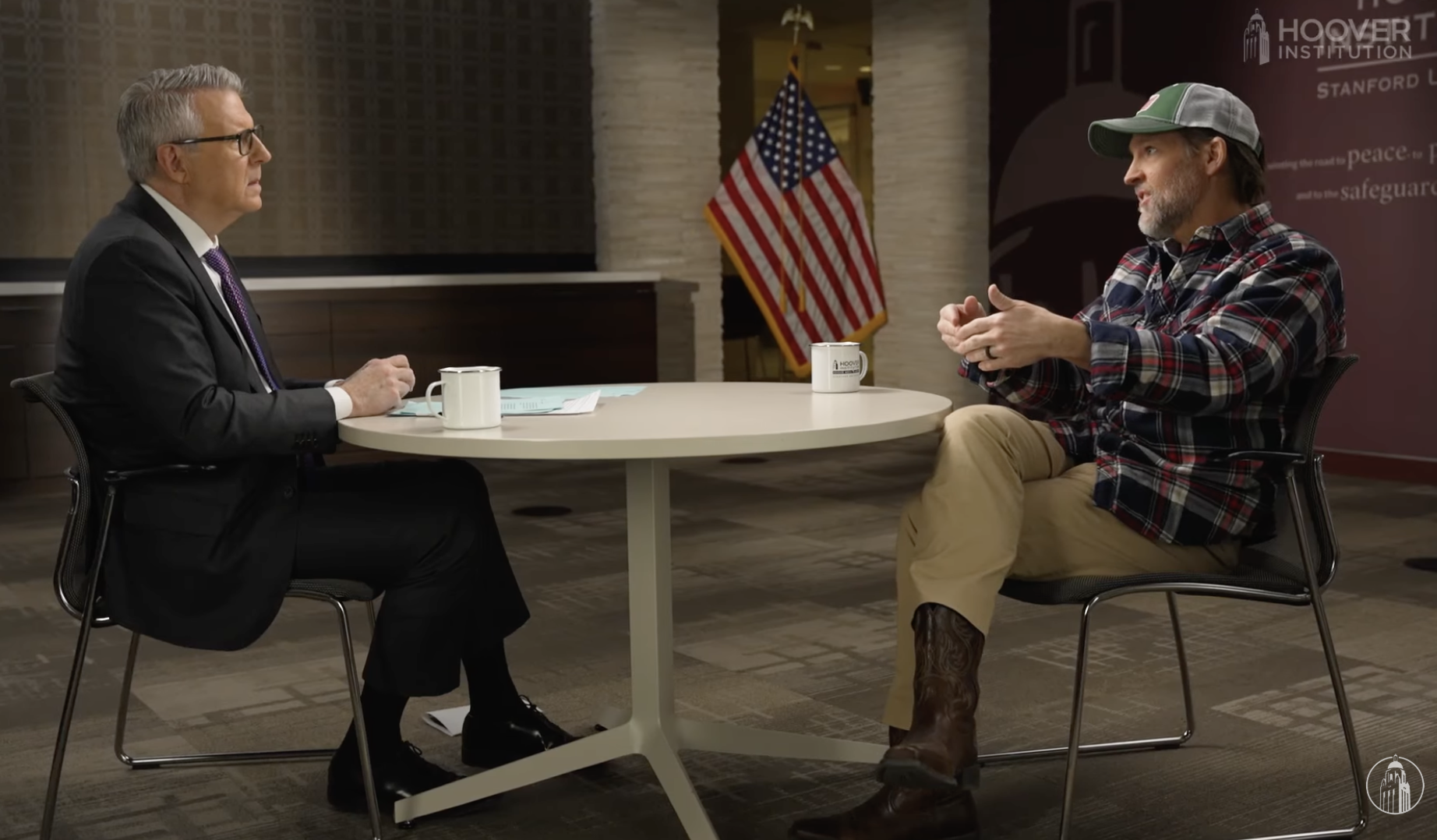

NASHVILLE (BP) – In a wide-ranging interview with Peter Robinson of the Hoover Institution, former U.S. senator and former university president Ben Sasse minced no words and even used some colorful ones when talking about the gravity of his condition and of the country’s challenges.
But he also expressed his complete confidence that the world contains no “maverick molecule” outside God’s control.
Sasse, who served as a senator from Nebraska from 2014-2023 and then as president of the University of Florida until 2024, announced in December that he has stage 4, metastasized pancreatic cancer. He was given 90 days to live. An aggressive experimental treatment will likely give him a bit longer. And while the treatment causes the need to sleep 16-18 hours a day, he is determined to use what time he does have well.
“Redeem the time in my theology means it is a great blessing to be able to live a life of gratitude to God by doing stuff that tries to benefit your neighbor,” Sasse said. “It is a blessing to get to be co-creators, but we don’t build any storehouses that last. The things that matter and endure are human souls and things way bigger than any of my projects. …
“I’m with Paul when he says, ‘To live is Christ, to die is gain.’ Obviously, death is a wicked thief. I don’t want it to happen. … This is not news to me that I had numbered days. It just became a more precise number. We all have numbered days. …
“Is God surprised by the fact that Ben Sasse’s torso is chock full of tumors? … A God who’d be surprised by it is way too small to be interesting. God is not surprised by the fact that I’m gonna die. We’re all gonna die. And the question is, what’s the use of that phase?”
For Sasse, the use of this time includes being a present husband and father while also continuing to write and even launch a new podcast, whose name exhibits the gallows humor Sasse has adopted of late: “Not Dead Yet.”
It also includes a lot of prayer.

“I would never want pancreatic cancer to exist,” he said. “But I also wouldn’t go back to a phase in my life where I hadn’t known the prayer of pancreatic cancer.”
America at 250
Sasse, who holds a PhD in American history from Yale, believes Americans need to learn (or perhaps relearn) the genius of the country’s founding. It’s one of the things he’s focusing on as America prepares to celebrate its 250th birthday this year.
“The Constitution is the most important political document ever written,” he said. “It says that government is not the author or the source of our rights. We have our rights from God via nature, pre-governmentally, and government is just a shared project. It’s a secular project to secure those rights and pass them on to the next generation.”
That view is “a weird thing in human history,” Sasse said, and requires constant vigilance to protect. He lamented what he sees as “post-Constitutional” views on both the left and the right.
“The founders believed you needed to divide government’s power over and over and over and over because if men were angels, you wouldn’t need government. And if governors were angels, you wouldn’t need checks on power,” he said. “But because we’re sinners, because we’re broken, because we’re selfish, we do need government. But we need the governors to also be constrained.
“… We believe this crazy creedal thing, which is universal human dignity. People are created with dignity. They’re endowed by their creator with inalienable rights. Among these are life and liberty, but also the right to pursue happiness even in ways that I don’t agree with.
“… I think the freedom to wrestle with ideas includes the right and freedom to publish those ideas. It includes the right and freedom to assemble for worship. And so if you believe those creedal things about human dignity, you have to pass them on. And … we’ve not been doing any of that. We haven’t done basic civics for a really long time.”
Living in distraction
One thing that’s made it harder to pass on the nation’s values is the constant distractions of what Sasse called the “technological revolution.”
“America only works if people are deliberative,” Sasse said, “if people are thoughtful, if people say, ‘My kid’s soul matters, but my neighbor’s soul matters too.’
“… Power isn’t the main thing. Our loves are the main thing. … it’s your loves. It’s your affections, it’s your passion projects, it’s your pursuits.”
And the American experiment depends on an informed public, which is harder in the digital age.
“The vast majority of Americans won’t come anywhere near reading a book in the year 2026,” Sasse said. “The shortening of our attention spans to digital clips and shorts doesn’t work for a deliberative republic that is anti-majoritarian that says, ‘I believe in freedom of religion, speech, press, assembly, protest, or redress of grievances.’
“Because these things are about souls. And souls are more important than things that can just be governed by power.”
The last enemy
As he faces the grief that accompanies his prognosis, Sasse is encouraged by the thought of Jesus weeping at Lazarus’ tomb.
“Let’s just go back and read that story and a dozen adjacent stories,” he said. “The Bible is so rich, and we spend so little time reading it together.
“Jesus weeps there and He knows that he’s going to raise Lazarus five minutes later. So it’s an amazing story because He is acknowledging that death is terrible and yet death doesn’t win.
“The Christian phrase in Christian literature for years has been to call death the last enemy. Jesus wept – two words. Last enemy – two words, pretty great.
“Death is a wicked thief. It’s an enemy, but it’s pretty great that it’s the last enemy. All the stuff that I regret for having been an inadequate husband and son and father and friend and worker, truth teller, all the stuff that I’ve been weak on, I’ll be freed from all of that. Death is the last enemy.”
The full interview is available here.
Related posts:
 FIRST-PERSON: Doctrinal fidelity without methodological conformity
  Lopez ministers to Uvalde community in wake of school shooting
  The Authority of the Bible
  Franklin Graham announces national prayer march in Washington
  Court vacancy puts spotlight on abortion again Calvinism ~ Southern Baptist Perspectives
  Sports betting ‘factors out God’ but pastoral help for gamblers waning
  Bill McCartney, legendary football coach who founded Promise Keepers, dead at 84