
BRENTWOOD, Tenn. – As Americans celebrate the 250th anniversary of the nation’s founding, half of pastors say their churches will join in the festivities.
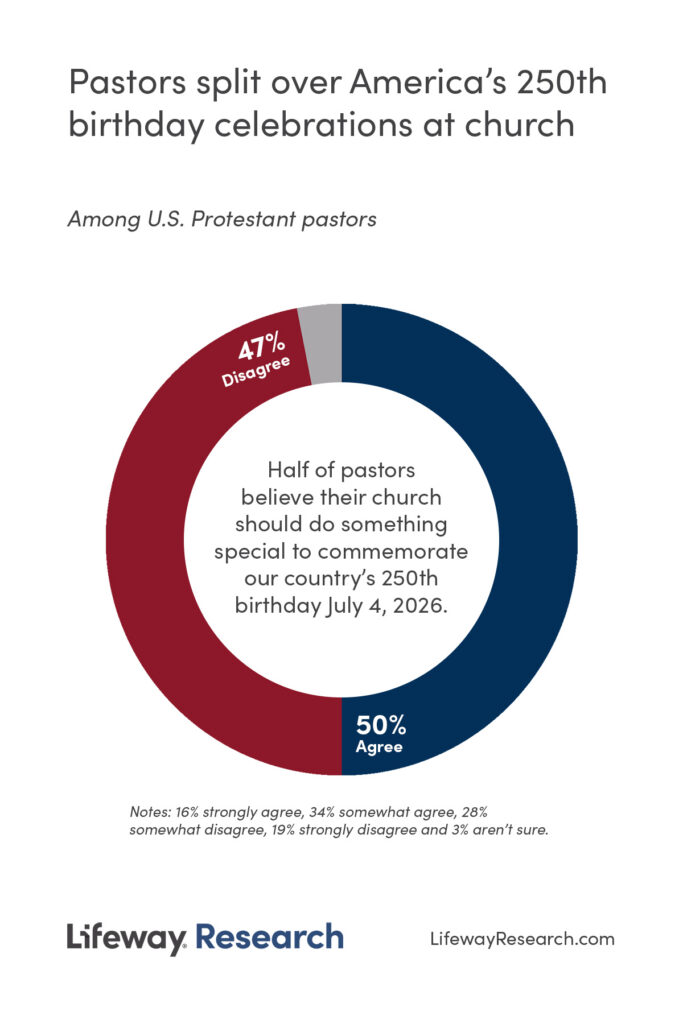
According to a Lifeway Research study, 50 percent of U.S. Protestant pastors believe their church should do something special to commemorate the country’s special birthday this year, including 16 percent who strongly agree. Slightly fewer (47 percent) disagree, and 3 percent aren’t sure.
The 250th anniversary celebration comes at a time when a decreasing percentage of pastors believe the worship service over the Independence Day weekend should include patriotic elements, and fewer see love for country crowding out love for God in their congregations.
“Is it the church’s place to celebrate America’s 250th birthday? Half of pastors say so,” said Scott McConnell, executive director of Lifeway Research. “Only 5 percent more pastors believe the 250th birthday of America deserves special celebration at church compared to those prioritizing the addition of elements to celebrate America in any July Fourth week’s worship service.”
Praise and patriotism
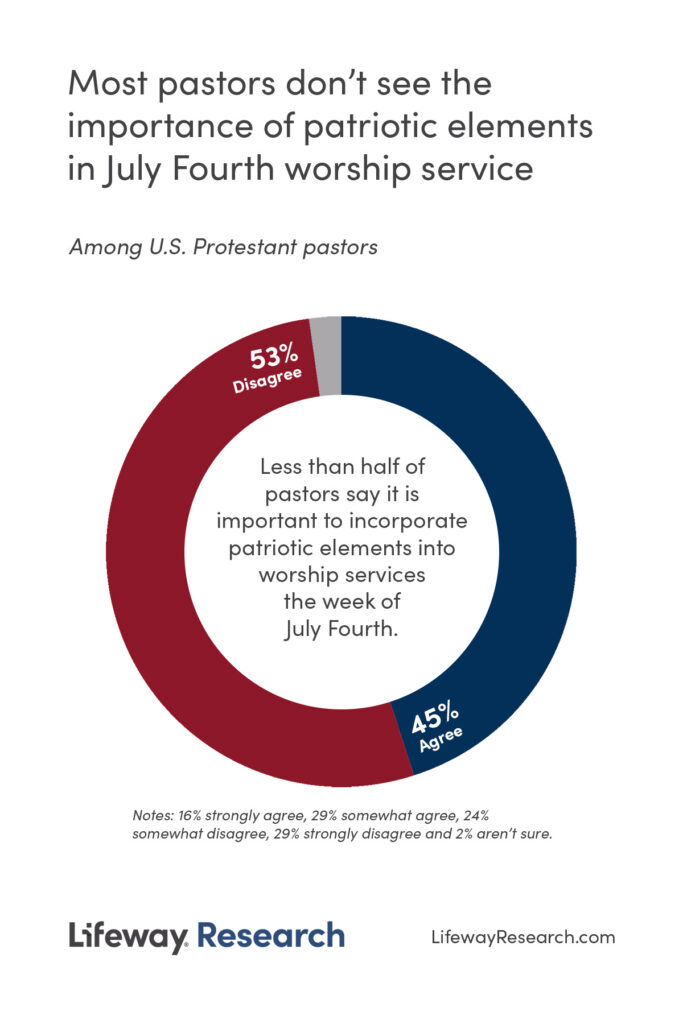
Almost half of U.S. Protestant pastors (45 percent) say it’s important to incorporate patriotic elements into worship services the week of July Fourth, including 16 percent who strongly agree. A slight majority (53 percent) disagree, while 2 percent aren’t sure.
The percentage of pastors who feel this patriotic pressure is decreasing. In a 2021 Lifeway Research study, 56 percent felt those elements were important. Three in 5 (61 percent) said so in a 2016 Lifeway Research study.
“Scripture teaches that Christ’s followers should give honor and respect to governing authorities and fulfill unpleasant duties such as paying taxes and tolls (Romans 13),” McConnell said. “But pastors are split on whether such honor has a place in a church service that is normally reserved for worshipping God alone.”
According to the most recent study, older pastors are more likely to see the importance of patriotic elements in the worship service than their younger counterparts. More than 3 in 5 pastors 65 and older (63 percent) say those aspects should be included during church services the week of Independence Day, compared to 49 percent of 55-64-year-old pastors, 40 percent of those 45-54 and 29 percent of pastors 44 and younger.
Pastors in the South (51 percent) and West (50 percent) are more likely than those in the Midwest (39 percent) and Northeast (37 percent) to say patriotic elements are important.

Denominationally, Pentecostals (64 percent), Baptists (53 percent), Methodists (49 percent), Holiness pastors (48 percent) and those at non-denominational congregations (47 percent) are more likely than those at Lutheran (32 percent) or Presbyterian/Reformed (29 percent) to believe they should include those aspects in their service.
Meanwhile, those leading churches in urban areas (54 percent) are more likely than those in rural areas (45 percent) to disagree and downplay the importance of including means of celebrating America during the worship service.
Additionally, mainline pastors (52 percent) are more likely than evangelical pastors (46 percent) to disagree.
When specifically considering a special commemoration of the country’s 250th birthday, older pastors are again more likely to recognize the importance. Those 65 and older (62 percent) and 55-64 (56 percent) are more likely than those 45-54 (41 percent) and 18-44 (38 percent) to say their congregation should do something special this year.
Pentecostals (65 percent), Methodists (56 percent) and Baptists (55 percent) are more likely than Lutheran (39 percent) and Presbyterian/Reformed pastors (31 percent) to agree.
Other pastors are more likely to disagree and don’t feel the need to commemorate the anniversary. Mainline (48 percent) are more likely than evangelical pastors (41 percent) to disagree. Those leading congregations of 250 or more (52 percent) are also more likely than those at churches with a weekly worship attendance of fewer than 50 (41 percent) to disagree.
Specific service changes
If pastors are going to make changes or additions to their worship service during the Fourth of July weekend, it will most likely include honoring individuals who are serving or have served in the military and their families.
Around 3 in 5 U.S. Protestant pastors say they recognize living veterans (62 percent) or recognize those with family currently serving in the armed forces (59 percent). Most say they include special music honoring America (55 percent) or recognize families who have lost loved ones in service to our country (51 percent).
Fewer say their congregation includes other special ceremonies to honor America (28 percent) or other changes to the service (11 percent)
Only 15 percent say they don’t do any of these, and their worship service the week of July Fourth is no different from other weeks. Less than 1 percent aren’t sure.
“While fewer pastors say it is important to incorporate patriotic elements into worship services the week of July Fourth, most still do something,” McConnell said. “For churches with something special for July Fourth during their worship service, more focus is on people within the congregation who have helped our country rather than a focus on the country itself.”
Compared to 2021, pastors are more likely now to say they recognize living veterans during the worship service over the holiday weekend (62 percent v. 56 percent).
Older pastors, those 65 and older, are among the most likely to say they will be changing their service to include recognizing living veterans (74 percent), recognizing those with family currently serving (70 percent), special music honoring America (70 percent) and other special ceremonies to honor the country (32 percent).
Some pastors are less likely to make any patriotic changes. Pastors 18-44 (21 percent) and 45-54 (24 percent) are more likely than those 55-64 (9 percent) and 65 and older (8 percent) to say their worship service during the week of Independence Day is no different than other weeks.
Holiness (20 percent), Presbyterian/Reformed (19 percent) and Lutheran pastors (18 percent) are more likely than Methodists (9 percent) and Pentecostals (7 percent) to say their service remains the same with no patriotic changes.
Patriotic idolatry?
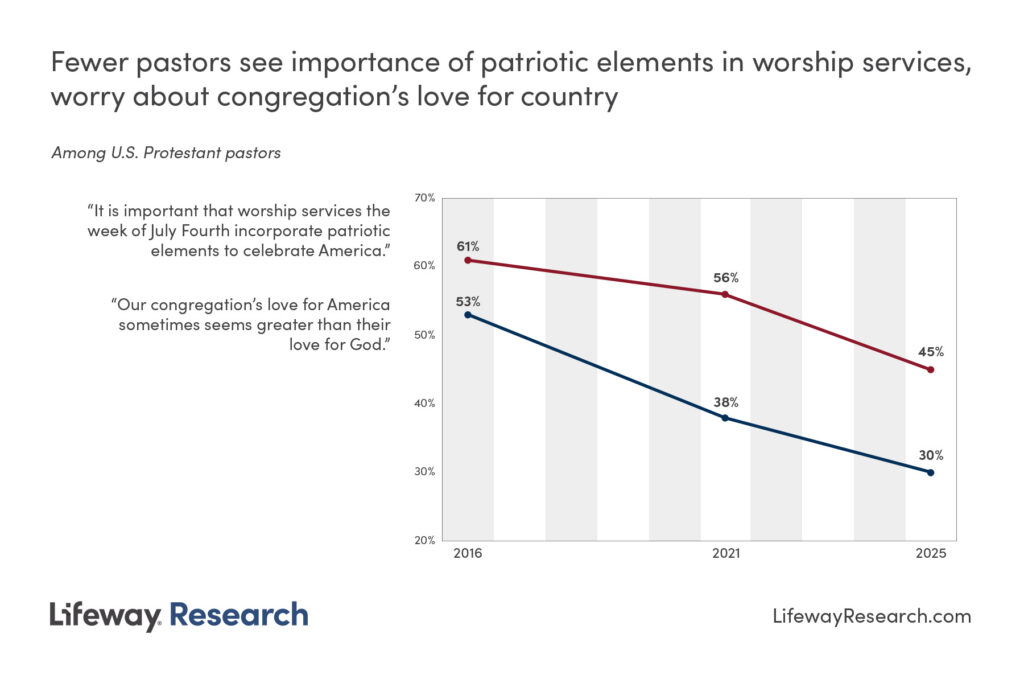
Some pastors worry the people of their church love the nation more than God, though the percentage of pastors with that concern is shrinking.
Currently, 30 percent of pastors say their congregation’s love for America sometimes seems greater than their love for God, including 8 percent who strongly agree. Around 7 in 10 (69 percent) disagree, and 1 percent aren’t sure.
This has become less of a concern for pastors over the past decade. In 2016, 53 percent expressed this reservation. That fell to 38 percent in 2021, before hitting 30 percent today.
“In the Bible, God describes Himself as a jealous God and asks His followers to love Him with all their heart, soul and mind. Pastors’ concerns about their congregations loving America more than God have eased considerably in the last decade,” McConnell said.
Pastors less likely to include patriotic elements in their services are often among those most likely to worry about the levels of national love among their congregants.
Younger pastors, those under 45 (37 percent), are more likely than older pastors, those 65 and older (25 percent), to agree their church’s love for America sometimes seems to rival their love for God.
Denominationally, pastors in Holiness (36 percent), Methodist (36 percent), Presbyterian/Reformed (36 percent), Baptist (35 percent) and Lutheran churches (30 percent) are more likely than those in non-denominational congregations (20 percent) to agree.
Pastors at the smallest churches, fewer than 50 in attendance (26 percent), are among the least likely to worry their congregation’s love for America sometimes seems greater than their love for God.
For more information, view the complete report and visit LifewayResearch.com.
Methodology
The phone survey of 1,003 Protestant pastors was conducted Sept. 2-24, 2025. The calling list was a stratified random sample, drawn from a list of all Protestant churches. Quotas were used for church size. Each interview was conducted with the senior pastor, minister or priest at the church. Responses were weighted by region and church size to more accurately reflect the population. The completed sample is 1,003 surveys. The sample provides 95 percent confidence that the sampling error does not exceed plus or minus 3.3 percent. This margin of error accounts for the effect of weighting. Margins of error are higher in sub-groups. Comparisons are made to surveys of 1,000 Protestant pastors conducted by Lifeway Research Sept. 1-29, 2021, and March 9-24, 2016, using the same methodology.