
Editor’s note: Audio recordings of meetings held by the SBC’s Great Commission Resurgence Task Force in 2009 and 2010 were released earlier this year after being embargoed for 15 years. Baptist Press has spent the past few weeks listening to these recordings and talking with key task force members to get their thoughts on the task force’s effectiveness. This piece is the second in a four-part series. The first piece is here.
NASHVILLE (BP) – Though none of the seven components of the Great Commission Resurgence Task Force (GCRTF) Report delivered in 2010 specifically addressed engaging younger leaders, the subject had hovered over discussions among task force members the previous 10 months.
“We will, hopefully, have a vision … that is compelling enough to attract them, [for them] to say, ‘Hey, [the SBC] is worthy and … good. That is our goal. That is our heart,” said Chairman Ronnie Floyd at the group’s January 2010 meeting in San Antonio.
Fifteen years later, opinions differ on whether it was a success.
Orlando messengers in 2010 approved the GCR report by a wide margin as attendance crossed 11,000 for the first time in four years. The following June, though, the same figure dropped to its lowest point in 67 years. The westward location, Phoenix, was a factor, as was the fact there was no election for SBC president. But even Fred Luter’s election as the first African American SBC president in New Orleans in 2012 brought only 7,874 messengers.
After that, attendance didn’t get above 5,500 until St. Louis in 2016, when Southern Baptists showed it was possible not to have a majority winner even with only two candidates.
Overall membership in the SBC had begun to plateau in the mid-2000s, then drop in the latter half of the decade. Those concerns prompted attempts to engage with younger leaders, such as Lifeway President Jimmy Draper’s listening sessions that culminated in the June 2005 Younger Leaders Summit.
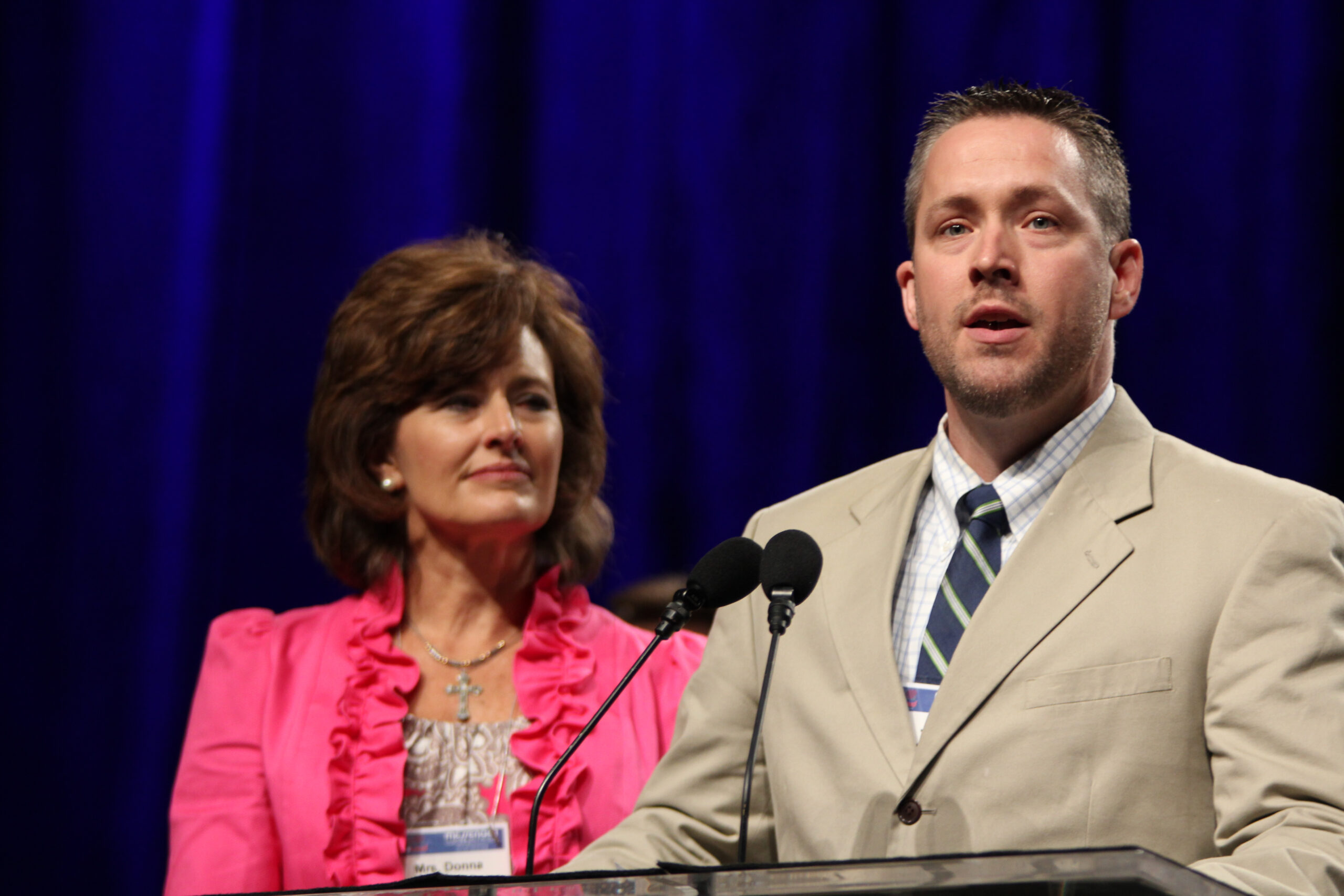
“Jimmy Draper and I communicated a lot back then,” said J.D. Greear, pastor of The Summit Church in Druham, N.C., in a recent interview. At 36, Greear was one of the GCR Task Force members representing younger pastors. Days before Southern Baptists gathered in Orlando in 2010, he wrote a column on the GCR recommendations, why his church was a part of the SBC and why younger pastors should pay attention to the moment.
One of his questions for the task force was what it meant, stylistically, to be a Southern Baptist. Was it required to fit into the traditional “First Baptist” mold?
“There were other expressions of church,” Greear, now 51, recently told BP. “Could a new kind of generation be faithful to the Baptist Faith and Message and every bit as conservative in their theology, but more modern in their approach?”
That was the point of tension he remembers most from the GCR meetings. But it also allowed him to observe older members of the group engaging honestly in that conversation.
“I felt the temperature rise in the room,” Greear said. “But I also saw a lot of willingness to adapt from state convention leaders. [Former N.C. Baptist executive director] Milton Hollifield was just wonderful in thinking creatively. I saw them thinking through new ways to present cooperation than the traditional lanes. There was movement happening both ways. It seemed to be a very positive development.”
In 2016, Greear stepped aside in the SBC presidential election to avoid another runoff vote, which opened the way for Steve Gaines to fill the role for two years. Greear’s influence as a younger pastor with a church exploding in baptisms and missions involvement became apparent in 2018 in Dallas, as the largest group of 18- to 39-year-olds in a generation to attend the annual meeting voted the North Carolina pastor in as president.
Greear credits the GCR’s recommendations for his election.
“I feel like it opened some pathways [for younger engagement]. But opening a pathway isn’t the same as leading through it. They’re both necessary,” he said. “Without the GCR, we couldn’t have done what happened in 2018 and beyond.”
Those pathways had been filled in previous years at the Send conferences produced by the North American Mission Board. The first one in August 2012 drew over 2,000, more than three times what was expected. That figure doubled the next year in Plano, Texas, rivaling the 5,000 who showed up for the SBC Annual Meeting in Houston a month earlier. In 2015, more than 13,600 gathered at Bridgestone Arena in Nashville, about two-and-a-half times the size of the SBC meeting that year in Columbus.
“People were excited,” Greear said last month. “NAMB was hitting on all cylinders. We had evangelism under Steve Gaines [as president]. When I was elected, we were focusing on church planting, increasing diversity in leadership and international missions.
“We were known as the place where, if you want to get equipped and to network, come on.”
Greear was re-elected in 2019 in Birmingham and received a third year due to the 2020 annual meeting’s cancellation because of COVID. He’s proud of the steps toward greater diversity in the Convention during that time, but fears that today’s SBC is less welcoming to younger leaders than it was in 2010.
“Around 2021, some more strident voices got really loud to get us into these tribal fights,” he said. “It felt like the increased attendance from 2016 through 2021 was about mission. Over the last couple of years, we’re talking less about mission and more about infighting.”
Sam Rainer was a 29-year-old lead pastor at First Baptist Church in Murray, Ky., in 2010. At the time, he also served on the Kentucky Baptist Convention’s Great Commission Task Force.
His dad, former Lifeway President Thom Rainer, provided demographic information for the national GCRTF in their proceedings. Nevertheless, the younger Rainer doesn’t remember the GCR “being a major topic among my peers, and certainly not among members of my church.”
“Although there was some fanfare in 2010 when the recommendations were accepted, they were ultimately minor tweaks to an already failing system,” Rainer said.
“We created a new revenue category within the Cooperative Program, phased out funding agreements between state conventions and NAMB, transferred CP promotion from the Executive Committee to state conventions and increased the IMB allocation by 1 percentage point. Nothing in the GCR recommendations had much to do with energizing local churches to do more evangelism. The changes were simply shifts in the bureaucracy of the Convention.”
Though the GCRTF recommended that the EC’s CP allocation go from 3.4 to 2.4 percent (about 30 percent of the EC’s budget) so that IMB’s allocation could go from 50 to 51, that change was only about half accomplished. Currently, the EC receives 2.99 percent while the IMB receives 50.41.
Now the president of ChurchAnswers.com, Rainer pointed to a post earlier this year on the SBC’s shrinking percentage of younger members.
“We’re an older group that’s getting older. While there are certainly individual cases of churches doing well, I see nothing in current trends indicating the SBC is overall engaging younger leaders – indeed, anyone younger.”
As the son of a seminary president, Nate Akin was familiar with the ins and outs of the SBC in 2009, when he was 28. Southeastern Baptist Theological Seminary President Danny Akin’s role as a member of the GCR Task Force gave him a unique view of its work and impact.
Baptist21, where Nake Akin is executive director, has its roots in a group of younger pastors that first officially gathered at the 2009 Louisville SBC. He remembers a lot of discontent and talk about leaving the Convention over several reasons. They included doctrinal and missional discussions, but also freeing up dollars for ministry and resourcing congregations for church planting.
“There was this perception that to be Southern Baptist, you gave to the Cooperative Program and all of these entities did the work for you, rather than the local church,” Akin said.
“We were saying that the SBC isn’t perfect, but it’s really good. Instead of being critical from the outside looking in, we wanted to be a group on the inside trying to be constructive. We wanted the primary amount of our dollar going to starting and strengthening churches and training people to be a part of those endeavors.”
Akin became a pastor in 2011, serving in that role for six years before devoting himself full-time as executive director to both B21 and the Pillar Network, which plants churches internationally and in the U.S.
His own theory on the dip in SBC Annual Meeting attendance at the start of the decade and its rebound in the latter half includes the increased popularity of conferences like Send and Together for the Gospel as well as the rise of social, political and theological debates.
All things considered, his personal experience says the GCR “absolutely” led to younger leaders getting more involved in the Convention. It seems there are more younger leaders, but the 44-year-old Akin admits that may be just because he’s gotten older.
“It gave guys a rallying point,” he said. “At least theologically, to my recollection, the GCR was a return to the primacy of the church. Things aren’t perfect and guys will still get frustrated, but the GCR ultimately got more of them involved in and motivated to be a part of the SBC.”
Floyd, speaking with Baptist Press recently, feels the listening sessions prior to the GCR vote opened doors with younger leaders, but that the groundwork was already there.
“We were asking people questions, and we were listening,” he said. “Younger leaders like J.D. were on the task force and had a major influence also in the SBC. The GCR thing was really important to them.”
But many SBC presidents before the GCR like himself, Jack Graham and Johnny Hunt emphasized reaching younger leaders, too.
“That was an emphasis for a number of years,” said Floyd. “It just did not come out of GCR, but I do believe GCR was effective in that.”