
WASHINGTON (BP) – Brad Robertson was a new college graduate embarking on a career in Washington when someone invited him to King’s Church in the fall of 2021. He’d grown up agnostic, shepherded by agnostic parents.
“Originally I didn’t have much interest in going to church. I think that’s a constant theme in my generation. If you’re not growing up in the church, then you don’t go to the church,” Robertson, now 26, told Baptist Press. “But when I got to King’s, it was really the intentionality of the pastors that kind of kept me around.”

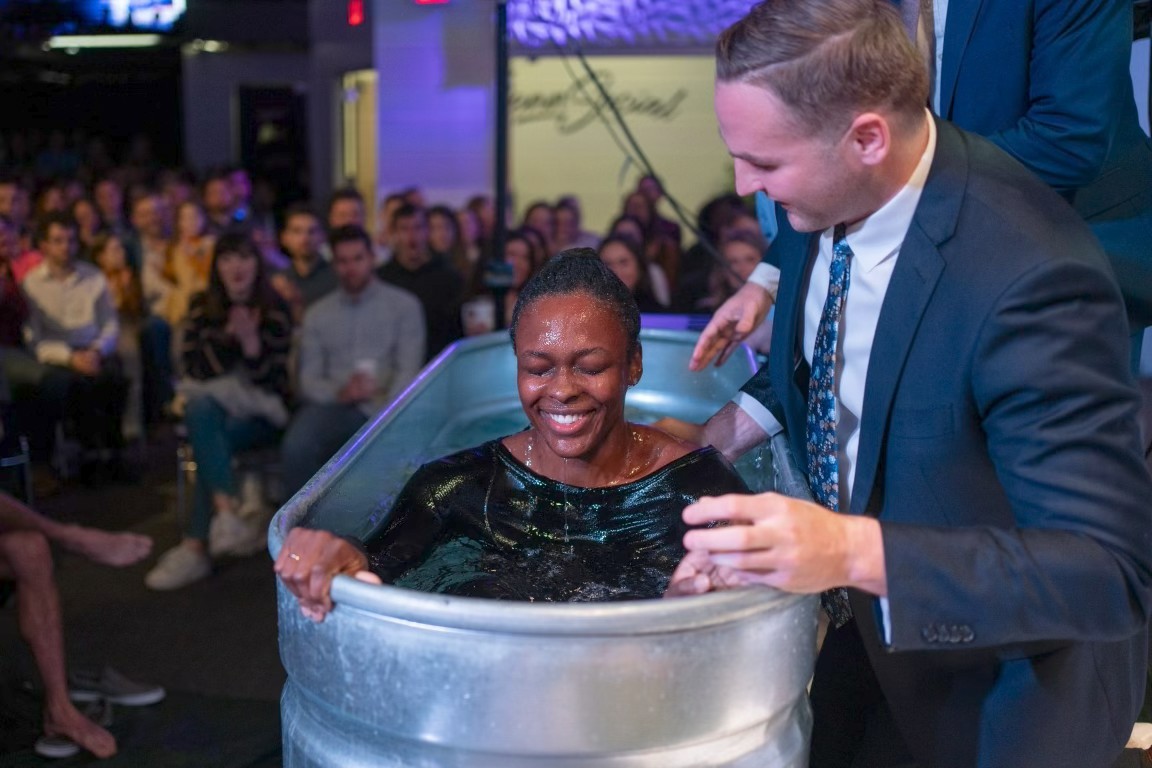
Robertson, now 26, was baptized in November of 2021, heard the call to the pastorate, is enrolled in Southeastern Baptist Theological Seminary and is employed fulltime at King’s Church as a pastoral intern and director of the college and intern ministry.
At the church founded in 2018, the average age of the 600 or so members is 28. Nearly a third, 30 percent, are new believers, staff pastors Ben Palka and Wesley Welch told Baptist Press. They are both alumni of Southeastern Baptist Theological Seminary.
The two describe their approach to the pastorate as being true to their roots, teaching clear theology, establishing real relationships and genuinely caring for people.
Younger people can tell when you’re being performative and inauthentic, Palka said.
“The younger generations are, we’ve found, very suspicious of … the performative-driven church,” Palka said. “They’re very well informed. And so, leaning away from anything that’s performative, for us, and just being more raw, kind of down to earth, teaching the Bible without a lot of bells and whistles, not doing anything over the top to try to be cool, has actually helped us be pretty effective.”
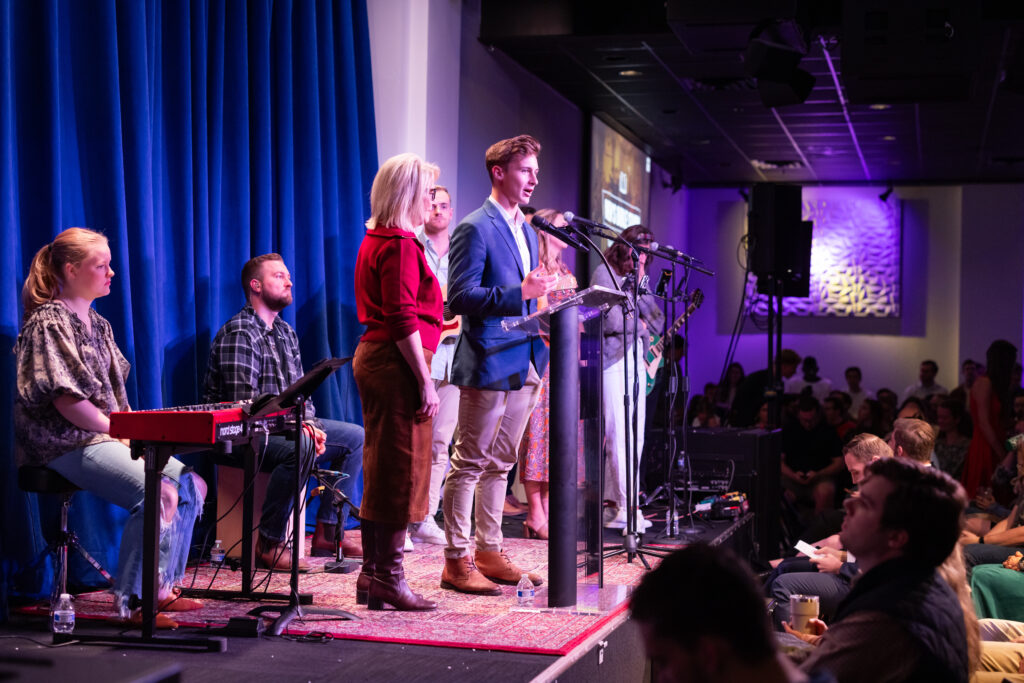
The pastors are available to attendees. Both with the title of staff pastor, each finds the time to meet with about 30 lay members and visitors a week.

“We planted the church together. There’s no senior pastor. We say the senior pastor is Jesus, 1 Peter 5, the chief shepherd, senior pastor,” Palka said. “So we have shared leadership, and that has been really important, to not set one person up as the benevolent dictator. We’ve had this shared authority from day one.”
Welch agrees that the pastors’ availability creates a healthy church.
“Don’t be afraid to know people in your church,” Welch adds. “And I would just encourage any pastor or ministry leader to really invest in the people that they’re called to lead. That is the best part of our job, is that we get to meet with people. We get to walk through life with them. We get to see the highs and lows of their life. I just would encourage people not to run away from that, because that has really made this a special place.”
The pastors’ example permeates the church, creating a sense of belonging among members and encouraging them to build relationships, Robertson said.
“I started doing Bible study with a few guys and then started meeting consistently with the pastors as well,” Robertson said. “Ultimately over the course of two or three months, and dozens of meetings with not only the pastors, but also other people at the church, I gave my life to Christ and was baptized in November of 2021.”
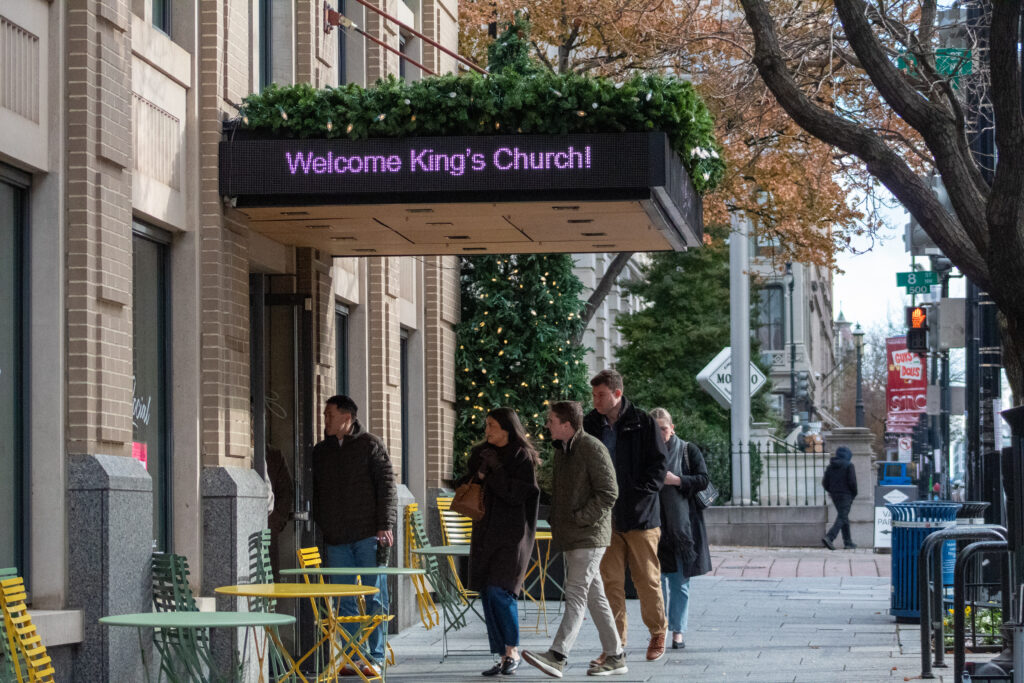
King’s Church is in the midst of a capital campaign to finance the construction of a permanent building. For now, the church meets at 801 E St. N.W., placing enough chairs in the basement of a sports bar to accommodate an average weekly attendance of about 600. Its offices are in a Capitol Hill home, while members host in their private residences 22 small groups attracting about 500 attendees each week.
Adults have comprised the majority of the 250 baptisms the church has conducted in its eight years of ministry, the pastors said. The church is diverse, with 70 percent Anglo and 30 percent additional ethnicities. Half are Gen Z, 30 percent are Millennials and others are younger or older. Half are single, the rest married. About 70 percent live in Washington, 29 percent in Virginia and 1 percent in Maryland. The congregation is 45 percent male and 55 percent female.
The church has three lay pastors who serve the congregation, in addition to a deacon body.
From the early struggles of the congregation that stood at 35 members a few years before the COVID pandemic, the pastors said they developed humility and learned to appreciate whomever God sent.
“I think the first two years, not to put a number on it, but being at 30 or 40 people, and surrendering that to the Lord, saying what does it look like to be a pastor of 30 to 40 people for life, we learned it,” Palka said. “And it was really awesome and really special. And now we’re a pastor of 600-700 people. And that’s great too.”
They accepted the ministry, whatever the size or age of the congregants, and began ministering with a knowledge that the church is for everyone.
“Let’s be an every-member ministry. Let’s be an every-member kind of family,” they decided. “Everybody, everybody matters. There’s something special about that.”
Related posts:
 Letters help young woman grieve her best friend, slain at school
  Bike-riding kids raise $6,000 for missions
  State of the Church: More men attending than women, volunteering rebounding
  Good drama: Wisconsin church celebrates 50 years of outdoor Easter witness
  Abuse Prevention and Response announces 2025-2026 webinars, Texas summit
  Texas Church Prepares for Crisis Events
  SBC DIGEST: Curtis Woods accepts pastorate; Summit Church to hold on-campus worship
  Contextualized ministry guides Montana pastor in outreach