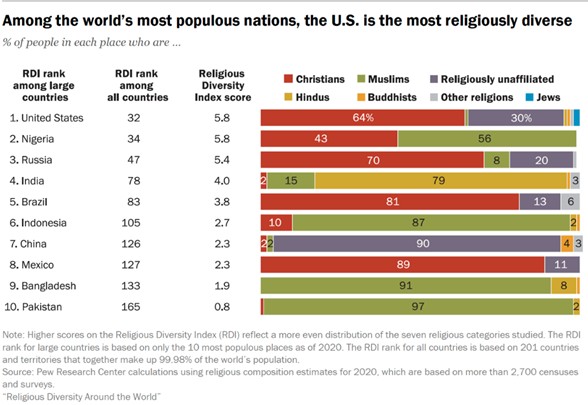

WASHINGTON (BP) – The United States and Nigeria are the most religiously diverse nations among populations of at least 120 million people, Pew Research said Feb. 12, based on 2020 numbers dividing belief systems into seven religions.
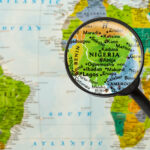
Among the 10 most populous nations, the U.S. ranks first with a population that is 64 percent Christian and 30 percent religiously unaffiliated, with the remaining 6 percent comprised of 1 percent to 2 percent each of Muslims, Hindus, Buddhists, Jews and people in the “other religions” category. Nigeria follows the U.S. in religious diversity with 56 percent Muslims and 43 percent Christians, with Russia, India and Brazil in succession among the top five.
When considering all 201 nations studied, irrespective of size, Singapore is the most religiously diverse nation in the world, followed respectively by Suriname, Taiwan, South Korea and Mauritius. Nearly a third of Singapore’s population, 31 percent, are Buddhists, followed by 20 percent religiously unaffiliated, 19 percent Christians, 16 percent Muslims, 5 percent Hindus and 9 percent other.
The numbers put Singapore at 9.3 on Pew’s Religious Diversity Index (RDI) spanning 0 to 10, with a higher number indicating more diversity. Suriname registered an RDI of 7.5, followed by Taiwan at 7.5, and South Korea and Mauritius both falling at 7.3. France, the only European nation in the top 10, scored 6.9 on the RDI.
Not accounting for population size, the U.S. ranks as the 32nd most religiously diverse nation in the world, with an RDI of 5.8. Nigeria ranks 34th overall, also scoring an RDI of 5.8; followed by Russia at 47th with an RDI of 5.4, India at 78th with an RDI of 4, and Brazil at 83rd with an RDI of 3.8.
Pew gave no country the highest possible score of 10 on the RDI, a metric based on the number of religious groups represented and the comparable size of each. Previously conducted in 2010, the religious diversity study is based on more than 2,700 censuses and surveys studying 201 nations that comprise 99.98 percent of the world’s population, Pew said.
“Broadly speaking, religious diversity levels around the world did not change much between 2010 and 2020, as the religious composition of most countries was fairly stable,” Pew said in its report. “However, the RDI scores of around two dozen countries changed considerably over that decade, primarily due to widespread religious disaffiliation among Christians.”
Most people who left Christianity chose no religious affiliation in its place, Pew said, accounting for a rise in “nones;” while Muslim populations increased “due to Muslims having a relatively young age structure and high fertility rate,” Pew said, “two characteristics that result in natural population growth.”
For example in the U.S., Christians comprised 78 percent of the population in 2010, but dropped to 64 percent in 2020 numbers just released. The drop in Christianity moved the U.S. from a moderate level of diversity in 2010, with an RDI of 4.2; to a high level of diversity in 2020, with an RDI of 5.8.
Ranking lowest in religious diversity, respectively at numbers 197 through 201, are Morocco (RDI 0.1); Iran (RDI 0.1), Somalia (RDI 0.0),
Afghanistan (RDI 0.0), and Yemen at the very bottom with an RDI of 0.0.
Among global regions, the Asia-Pacific is the most religiously diverse, scoring an RDI of 8.7 and including a population that is 6 percent Christian, 26 percent Muslim, 33 percent religiously unaffiliated, 26 percent Hindu, 7 percent Buddhist, 2 percent other religions and less than 1 percent Jewish.
Following in regional rankings are:
- North America with an RDI of 6: Christians 63 percent, Muslims 2 percent, religiously unaffiliated 30 percent, 1 percent each Hindus, Buddhists and other religions, and 2 percent Jewish.
- Sub-Saharan Africa with an RDI of 5.9: Christians 62 percent, Muslims 33 percent, religiously unaffiliated 3 percent, less than 1 percent each Hindus and Buddhists, 2 percent other religions, and less than 1 percent Jewish.
- Europe with an RDI of 5.6: Christians 67 percent, Muslims 6 percent, religiously unaffiliated 25 percent, less than 1 percent each Hindus and Buddhists, 1 percent other and less than 1 percent Jewish.
- Latin America – Caribbean with a n RDI of 3.1: Christians 85 percent, Muslims less than 1 percent, religiously unaffiliated 12 percent, less than 1 percent each Hindus and Buddhists, 3 percent other religions and less than 1 percent Jewish.
- Middle East – North Africa with an RDI of 1.3: Christians 3 percent, Muslims 94 percent, religiously unaffiliated less than 1 percent, Hindus 1 percent, less than 1 percent each Buddhists and other religions, and 3 percent Jewish.
Study results are accessible at pewresearch.org.