
ORLANDO (BP) – Messengers still contemplating their vote for Southern Baptist Convention president this afternoon received two opportunities in recent days to hear the views of Florida pastor Willy Rice and his South Carolina counterpart, Josh Powell, with each laying out their many similarities and relatively few, though noted, differences.
The first of those events took place on June 7 as part of the evening banquet held by the Southern Baptist Conference of Associational Leaders (SBCAL), moderated by Greater Dayton (Ohio) Associational Missions Strategist James Risner. Last night, Rob Collingsworth, director of Strategic Relationships for Criswell College, and David Sons, pastor of First Baptist Church North Augusta in South Carolina, hosted a discussion through The Baptist Review (TBR).
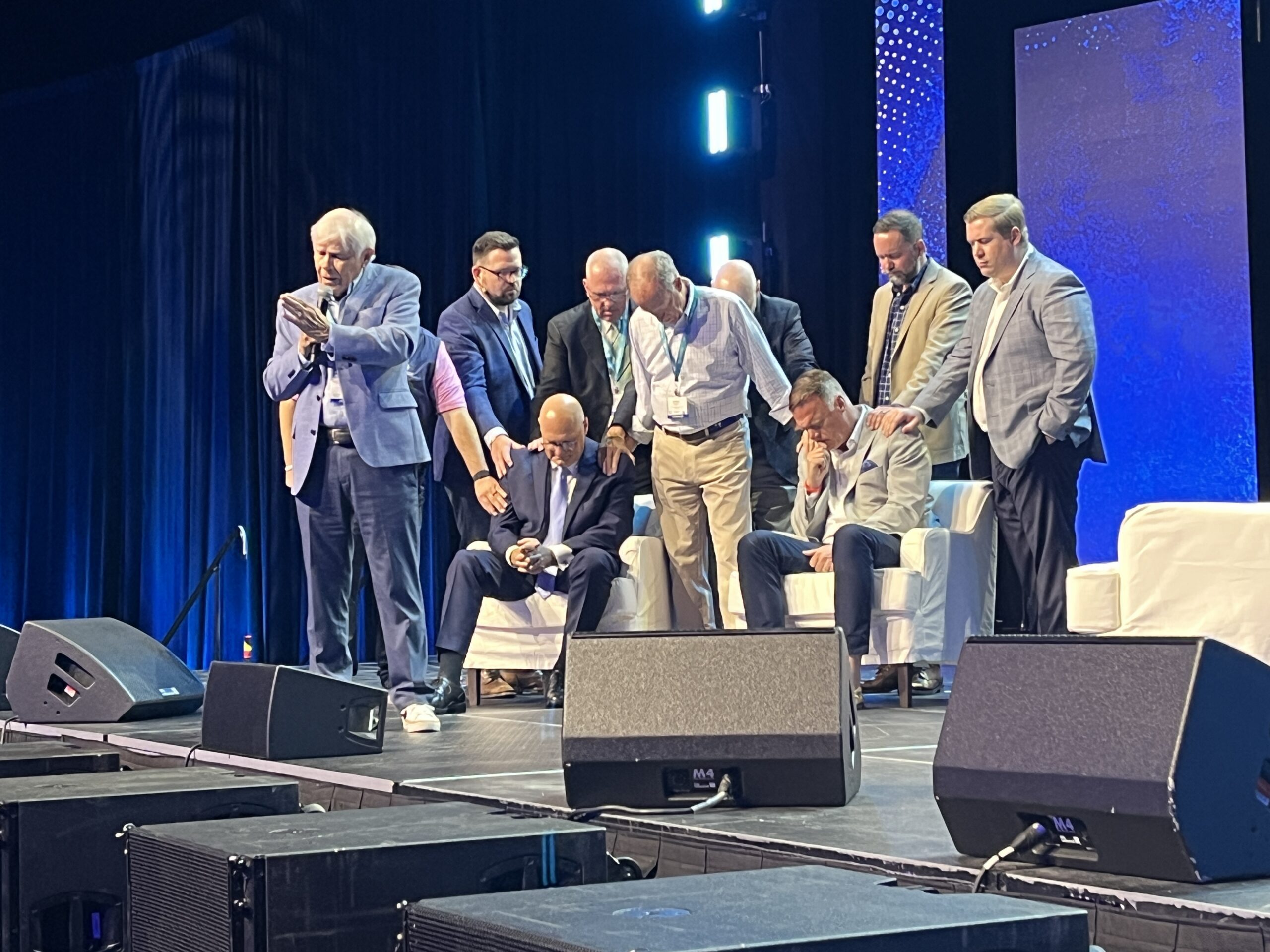
At the close of the latter, former SBC Presidents Bart Barber, Jim Henry, James Merritt and Bryant Wright joined others on stage to pray over Powell and Rice. Henry, the longtime pastor of First Baptist Church in Orlando, offered the prayer.
While both forums observed wider discussions within Southern Baptist life, Sunday night’s also addressed topics for the gathered audience.
“Associational leaders appreciated the candidates’ clarity, as well as their clear commitment to the priority of associations in a healthy SBC ecosystem,” said SBCAL President Ray Gentry. “Associationalism is rising, and AMSs were happy to hear the candidates acknowledge this positive trend. We feel blessed to have two solid candidates, and have confidence in them both.”
In a discussion with Sons and Collingsworth that often highlighted the similarities and mutual respect between Rice and Powell, topics also pointed out alternate viewpoints.
Both are in favor of an expected amendment by Southern Seminary President Albert Mohler, for instance, on the title of pastor as it applies to men. Differences appear in whether a task force to study the subject, as Rice has proposed, would provide further clarity on the subject or, as Powell stated, would be duplicitous on a subject that Southern Baptists have stated their position clearly through previous votes overwhelmingly in favor of men holding the office of pastor.
“A task force is not something that we should look down on or disparage,” said Rice, pastor of Calvary Church in Clearwater, Fla. “It is a group of Baptists outside the system that work on the system.”
“Southern Baptists have been absolutely clear. The Baptist Faith and Message had been absolutely clear,” said Powell. “We have a precedent that has been set when these issues have come before the messengers, and we have voted 90 percent, sometimes 95 percent, with clarity, that [having a woman as a pastor] is beyond the bounds of what we would like.”
Sons referenced a recent article in Baptist Press where Powell said he wanted Southern Baptists to “start pressing hard on the gas of the Great Commission.” The statement brought criticism from some online, saying it reflected a leadership position reluctant to address perceived issues within the SBC.
“Southern Baptists are at their best whenever we are laser-focused on the Great Commission,” Powell said. “It’s why we gather together. It’s what we cooperate to do … to send missionaries, plant churches, train pastors, to do those things. … I’m a little thrown back that that could be controversial among Southern Baptists.”
Powell pointed out that Southern Baptists have dealt with controversies and disagreements throughout the Convention’s history, but always known where to keep the focus.
“When we face challenges, we lean into what we do together, and we continue. I don’t want to call our missionaries and say, ‘Hey guys, we have some problems. Let’s pull over. We gotta fix this before y’all can continue.”
Agreeing with Powell in principle, Rice said that “you have to deal with problems as well as lean forward.”
Those problems stem from Southern Baptist leadership over the last 10 years that Rice said left the SBC in a “riptide” that “pulled us into some social justice movements, into some resolutions that got us into major trouble.”
“You’re talking about being focused on the Great Commission; that pulled us off the Great Commission,” he said. “So many times, I’ve heard guys out there in the last few months saying, ‘I just wish I could hear some of our leaders go, ‘He, we got that wrong. That guy we put up there and we recommended, and that guy that was leading, and we were all getting him to sign our Bibles and getting his autograph, we got it wrong.’”
Phrases like “The world is watching” led to “cultural pragmatism” in the SBC during that time, he later added to a question on the need for another conservative resurgence.
“If you’re not careful, it means you’re more concerned about the pressure of the people and pleasing outside forces than doing what we know is right. And I do think we saw some leaders who capitulated to cultural pressures and to some societal issues out there,” he said.
Powell pointed out that “those leaders are no longer in place” and offered that the Lord should deal with their hearts on whether or not they should apologize.
“I’m not looking in the past to try to get them to do anything,” he said. “I say, now, we’ve got to advance the Gospel because every single week, a million people die without knowing Jesus Christ.
“What’s not slowing down is the need for the Gospel. I’m not trying to look in the rear view [mirror]. Let’s keep going.”
The investigation into covering up and mishandling claims of sexual abuse took place during that time. Both Powell and Rice disagreed with the word “crisis” as an insinuation that sexual abuse was rampant among Southern Baptist churches, though they did acknowledge that it feels like a crisis when it happens in even one church or one family.
The two also agreed that Southern Baptists must work to identify those called into the ministry and disciple them accordingly.
Rice recounted how he grew up at Calvary Church and was discipled and trained for the ministry there. He gave credit to his ministry team and its monthly meeting devoted to maintaining that pipeline.
“Churches have got to reproduce leaders,” he said. “You’re not just going to go to Target and just pick ‘em off the shelf. Many of the people who serve at Calvary grew up there.”
Those efforts joined others, Rice added, to send 24 Calvary members to the International Mission Board over the last decade.
“Willy’s right,” said Powell, who recounted his call to the ministry at a Dawson McAllister conference in Jekyll Island, Ga. “You have to have the structure there. You have to have the setup [to have] the pipeline for … training [and] discipleship.”
The goal, he added, shouldn’t be for that training to have a “jumping off point,” but to take them “all the way to the point where they are installed and in place to preach and pastor churches.”
The decline of Cooperative Program giving over the last two decades isn’t because Southern Baptists are less generous, both said. Each did offer different primary reasons, though.
Powell offered, for example, that the increase in nonprofits has siphoned Southern Baptist dollars that normally flowed through CP. Referring to Rice’s chief reason for the decline, he acknowledged that “for some people, it probably is a trust issue.”
“I think it is a loss of institutional trust,” Rice posited, noting that as something he heard during numerous visits with pastors and groups since the beginning of the year.
“Some of the problems that we’ve had caused some of that loss of trust. We’ve got to take that serious and work to repair it. And the way you work to repair it is you listen to people. Don’t ignore them. Unity is not telling people you disagree with to hush.”
When asked to give the biggest difference between himself and Powell, Rice said he would probably “challenge the system a little more.”
“I’m not trying to burn it down. … I’ve been in the system [and] on the committees,” he said. “… But, I do think the president has to challenge the system.”
Powell acknowledged the difference of opinion.
“I have great optimism for what we have accomplished and what we can accomplish together,” he said. “I’m gonna press into that optimism and move forward, and maybe if that means challenging less and championing more, it may be a slight difference in what we do, but that would be where I land.”