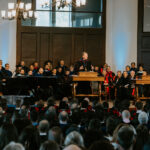
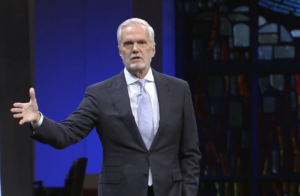
KANSAS CITY, Mo. – Renowned preacher and professor Robert Smith delivered lectures on the burden, joy and foolishness of preaching at Midwestern Baptist Theological Seminary’s Spurgeon Lectures on Biblical Preaching earlier this month.
Smith, distinguished professor of divinity at Beeson Divinity School, has had a “profound preaching and teaching ministry now spanning several decades,” MBTS President Jason Allen said.
“His energy and conviction in the pulpit are inspiring and instructive. I am grateful our students were able to sit under his teaching for these two lectures.”
The burden and joy of preaching
In his lecture Nov. 4, Smith preached on the burden and joy of preaching from Acts 18:24-28. His initial lecture urged listeners to pursue a life and ministry marked by humility, dependence on the Spirit of God, and closeness to Christ.
He began the sermon by noting that every disciple is covered in the dust of those who discipled and taught them: “Timothy was the student of Paul, and that’s when he got some Pauline dust on him. And Paul was the student of Jesus, and even he said to us, ‘Follow me as I follow Christ,’ walking close behind Jesus and covered in His Christological dust.”
Throughout his message, Smith returned to the image of “Christological dust,” stating that, like Paul, the preacher must always want to know Christ more – not just content about Christ, but the experience of Him.
He emphasized that ministry requires both knowledge and experience: “When you realize you have been justified, it makes a difference. Our sanctification is the process of catching up to our exegesis.”
“We are learning more of who we are, and when you know who you are, it makes a difference in how you live,” Smith said.
He then illustrated this posture through the example of Apollos.
Smith pointed out that Apollos is described as one fervent in spirit and further expounded on the necessity of the Spirit for Gospel ministry: “The Holy Spirit is not a luxury. The Holy Spirit is a necessity,” Smith said. “We need the Holy Spirit in our lives and in our ministries – even to the point that we cannot be effective in anything we do without the Spirit.”
Smith declared that Apollos recognized the centrality of the Spirit to transform and bring change: “He knew that, regardless of preparation or linguistic ability, his words would fall to no effect without the Spirit of God.”
Smith also emphasized that while Apollos was an eloquent man who was competent in the Scriptures, he needed to receive fuller instruction from Priscilla and Aquila. Since Apollos was both intelligent and humble – as one who wanted to know and experience Christ – he received their encouragement.
“They took him aside not to reprove him but to improve him,” Smith said. “He understands that you cannot say, ‘Thus saith the Lord,’ unless you know, ‘What saith the Lord.’”
Smith concluded his message by saying that it is a burden to work alongside someone with an incomplete message, like Apollos, but a joy to see God bring him to maturity and make him an effective preacher of the gospel of Jesus Christ.
His final words challenged listeners to pursue greater nearness to Christ—to walk so close behind Him that they are covered in His “Christological dust,” reflecting more of His likeness with every step.
The foolishness of preaching
In his second lecture Nov. 5, Smith preached on the foolishness of preaching from 1 Corinthians 1:18-31, stressing that faithful preaching doesn’t aim to sound logical or simple – it carries a message the world calls foolish.
Smith warned that preachers must resist the temptation to domesticate the text to make it more appealing: “Preaching comforts the afflicted,” he said, “but it also afflicts the comfortable.”
He continued, “The world that thinks it is standing right side up must be confronted by a Gospel that turns it upside down – by pointing to the One who hung on the cross right side up, crucified as the Messiah, yet rose Sunday morning with all power in His hand.”
He explained that “foolishness” describes the work of God that surpasses human understanding and must be received by faith. In doing so, he urged listeners to redefine wisdom itself: what the world calls foolish is the wisdom of God.
Smith then pressed a question upon the audience: “Are you ready to preach this kind of foolishness?”
Smith closed his sermon by stating the comfort of such a “foolish” message, declaring, “I don’t understand many things about tomorrow, but I know who holds tomorrow. When I don’t know what, I know who. When I don’t know when, I know who. When I don’t know where, I know who. When I don’t know how, I know who. I know who holds tomorrow, and I know He holds my hand.”
To watch this year’s Spurgeon Lectures, click here.