
BRENTWOOD, Tenn. — Most churchgoers look for time to spend with God and regularly find themselves with Him in unplanned moments.
Both deliberate and spontaneous instances of prayer and worship are part of seeking God, according to Lifeway Research’s State of Discipleship. Seeking God is one of eight signposts that measure characteristics evident in believers progressing in spiritual maturity. The average churchgoer scores 78.5 out of 100 in seeking God, ranking it first among the signposts.
“The Bible describes the redemption story in which God has made a way through Jesus Christ for humans to have their sins paid for and to have a relationship with Him. It is not surprising that churchgoers excel in seeking God the most among other aspects of their journey with Christ. Without a desire and practice of seeking God, other aspects of following Him lack purpose,” said Scott McConnel, executive director of Lifeway Research.
Purposeful and unplanned times
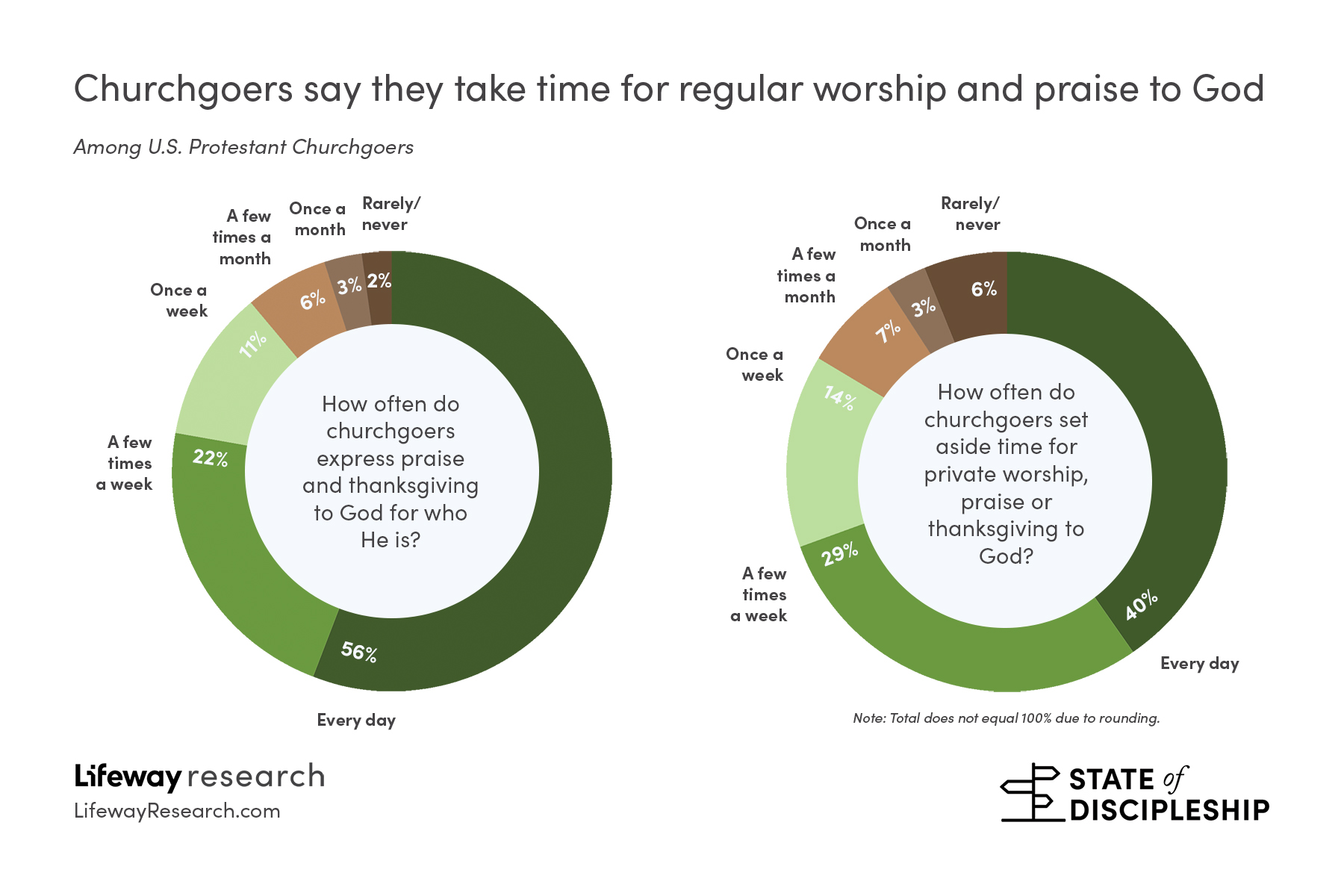
Around 7 in 10 U.S. Protestant churchgoers (69 percent) say they set aside time for private worship, praise or thanksgiving to God at least a few times a week, with 40 percent doing so every day. Around a quarter (25 percent) intentionally carve out specific moments either once a week (14 percent), a few times a month (7 percent) or once a month (3 percent). Just 6 percent say this is something they rarely or never do.
Those numbers are consistent with a 2019 Lifeway Research study, when 67 percent said they set aside private time regularly or at least a few times a week, 24 percent said occasionally or less often but at least once a month, and 9 percent rarely at most. More churchgoers, however, are intentional compared to a 2012 Lifeway Research study, when 54 percent said they set aside time regularly, 30 percent occasionally and 17 percent rarely or never.
Additionally, 4 in 5 churchgoers (79 percent) say they find themselves praying at the spur of the moment throughout the day, including 41 percent who strongly agree. Few disagree (8 percent) or aren’t sure (13 percent). A similar percentage of churchgoers had the same practice in 2019 (78 percent) and 2012 (75 percent).
“Valuing this relationship with God is evident in many churchgoers’ lives as they often protect times to worship Him on their own. But the value of God in their lives is also seen as they want His involvement throughout the day,” said McConnell.

Whether intentional or impromptu, most churchgoers say they regularly, personally express praise and thanksgiving to God for who He is. Most (56 percent) say this is an everyday practice, while 22 percent do so a few times a week, 11 percent once a week, 6 percent a few times a month, 3 percent once a month and 2 percent rarely or never do so.
Honoring God
As they seek God, most churchgoers look to honor and bring Him glory. They say that is the meaning and purpose of their lives.
Four in 5 U.S. Protestant churchgoers (80 percent) say they have committed their life to bringing glory to God, including 44 percent who strongly agree. Few (5 percent) disagree, and 15 percent aren’t sure.
Similarly, 7 in 10 (71 percent) say they find meaning in their lives only by pleasing and honoring God, including 36 percent who strongly agree. Around 1 in 10 (10 percent) disagree, and 19 percent aren’t sure.
“The Bible says and Christians have historically taught that the purpose of humans is to glorify God and to enjoy Him forever. Eight in 10 churchgoers are committed to bringing glory to God and almost as many lean into practices that help them live this out,” said McConnell.
For more information, view the complete report and visit LifewayResearch.com/Discipleship.
Methodology
The online survey of 2,130 Protestant churchgoers was conducted March 19-26, 2025, using a national pre-recruited panel. Respondents were screened to include those who identified as Protestant/non-denominational and attend religious services at least once a month. Respondents could complete the survey in English or Spanish. Quotas and slight weights were used to balance gender, age, region, ethnicity, education and denominational affiliation. The completed sample is 2,130 surveys. The sample provides 95 percent confidence that the sampling error from the panel does not exceed plus or minus 2.21 percent. This margin of error accounts for the effect of weighting. Margins of error are higher in sub-groups.