

Editor’s Note: the following is an excerpt from “If Only We Could See: Reimagining Creativity, Compassion, and Calling through the Extraordinary Life of Lilias Trotter,” released April 14, 2026 from B&H Publishing.
It’s 1853. Queen Victoria has been reigning for nearly two decades, and Britain is at the very height of its wealth and power as the world’s most far-reaching empire – despite the rumblings of imminent rebellion in India. Isaac Singer has recently patented his sewing machine, and textile factories are sprouting up around the country employing hundreds of thousands of men, women and children to keep up with the exploding fashion industry. Charles Dickens is churning out monthly installments of his bestselling new novel “Bleak House.” Londoners ride horse-drawn omnibuses and steam-powered trains, pay a penny for stamps and send telegrams over electric wires. The rising generation will live to see the advent of typewriters and telephones, automobiles and traffic lights, toilet paper, light bulbs, radios and refrigeration.
And on July 14, a little girl named Isabella Lilias is born to Alexander and Isabella Trotter in London’s stylish West End.
She’s a dark-eyed, sensitive and imaginative child growing up in a happy family, with all the privilege, education and opportunities to slide easily into a comfortable upper-class English adulthood someday – perhaps with a husband in banking like her father, a dozen well-dressed children raised by nannies and taught by governesses and a calendar brimming with social calls and charitable committees.
But Lily’s world is shaken, turned topsy-turvy not once but four times. First by intense grief – her father’s death when she is only 12. Then by a spiritual awakening that begins in her teens and catches fire in the summer of her 21st year as religious revivals sweep through the country. With a new sense of calling and purpose, she joins the fledgling Young Women’s Christian Association (YWCA), setting aside the future prospects of a woman of her class in order to spend her life at the vanguard of social reform and inner-city ministry.
If the story ended there, it would make a fascinating picture – a black-and-white image of a forgotten Victorian lady, whose eyes stare back at you with such depth and intelligence and humor that you know she has a rich trove of stories to tell – and whose name has been lost to history.
But a third shaking comes only a few years later. She is discovered. Like a talent agent swooping down upon an unsuspecting future movie star, John Ruskin, one of the most famous celebrities of her day, is stopped in his tracks by the sight of her sketchbook. Underneath the wealthy upbringing, behind the tireless activity and evangelistic fervor, this girl also paints really, really, really well.
And he sees her. Sees her imagination, her love of colors and light, her deep joy in the simple act of capturing beauty with her pencil and brush. He sees the unique pieces inside of her that don’t fit neatly into the life she’s chosen.
So he takes her under his wing. He nurtures her raw talent until one day he confronts her with the truth about herself as he sees it. You are good, he tells her.You could be the best – the greatest painter of your generation. Commit to this, let me guide you and the sky is the limit.
And she says no – a decision that will take a lifetime to unpack and discover all the implications of.
Back to London she goes, back to her work with the YWCA, where her creativity thrives in a hundred ways that Ruskin cannot see. And then, out of the blue, there is a final shaking.
At the matronly age of 35, when she’s content with how the pieces of her life have fallen into place, at the moment when she’s least looking for it, she feels a call to become a missionary. And so in March of 1888, with no organizational backing, no formal training, no knowledge of the language and no clear plans other than a powerful conviction of God’s leading, Lily and two friends board a steamship for Algeria, where she will spend the remaining 40 years of her life.
And it is only because of that final sharp turn, that seemingly impulsive and ludicrous decision flying in the face of friends’ expectations, social conventions, career considerations and even practical good sense, that we know anything at all about Lilias Trotter today. It is in North Africa that her imagination flourishes, her art finds a home, her vision finds a voice and those who love her and are loved by her preserve her memory so that we might meet her too.
Can you see her yet? I’m drawing only the bare outline, the contour defining the external shape of her life. But I have tried to learn from Ruskin’s art lessons as Lily did and to find what he called the leading lines – the lines in any object or scene that show growth and movement, that tell a story, like the deep wrinkles and smile lines on a face.
From the day she first steps off the boat in Algiers to the day she is buried there, Lily’s face bears the spreading creases of a woman who is well acquainted with both sorrow and joy. Her mouth is broad and full, one corner always slightly cocked – barely hidden mirth coiled there waiting for its moment to spring loose. And when it does, laughter and delight splinter outward from the corners of her intense, deep-set eyes.
It’s a wide-open face, hair swept back into a simple knot at her neck, always turned toward the next challenge, the next opportunity.
For months at a time, she and her companions travel by camel caravan deeper and deeper into the Sahara Desert, falling in love with the land and its people, sleeping in tents under the stars or in hammocks strung up in the courtyard of a friendly local sheik. When political pressures temporarily suspend these southern adventures, they continue to ride donkeys up and down the hills that hug the coast, befriending villagers, offering simple medical care and hauling cartloads of little Gospel books for anyone curious enough to come and read. When the French colonial government accuses the missionaries of treason and proselytism, they turn to publishing. The sprawling house that eventually serves as the Algiers Mission Band headquarters becomes a refuge for families in need, abused women, orphans, exhausted missionaries on furlough, curious Americans, adventurous English girls trying to figure out their calling in the world and spiritual seekers promised welcome and wisdom from this woman whom the locals affectionately call “Lalla Lili.”
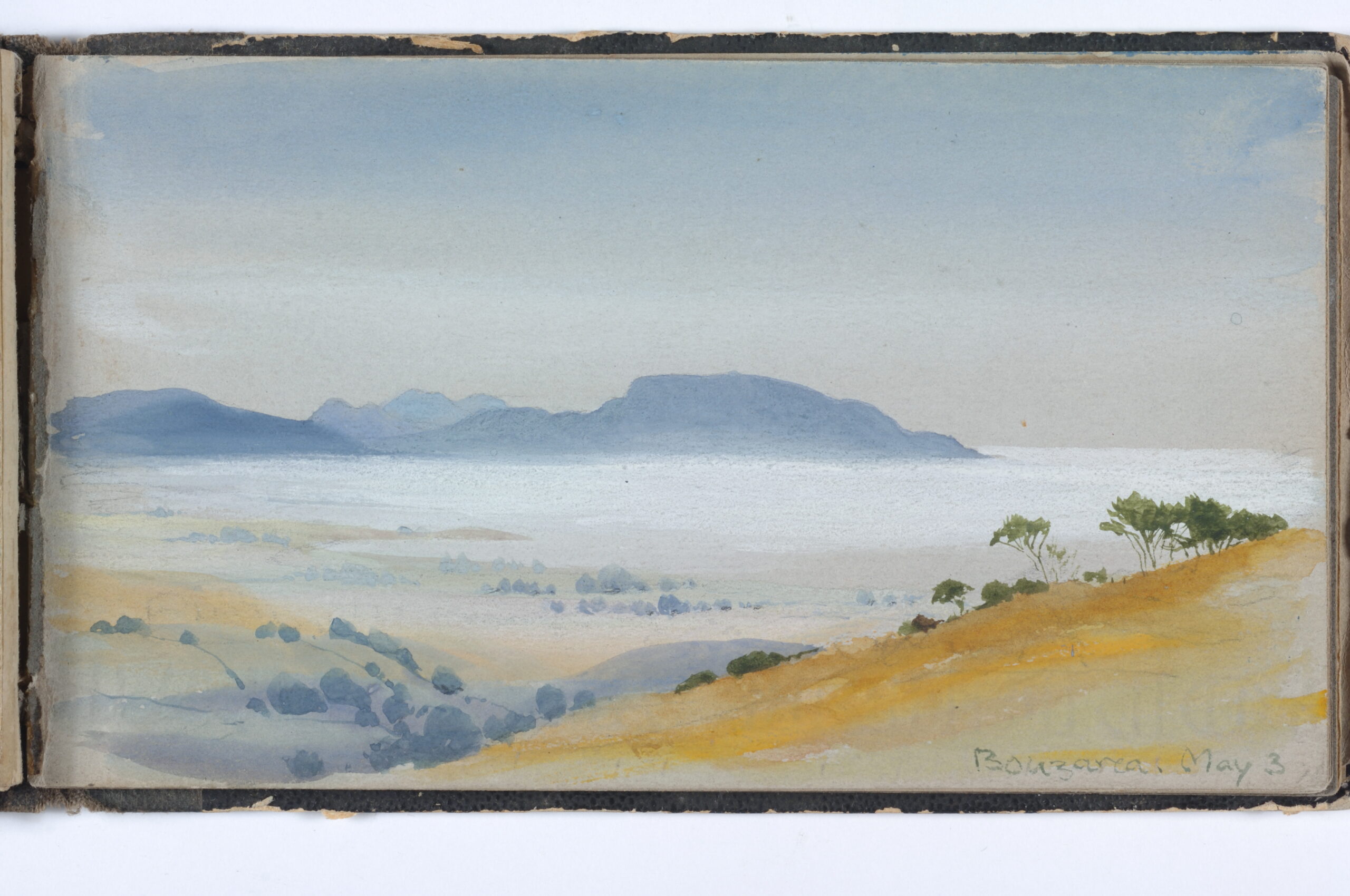
And all the while, she paints. Desert landscapes. Arab homes. Mountains and rivers and sunsets and flowers. Faces she loves. So many faces.
She spends her final four years bedridden – presiding, like a frail queen from a throne of pillows, over 30 workers at 15 mission outstations, writing and illustrating books in three languages, and coming full circle back to what her mentor John Ruskin taught her so long ago: that one of the greatest things in life is to see, and to tell what you saw.
After 40 years in North Africa, she leaves behind no church, founds no schools or hospitals, leads no great movements. And yet at the time of her death in 1928, she is considered to be not only one of the most beloved and respected missionaries of her day but “a world-wide spiritual force.” For she, like the unhistoric Sarah Smiths of the world, has dared to live a hidden life and to live it with all her heart.
After she dies, a Sufi sheik asks for a copy of a French book – though he could barely read a word it – because it includes her photograph. “Really her face, how well I remember her.”