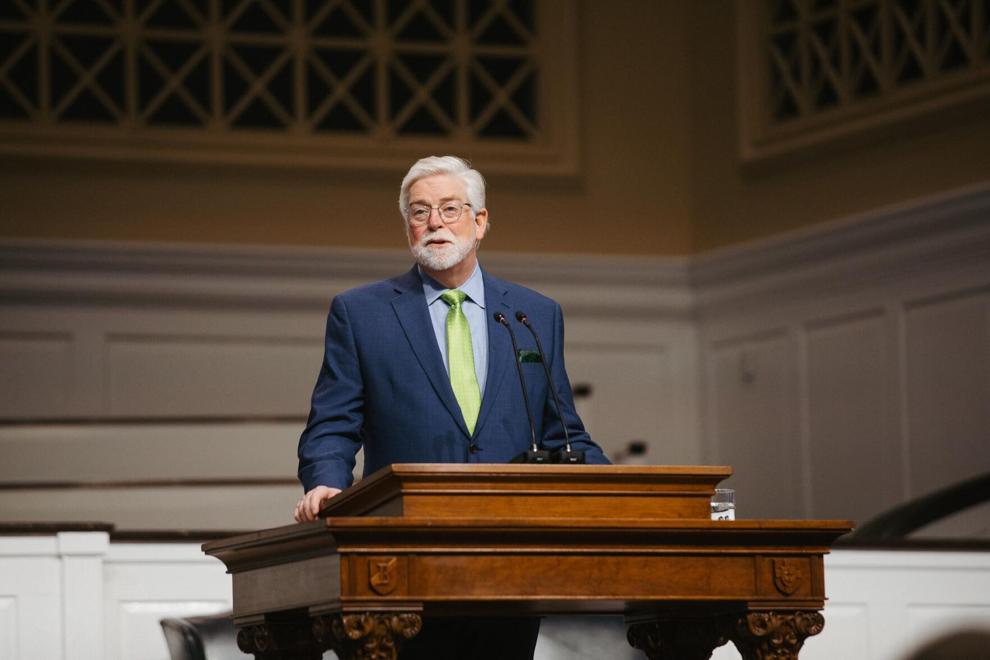

LOUISVILLE, Ky. — Two accounts from Luke 10 provided the text for Dr. Hershael York’s last chapel message Tuesday in his role as the Dean of the School of Theology at Southern Seminary.
York, who will step down from the dean position after the spring semester, will continue to be on the faculty as professor of Christian preaching. In his chapel message, he used Luke 10 to explain the clarity Jesus gives to our confused priorities — to live with the priorities of Jesus.
“It has been an incredible honor to serve the Lord and my colleagues in this role since 2018, but I am ready to return to being simply a professor,” York told Kentucky Today. “It has been an honor and the joy of my life to serve as the dean of the School of Theology — to reach a sense of completion of that task and hand it off to someone as capable and enthusiastic as Dr. Andrew Walker.”
After a year sabbatical for a writing project, he said he will return to teach at SBTS “for an undetermined length of time. I still have a delight in teaching and have a lot of doctoral students who I want to bring to completion with their degrees.
“I’ve been at Southern Seminary for 29 years, serving with Dr. (Albert) Mohler and seeing such a tremendous impact the seminary has. We’re teaching students who are serving literally across the world. For a boy from Julien, Ky. (Christian County), the Lord has been so gracious.”
York is one of the longest-serving deans of the 11 men — dating back to 1959 — who have served as Dean of the School of Theology.
He is pastor of emeritus at Buck Run Baptist Church in Frankfort, where he served for 20 years, and is currently interim pastor of Crestwood Baptist Church.
Mohler described York as being “one of the most encouraging human beings I have ever known and one of the most faithful friends anyone could know. He is encouraging in so many substantial ways, and one of the ways is the constancy of his character. He is one of the finest professors this institution has ever had,” and indicated York would be in the pulpit again at Southern, but not as dean.
Drawing from Luke 10, York told how a lawyer tested Jesus with the question “what must I do to inherit eternal life,” leading to the parable of the Good Samaritan.
“That question sounds like a sincere question, but Jesus exposes something deeper. You can assume you are right with God and be completely wrong.”

The question the lawyer did not ask was “how he can better love God. He skips past the first command to love God with all your heart, with all your soul, with all your strength, and with all your mind. He thinks he does that well enough — it is the neighbor he has trouble with. As long as we are the judge, we can always find a way to declare ourselves acceptable.
“Jesus drives home the uncomfortable point that you can be religious and consumed with keeping the law of God and completely miss His heart, refusing to love.”
York said the Samaritan “made himself a debtor” to someone he didn’t know. “This is love that binds itself to another person’s deepest needs. Jesus exposes the heart of self-justification. For the lawyer, neighbor is a noun, for Jesus it is a verb, it is what you do for someone. Holiness is not found in the temple courts, but on a dangerous road beside a broken, bleeding man.”
While that parable “shows us the true place of service, the next story shows the holy place of worship,” York noted.
“Just as you can be busy contemplating God and still miss His heart, you can be busy serving Jesus and still miss His heart.”
The story of two sisters, Mary and Martha, tells when Martha became irritated because she was busy serving while Mary sat and listened to Jesus. “She’s upset with Mary and Jesus.”
York said Jesus’ words about Mary being troubled about many things “is a description of the Christian life. When someone gets so consumed with their burden, they often don’t see the necessity of other’s burdens — but judge other people because they don’t have their burden. When Jesus demands worship and He just wants to speak to our hearts, ministry can become a distraction.”
He added that Martha wasn’t thinking about bad things and not being selfish. “Her motive (serving) is good, but she is missing the important thing. Everything else has to find its place around that one thing or else it will take its place.
“Contemplation of God without concern for people makes us conceited. Work for Jesus without worshipping Jesus makes us cranky. It’s a scary thought that so many of our churches are filled with conceited, cranky people — filled with self-justification.
“Jesus said Mary has chosen the best portion. You have to make the choice – to not be driven by many things, but by one thing, the worship of the Lord Jesus Christ, devotion to Him. Listening to Him from His word is to be the driving force of your life.
“Adoring Christ is best. Martha is living by bread alone, Mary is hanging on every word that proceeds from the mouth of the Lord.
“The only thing that is greater than service to others is adoring and listening to Jesus. Ministry often brings anxiety and troubles, but worship quiets and stills the hearts disturbed by ministry. You have to choose Christ Himself.
“Ministry can be taken away … people can live without you, but your relationship with Christ cannot be taken away. Why invest your life in something you can lose and spend so little time with the One from whose hand you can never be taken.
“You must be with Him before you can do for Him. Serving Jesus is not the same thing as sitting at His feet. Adoring Christ is better! You exchange anxiety for peace. Martha is anxious because everything depends on her. Mary is at peace because she is resting in Him.
“When your heart pounds with the thrill of His presence and your eyes tear up just to know He loves you, you will find yourself incapable of passing by the broken and hurting and wounded because you know that is what Jesus did for you. He stopped and He came to your rescue. When your service to others is fueled by your passion for Christ, that is when your priorities are in the right order.”