
LOUISVILLE, Ky. (BP) – A vote at the General Assembly of the Presbyterian Church in America (PCA) in favor of the Danvers Statement brings greater clarity to the denomination’s position on complementarianism.
The Danvers Statement is a document published in early 1988 by the Council on Biblical Manhood and Womanhood that establishes the framework for complementarianism in both the home and the church.
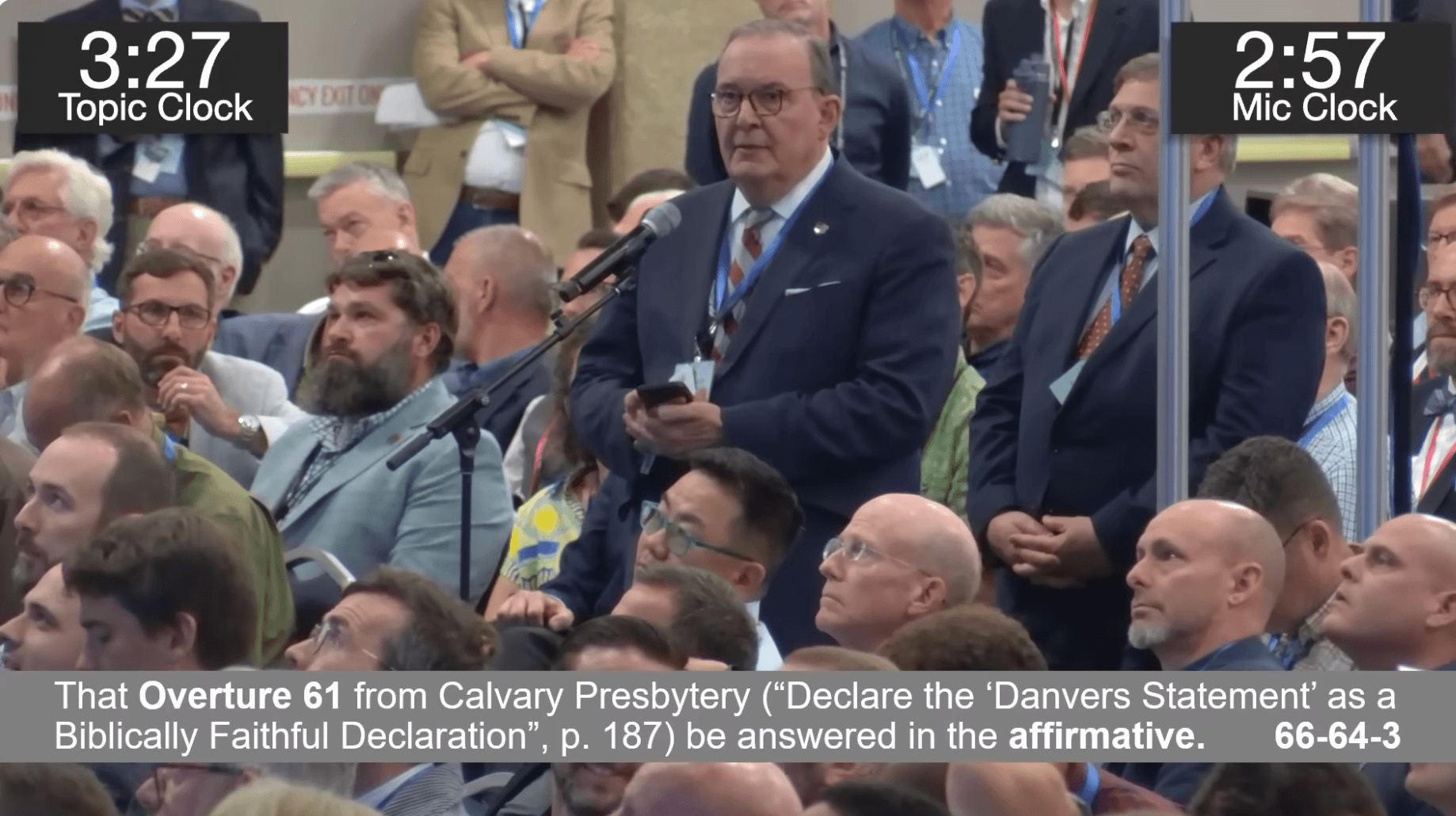
Calvary Presbytery, a body of PCA churches in 13 counties of the Upcountry region of South Carolina, unanimously adopted Overture 61 on declaring the Danvers Statement as a “Biblically Faithful Declaration” at its meeting on Feb. 7. During the general assembly on June 27, the overture passed by a 934-841-34 vote, two days after making its way out of the Overtures Committee by a slim 66-64 vote, with three absentations.
Its passage makes the Danvers Statement suitable to promote among PCA teaching materials and in the PCA bookstore.
The vote came weeks after Southern Baptists gave a two-thirds affirmative vote for the Truth and Unity Amendment. A second two-thirds approval next year in Indianapolis would make it part of the SBC Constitution.
The Danvers Statement’s three sections outline its rationale, purposes and affirmations.
Ten points in the “Rationale” section point to areas such as “widespread uncertainty and confusion” over complementarian roles as well as an “increasing promotion given to feminist egalitarianism” that disturbs “the glad harmony portrayed in Scripture between redeemed husbands and wives.” It also includes criticism of church leaders’ accommodating “the spirit of the age” rather than rely on the reformative power through the Holy Spirit.
Purposes outlined in the document include setting a biblical view of the relationship between men and women, at home and church, as well as continued study among all to apply Scripture’s teachings on manhood and womanhood.
Affirmations cover how Adam and Eve were both created in God’s image, but the Fall distorted the relationship between men and women. How redemption through Christ heals those distortions and gives equal measure to salvation, with governing and teaching roles in the church restricted to men.
“The Presbyterian Church in America is a pace-setting denomination within evangelicalism,” said CBMW President and Boyce College Professor Denny Burk. “I am grateful that they declared the Danvers Statement a faithful declaration of biblical conviction. This kind of clarity will serve their churches well. I’m also grateful that the PCA voted decisively to maintain its ordination standards for deacons. This move was crucial for maintaining complementarian integrity within their polity.”
The PCA broke away from the larger Presbyterian Church in 1973 over concerns of increasing liberalism within the denomination. Since then, the PCA has historically aligned with the Southern Baptist Convention on issues from a conservative viewpoint such as the authority of Scripture, the sanctity of human life, traditional marriage and religious liberty.