
Melson to become president of Moody Bible Institute
By SBU Staff
BOLIVAR, Mo. (SBU) —The Southwest Baptist University (SBU) Board of Trustees today announced that Rick Melson, the university’s 26th president, has accepted the call to become the next President of Moody Bible Institute in Chicago, Ill. Melson will continue serving as president of SBU until the week of Aug. 10, with the board initiating a comprehensive transition process to ensure continued momentum and stability.
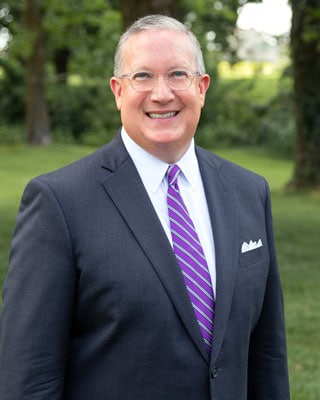
SBU’s trustees also unanimously selected Jonathon Woodyard to serve as interim president beginning the week of Aug. 10. Woodyard currently serves as Vice President of Student Development and Dean of Chapel. More details about the transition plans will be determined in the weeks ahead.
Since assuming the presidency in September 2021, Melson has led Southwest Baptist University through a season of renewal marked by enrollment growth, strategic innovation, financial strengthening, fundraising success, expanded academic opportunities, a nd a renewed focus on student success and Christ-centered discipleship.
Joe Brand, Chair of the SBU Board of Trustees, expressed appreciation for Melson’s leadership and confidence in the university’s future.
“On behalf of the Board of Trustees, we congratulate Dr. Melson on his election as President of Moody Bible Institute. While we will certainly miss his leadership, we celebrate God’s calling on his life and the influence he will have through one of the world’s most respected evangelical ministries,” Brand said. “President Melson has led Southwest Baptist University with vision, integrity, humility, and an unwavering commitment to our Christ -centered mission. Under his leadership, SBU has seen renewed momentum, improved financial health, increased enrollment, significant fundraising success, and renewed confidence in our future. We are deeply grateful for his faithful service and know that his impact on this university will be felt for many years to come.”
During his presidency, Melson worked alongside faculty, staff, trustees, alumni, churches, donors, and students to advance a student-first strategic vision that positioned the university for long-term flourishing. Among the many accomplishments during his tenure were:
- Welcoming four consecutive record-setting incoming classes, culminating in more than 1,000 new students enrolling this past fall — reversing years of prior enrollment decline.
- Developing and launching a comprehensive five-year strategic plan and a ten-year campus master plan.
- Strengthening financial health and donor support, ending the 2026 fiscal year with a balanced budget and modest margin, and achieving the highest giving year in university history, with more than $8.96 million in gifts and $10.05 million in gifts and commitments.
- Expanding academic offerings through SBU Worldwide and new graduate and online programs.
- Successfully leading the university through its Higher Learning Commission reaffirmation with no findings or concerns.
- Investing in campus life, student experience, spiritual life and chapel, and operational excellence across the university.
Reflecting on his time at SBU, Melson expressed deep appreciation for the SBU community.
“Serving as President of Southwest Baptist University has been one of the greatest privileges of my life. Tammy and I will forever cherish the relationships we have built and the extraordinary people who make this university so special,” Melson said. “God has done remarkable things over these past several years. Together we embraced a student-first vision, strengthened the university, celebrated meaningful milestones, and, most importantly, watched students grow in their faith, discover God’s calling, and prepare to impact the world for Jesus Christ.
Chinese authorities allegedly target Texas family
By Faith Pratt/Baptist Standard
DALLAS – International Christian nonprofit organization ChinaAid reported the alleged harassment of a former Chinese house church leader now living in the Dallas area.
According to the report, Zhang Mei, a former volunteer lay leader at underground house churches in Yueyang, Hunan Province, in south-central China, received recurrent threatening phone calls from Chinese authorities urging her to return to China.
Zhang told ChinaAid the calls also targeted her daughter, 27-year-old Li Dixuan, who is in the United States on a student visa. Both Li and her mother have applied for asylum in the United States. Li and her husband, Nathan Clemetson, are members of Nations Church Arlington in the Dallas area.
Authorities have also contacted Zhang’s husband, who remains in China. According to Zhang, state security officials have made similar inquiries to him.
Church members and acquaintances familiar with the family’s circumstances have advised Zhang and Li against returning to China, citing concerns they could face significant legal repercussions and threats to their personal safety.
In the report, ChinaAid President Rev. Dr. Bob Fu said: “This case demonstrates that the Chinese Communist Party’s campaign against independent Christians no longer stops at China’s borders. No family seeking safety in the United States should have to fear harassment from a foreign government.”
Separately, in a YouTube interview, Li’s husband Clemetson, a U.S. citizen, stated his wife filed a petition for withholding of removal to avoid deportation to China.
Calls follow police raids, new legislation
The harassment comes days after police carried out coordinated raids on several house churches in Yueyang, where Zhang served as a volunteer lay leader before relocating to the United States. Chinese police coordinated raids across Yueyang at approximately 7:40 p.m. Beijing time on July 11.
Those reportedly detained included Pastor Huang Lei, Elder Yang Jianjun, Teacher Yuan Shiying, church coworkers, numerous congregants, and children and teenagers participating in church activities. Several congregants who were later released said police questioned them for hours before releasing them, with some not freed until about 3 a.m. Beijing time on July 12.
The harassment also follows the implementation of China’s new law on “Promoting Ethnic Unity and Progress,” a sweeping national statute that codifies the Chinese Communist Party’s shift toward aggressive assimilation of its 55 recognized ethnic minorities.
The law aims to forge a single, shared Chinese national identity, and authorizes authorities to take action against conduct they deem harmful to “ethnic unity and progress,” raising concerns among religious freedom advocates. Passed on March 12, 2026, and enacted on July 1, the law has drawn severe criticism from international bodies, including the United Nations and the European Parliament.
Highly controversially, Article 63 asserts extraterritorial power, giving the Chinese government the legal right to penalize individuals and organizations outside of China who are deemed to undermine “ethnic unity.”