WASHINGTON (BP) – Young men are not leading a revival in religiosity, Bible reading and churchgoing in the U.S. today, Pew Research said in its latest findings, bucking 2025 reports from other top researchers.
“Our recent polls, along with other high-quality surveys we have analyzed, show no clear evidence that this kind of nationwide religious resurgence is underway,” Pew said Dec. 8, referencing several years of data since 2020. “On average, young adults remain much less religious than older Americans. Today’s young adults also are less religious than young people were a decade ago. And there is no indication that young men are converting to Christianity in large numbers.”
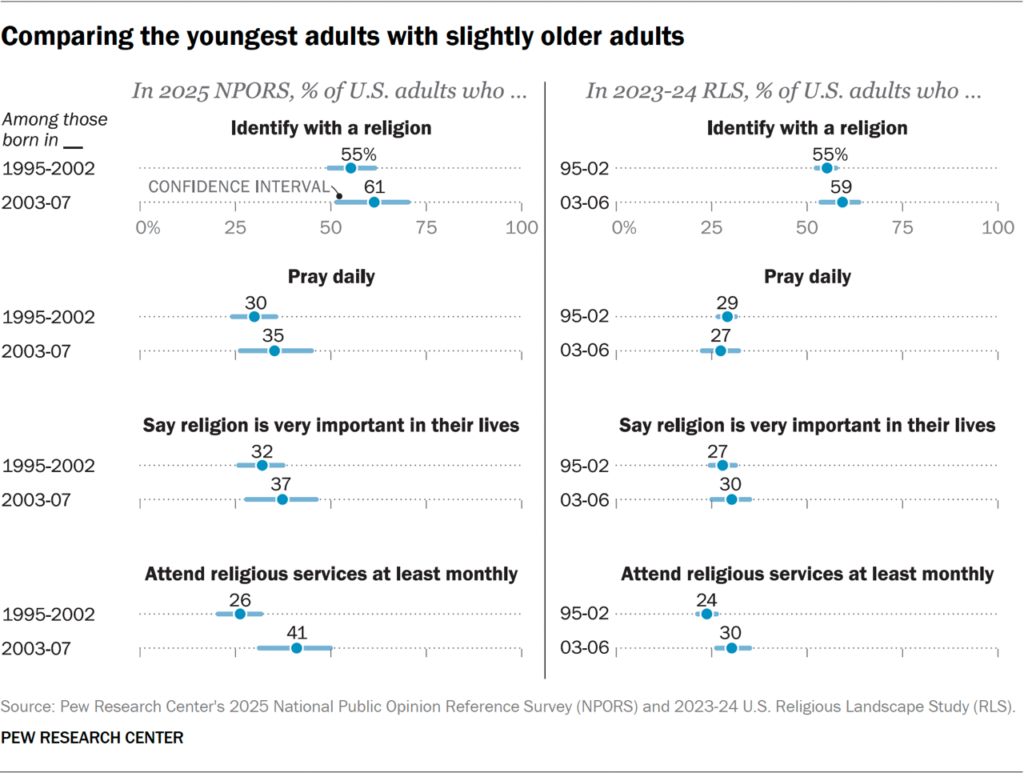
By the numbers, 32 percent of 18- to 30-year-olds told Pew they pray daily, compared to 49-to 59 percent of those born in 1965 and earlier; 33 percent of the younger group said religion is very important to them, compared to 53-55 percent of the older group; and 31 percent of the younger ages attend religious services at least monthly, compared to 36-43 percent of the older. The numbers have been fairly steady since 2020, Pew said.
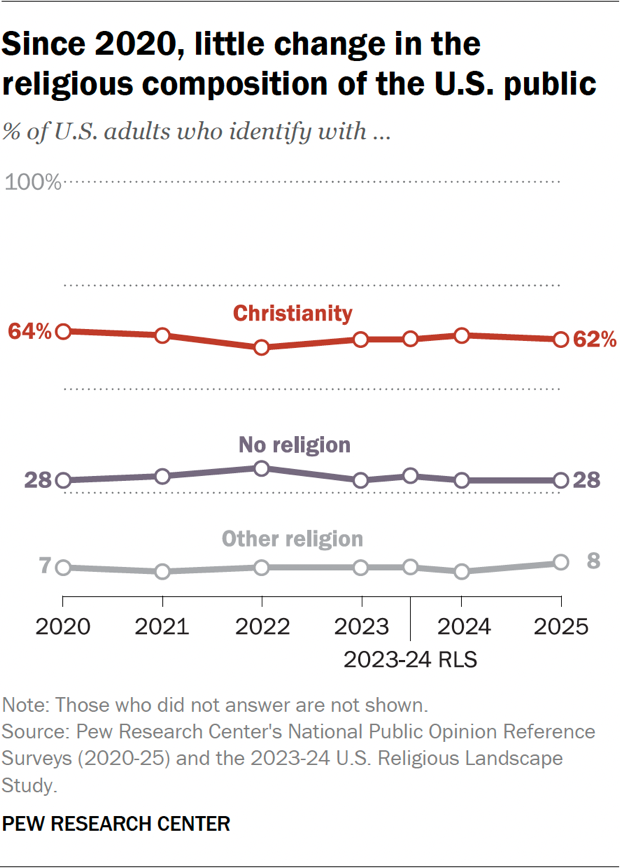
“The recent stability is striking because it comes after a prolonged period of religious decline,” Pew said. “For decades, measures of religious belonging, behaving and believing had been dropping nationwide.”
Pew’s conclusion is contrary to 2025 State of the Church and State of the Bible findings.
In November, State of the Church reported a 12-point resurgence in weekly Bible reading in the U.S. after a 15-year low, with Millennial and Gen Z men leading the way. The report followed State of the Church’s September report that for the first time in decades, Gen Z and Millennials are attending church more frequently than older adults.
The American Bible Society (ABS), in the April release of Chapter 1 of its 2025 State of the Bible, described 41 percent of U.S. adults as Bible users, indicating a 3 percent rise from the previous year. Millennials led the way, SOTB said, and men were the leaders in every generation. State of the Bible defines Bible users as people who independently consult Scripture at least three times a year.
“This year’s State of the Bible research shows a renewed interest in Scripture in our culture, marked by a notable uptick in Scripture engagement and Bible use — driven especially by men and young adults,” John Plake, ABS chief innovation officer and State of the Bible editor-in-chief, said Dec. 5 in reviewing the year’s findings. Yet despite a 9-point increase in Bible use among Millennials – 39 percent in 2025 compared to 30 percent in 2024 – the generation still trailed Boomers, who registered at 45 percent in 2024 and 46 percent in 2025, State of the Bible said.

In refuting the reported trend, Pew acknowledged the possibility of changes that are too small to impact national findings, and said younger generations are indeed experiencing shifts.
“For example, young men are now about as religious as women in the same age group,” Pew said, marking a notable change from when young women tended to more religious than male counterparts. “However, this narrowing of the gender gap is driven by declining religiousness among American women. It is not a result of increases in the religiousness of men.”
Pew relied on findings from its annual National Opinion Surveys from 2020-2025, its National Public Opinion Reference Survey and its 2023-2024 U.S. Religious Landscape Study of more than 35,000 adults.
Read Pew’s report here.
Related posts:
 Trump taps N.C. congressman, pastor for top religious freedom post
  Southern Baptist Churches in the News
  District court strikes down Title IX change that would change meaning of ‘sex’
  James Dobson, Focus on the Family founder and family values advocate, dies at 89 America awaits justices’ action on same-sex marriage
  Barrett confirmed; SBC leaders focus on prayer
  Americans judge the Good Book more positively, but still often by its cover
  West Virginia transgender sports ban discriminates against teen athlete, appeals court says