
BRENTWOOD, Tenn. — Regular small group participants are likely to be among the most mature disciples in a church, but they still need encouragement in some areas.
According to the latest analysis of Lifeway Research’s State of Discipleship study, U.S. Protestant churchgoers who regularly attend a small group Bible study, such as Sunday School, have the highest discipleship scores.
Those who attend a small group five times or more each month (74.1) and those who attend three to four times (72.4) have higher scores in the discipleship assessment than those who attend once or twice (67.2) and churchgoers who do not participate in small groups at all (60.4).
Across eight signposts that highlight characteristics consistently present in the lives of believers progressing in their spiritual maturity, those who participate in a small group five times or more a month have the highest scores in four signposts and among the highest in two others.
“The value of small groups is seen in higher levels of evangelism, service, giving, disciplines and relationships among those who regularly participate in small groups of adults from church compared to those who don’t,” said Scott McConnell, executive director of Lifeway Research. “Americans like to do things themselves, but that isn’t the biblical pattern for following Christ.”
Ken Braddy, director of Sunday School at Lifeway, said those participating in small groups are in environments where the key behaviors of spiritual growth are practiced consistently. “The reason is not simply that people are attending another church event,” he said. “Small groups create the conditions where discipleship flourishes.”
Areas of strength for small group participants
If someone attends small group frequently, they’re also likely to attend worship services and serve in their congregations. Churchgoers who participate in small groups at least five times in a month say they’re at worship services 9.1 times in a typical month, more than any other group. They are also among the most likely to have regular responsibilities in their congregation (48 percent) and to serve their community with a ministry outside of their church (41 percent).
Not only are small group attendees active participants at church, but they also seek to make their faith a priority outside the church walls. More than others, those who attend five times a month or more say they’ve made decisions to obey or follow God, with an awareness that choosing His way might be costly to them (13.8 times in a typical month).
Those who participate in church small groups at least five times each month have the highest scores in building relationships (80.5), engaging the Bible (79.4), serving God and others (78.6) and sharing Christ (69.7). And, along with those who attend three to four times a month, those who attend at least five times each month have the highest scores in seeking God (81.9) and obeying God and denying self (79.1).

“In a healthy group, people study and discuss Scripture together, receive encouragement and accountability, pray for one another, serve alongside one another and build meaningful relationships,” said Braddy. “These experiences move discipleship from information to transformation. In short, worship services inspire discipleship, but small groups personalize it.”
Additionally, those who more frequently attend church small groups are the most likely to engage every day in numerous other Christian habits such as studying the Bible themselves (31 percent) and listening to or reading teaching about the Bible (38 percent).
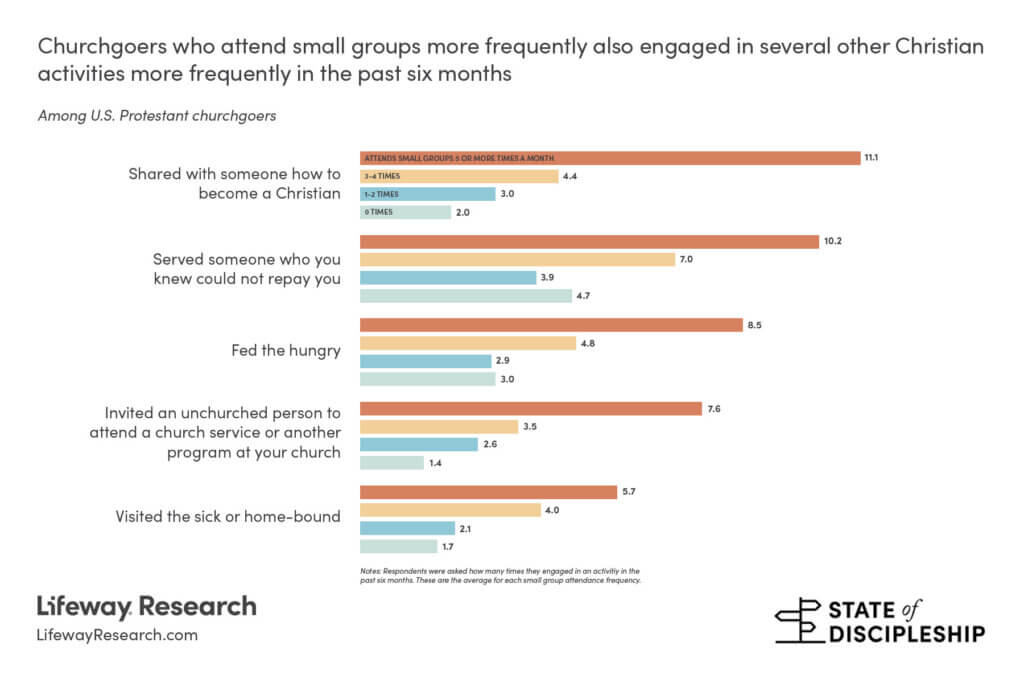
In the past six months, they have most frequently shared with someone how to become a Christian (11.1 times), invited an unchurched person to a church service or program (7.6 times), fed the hungry (8.5 times), visited the sick (5.7 times) and visited those in prison (3.6 times).
The most frequent small group attendees are the most likely churchgoers to have participated in a mission trip both in the United States (44 percent) and internationally (33 percent). They are also the most likely to have been discipled one on one by a more spiritually mature Christian (63 percent) and to have done that type of individual spiritual mentorship themselves (54 percent).
“Groups provide a smaller community where believers can practice obedience, apply biblical truth, receive accountability and experience genuine care,” said Braddy. “Healthy groups should do more than discuss biblical truths; they should give members opportunities to practice them.”
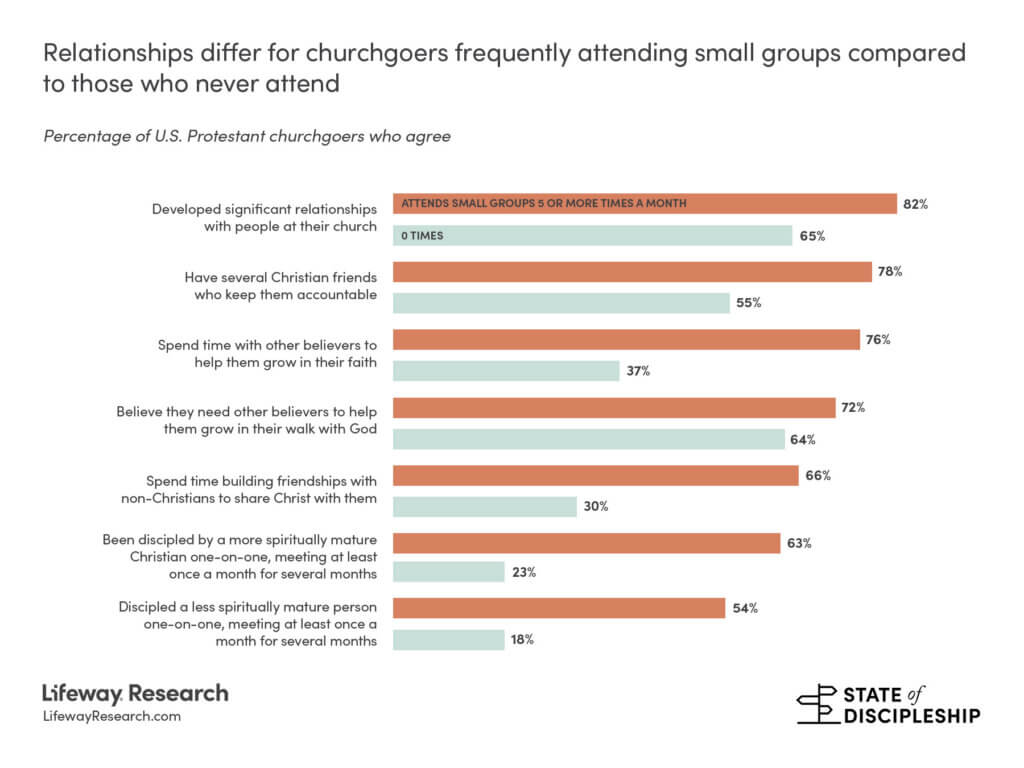
By contrast, those who say they never participate in a small group attend worship services 3.9 times per month on average. They are also the least likely to have invited someone to church in the past six months (1.4 times compared to 7.6 times for those who attend five times or more). And they are the least likely to have regular responsibilities at their church (16 percent).
Those who never attend have the lowest scores in obeying God and denying self (69.4), serving God and others (66.4), engaging the Bible (59.8) and sharing Christ (41.1, the lowest score for any attendance group across the signposts).
Compared to their fellow churchgoers, those who don’t participate in small groups are the least likely to say they regularly ask God to help them love all people (72 percent), follow their pastor’s teaching from the Bible (74 percent), adjust other priorities to keep God first (58 percent) and seek justice for those who need it (60 percent).
One of the most significant impacts of not being in a small group is seen in relationships. Compared to those in groups five or more times a month, those not in groups report significantly lower involvement in biblical community. They are far less likely to have developed significant relationships with people at their church (65 percent v. 82 percent), have several Christian friends who keep them accountable (55 percent v. 78 percent), or believe they need other believers to help them grow in their walk with God (64 percent v. 72 percent). Half as many spend time with other believers to help them grow in their faith (37 percent v. 76 percent) or build friendships with non-Christians for the purpose of sharing Christ with them (30 percent v. 66 percent).
“Not everyone is looking for relationships or has the people skills to easily form relationships, but healthy small groups should welcome and include those people as well,” McConnell said.
“Many people who are in small groups may not realize how essential relationships with other believers are to their spiritual walk. Jesus wants believers to follow Him together, encouraging and helping each other along the journey.”
Other attitudes and activities across the discipleship signposts, however, suggest those who are frequent small group participants could still use some help in their Christian journey.
Areas small group participants need encouragement
In general, the more someone attends small group Bible studies at their church, the higher they score on the discipleship assessment. Two signposts, however, are the exception: exercising faith and living unashamed. In those two, there is no correlation between attendance and scores.
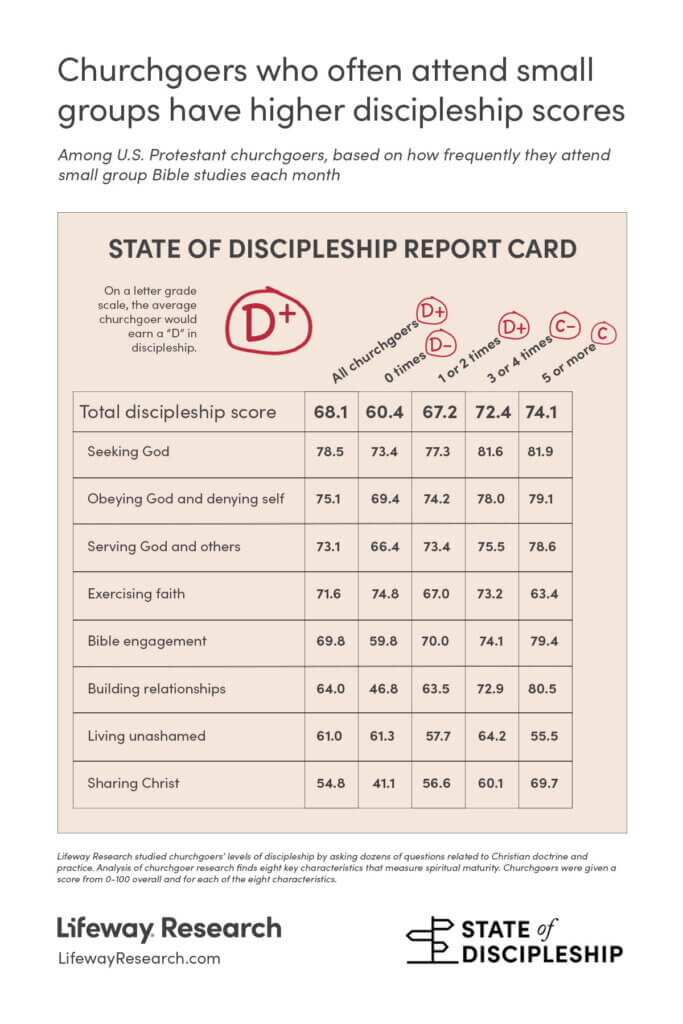
In exercising faith, those who attend five times a month or more (63.4) and those who attend once or twice (67.0) have the lowest scores, while those who attend three to four times (73.2) and those who never attend (74.8) have the highest.
Similarly, in living unashamed, those attending at least five times (55.5) and those attending once or twice (57.7) have lower scores than those never attending (61.3), and those attending three to four times (64.2) have the highest scores.
“Most of the signposts include a good mixture of questions on beliefs, desires and actions. The living unashamed and exercising faith signposts focus on one’s dependence and identification with Christ and only ask at a summary level about actions such as telling others you are a Christian, doubting God or needing God’s help,” McConnell said.
“It is likely these two signposts don’t improve with each higher frequency of small group involvement because frequent group attendees may evaluate themselves more critically, and those who don’t attend groups may generalize they do these things decently.”
Churchgoers who attend small groups at their church five times a month or more are among the least likely to say they want to learn and be reminded of truths in the Bible (83 percent).
Additionally, when asked about life after death, those who attend small group the least are closer to the historic orthodox Christian belief than those who attend the most. Those who attend five times a month or more are more likely than those who never attend to say they will go to heaven because they have tried to be a good person and live a good life (17 percent v. 11 percent). The most frequent attenders are less likely than the least frequent attenders to say they will go to heaven because they have confessed their sins and accepted Jesus Christ as their Savior (63 percent v. 70 percent).
“Frequent participation in a small group is a helpful contributor to discipleship and should be encouraged,” McConnell said. “However, a perfect attendance record does not indicate a perfect disciple. Pastors and small group leaders must assume there are always attendees who need to surrender to Jesus Christ for salvation or to bring an area of their life in line with Jesus’ teaching.”
Braddy says certain aspects of discipleship require more intentional cultivation, and groups can build accountability into their practices to help members move from learning about their faith to exercising it.
“A healthy small group ministry is not measured primarily by how many groups it has or how many people attend them,” he said. “It is measured by whether those groups are producing disciples who increasingly look like Jesus and help others do the same.”
For more information, visit LifewayResearch.com/Discipleship.
Methodology
The online survey of 2,130 Protestant churchgoers was conducted March 19-26, 2025, using a national pre-recruited panel. Respondents were screened to include those who identified as Protestant/non-denominational and attend religious services at least once a month. Respondents could complete the survey in English or Spanish. Quotas and slight weights were used to balance gender, age, region, ethnicity, education and denominational affiliation. The completed sample is 2,130 surveys. The sample provides 95 percent confidence that the sampling error from the panel does not exceed plus or minus 2.21 percent. This margin of error accounts for the effect of weighting. Margins of error are higher in subgroups.
Additional analysis was done to compare across attendance rates at small group Bible studies at church. The four groups compared are those who attend five times or more a month, those who attend three or four times a month, those who attend once or twice a month, and those who do not attend at all.