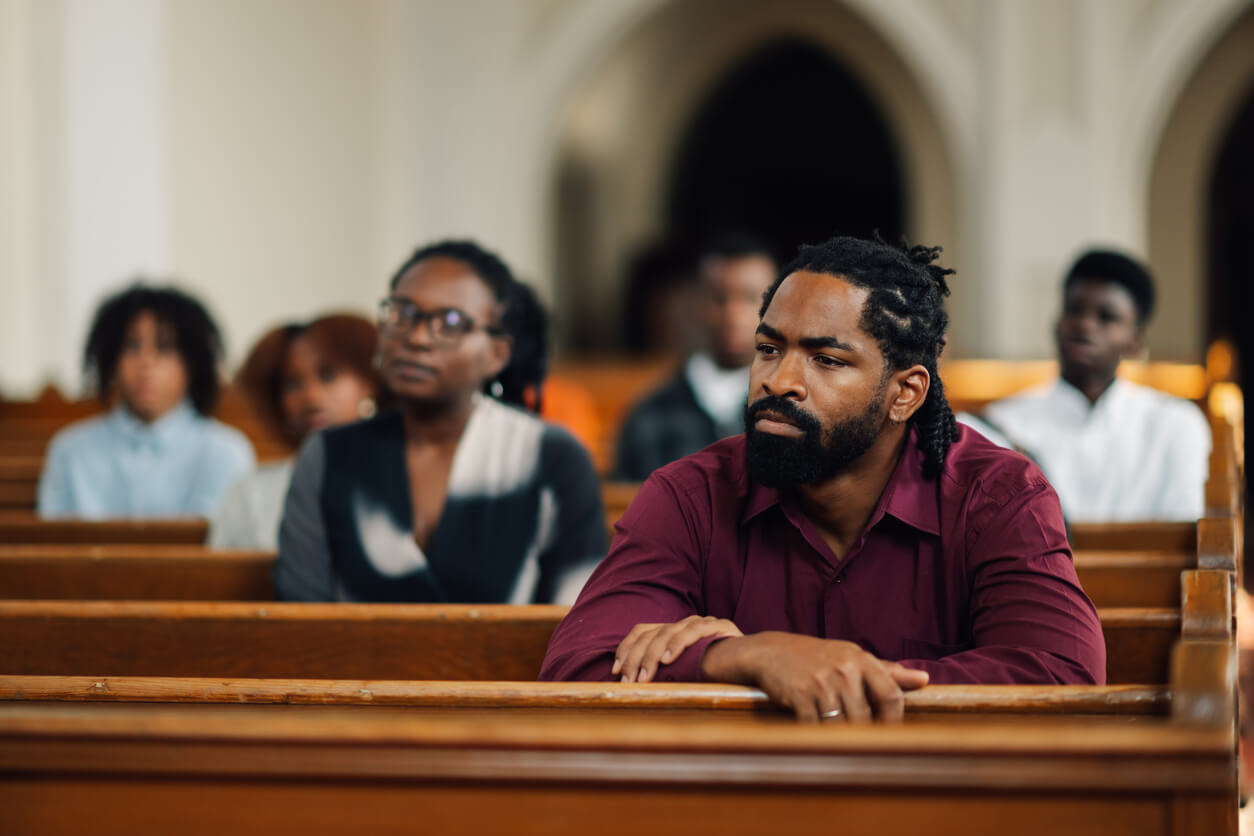
6 steps to eliminate confusion for unchurched in your worship services
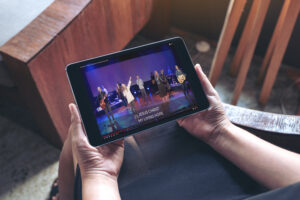
We almost can’t help ourselves. When we gather with a group of friends or people who share something in common, we often start talking in a way that excludes others.

We almost can’t help ourselves. When we gather with a group of friends or people who share something in common, we often start talking in a way that excludes others.

Adobe Stock Photo. Do not publish.
Vision is not measured by statements on a wall. Vision is revealed by how a church operates, evaluates ministry, and envisions the future.

Adobe Stock Photo. Do not publish.
Youth and student ministry have a robust history in Southern Baptist and evangelical circles, and rightly so. But, if you reach the children, eventually you will also grow a thriving youth ministry, as those sweet kids grow into teenagers.

Adobe Stock Photo. Do not publish.
There are only two ways to do local church evangelism – come and see or go and tell. Every church has a “come and see” strategy as it gathers on Sunday morning, posts its service times and welcomes guests to come and hear the Gospel.

What if God wants us to pray for more? Most of us believe we should pray more, but should we pray for more? In other words, is our prayer list too thin?
Are you motivated to pray? The word “motivation” doesn’t appear in older dictionaries since it wasn’t coined until the mid-19th century and didn’t come into common use until the 20th century.
It’s tempting to imagine that legendary ministers like E. M. Bounds or Andrew Murray or someone known as “Praying Hyde” were simply born to pray. Along with the likes of David Brainerd, Leonard Ravenhill, Armin Gesswein, Bertha Smith, George Müller and so many others, there is a group of Christians who are primarily remembered for their prayer lives or their teaching on prayer. But no one was ever born praying. The men and women most known for prayer were not members of a spiritually elite corps the rest of us weren’t invited to join. They learned to pray.
Ronald Reagan once humorously repeated a story often referred to as the “Texas Sharpshooter Fallacy.” The tale involves shooting a gun at a barn, then painting “bull’s-eyes” around the bullet holes. For the uninformed, the aftermath makes the shooter appear to be an expert marksman, when in reality he only managed to hit the side of a barn.
The 20th century political anarchist Edward Abbey loved the desert and once observed, “What draws us into the desert is the search for something intimate in the remote.” Abbey was not the only person who discovered intimacy in the solitude of the desert. The same could be said for some of the most influential people of prayer mentioned in Scripture. God originally created man in a garden, but He frequently recreates them in a desert.
Whether you fast one day, one week, one month, or longer, the goal of fasting is to disconnect from worldly distractions and prayerfully seek God. During your fast, indulge deeply in the reading of Scripture and longer seasons of private prayer. In addition, any opportunity to join with other believers in heartfelt praise, worship, and singing to the Lord will strengthen you spiritually.
The baseball legend Yogi Berra offered humorous and seemingly contradictory advice when he said, “When you come to a fork in the road, take it.” All of us come to proverbial “forks in the road” when the choices we should make or the directions we should take are not immediately obvious.
The late Tom Petty was right: "The waiting is the hardest part." Unfortunately, even prayer frequently requires waiting. The trouble is, we’re not patient. In fact, Americans are so impatient that recent studies can pinpoint what we’re most impatient about and how long it takes for us to grow agitated when waiting.
The 20th century was witness to some remarkable lives, but few were so universally admired as the Albanian nun known as Mother Teresa of Calcutta, India. Her work with the poorest and the most vulnerable people on earth gave her a moral authority rarely seen in modern Western culture.
Reading books on prayer is an important way to motivate your own prayer life. Since this is true, which ones should you read? Rather than merely reviewing titles, let’s look at some categories.