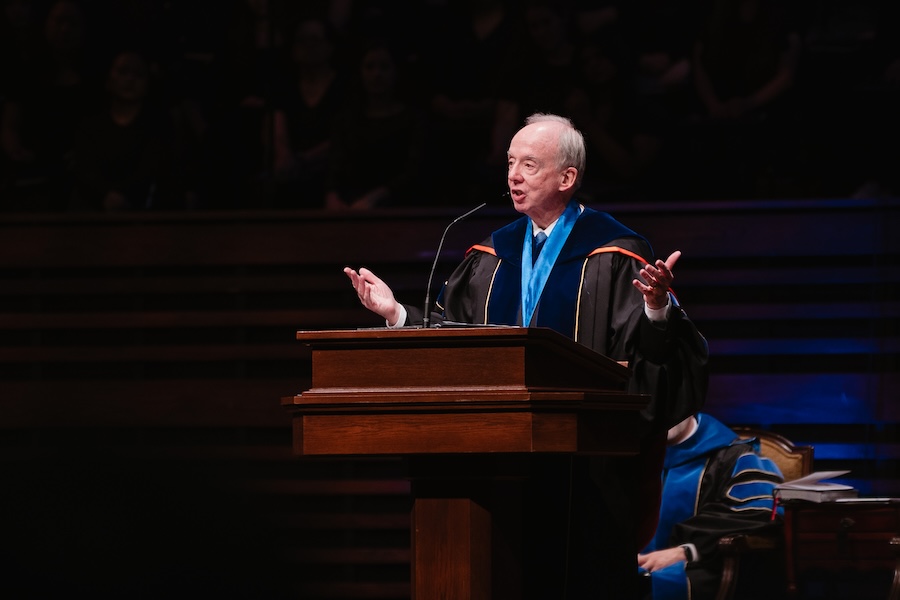

FORT WORTH, Texas — President David S. Dockery in recent years has used convocation addresses each new semester at Southwestern Baptist Theological Seminary to speak about the institution’s heritage, leaders who shaped its theology, its core values and what it means to be a “Southwesterner.”
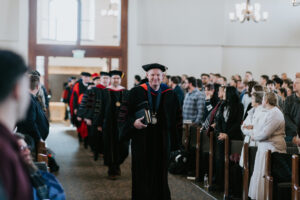
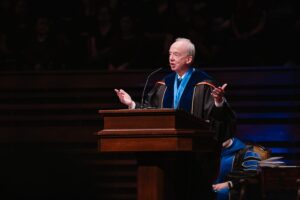
During his Jan. 20 Convocation address launching the spring 2026 semester, Dockery gave the Southwestern community practical examples of how to live as a follower of Christ and a Southwesterner through worship, a Christian worldview, work and service.
“Over the past three years, we’ve worked very hard to use convocation to help us understand the identity of Southwestern Seminary, to understand its history, to understand our mission, to understand our theological commitments, to understand our core values, and how these all work together as students, staff and faculty,” Dockery said, pointing out the value in understanding one’s history. “… Today, however, we want to try to build on those addresses by reflecting on our vision for theological education at Southwestern with application for our hearts, our heads and our hands.”
Dockery said these applications are the steps that should come after understanding the history, core values and identity of Southwestern Seminary. But that response must involve the entirety of the heart, head and hands, and not just part of that whole.
“We want to avoid the trap of separating head knowledge from heart knowledge, of driving a wedge between faith and knowledge, between revealed truth and observed truth, between fact and value,” Dockery said. “Sadly, this separation, this distancing, is what characterizes so much of higher education and characterizes our entire contemporary context.”
He quoted legendary Southwestern theology professor W.T. Conner, who said worship “is the first business of the church.” While the seminary is not a church, Dockery said it is a Kingdom entity with the goal of serving the Church, and so worship must remain at the heart of the institution’s identity.
“When genuine worship takes place, the entire body of Christ, or in our case the entire campus, is enhanced and built up,” Dockery explained. “Moreover, service and outreach are strengthened. The people of God who have worshiped Him are mutually strengthened and prepared to enter the world to touch lives, to meet needs, to counsel hurts, to speak to injustices, and ultimately to bear witness, to proclaim the saving message of the Gospel of Jesus Christ.”
While there are many different forms and styles of worship, Dockery said worship should always be grounded in Scripture with the goal of declaring the worth of God with voices, minds and hearts.

With a heart focused on worship, he said believers will then have the perspective to think rightly of the world, seeing it through the lens of God’s revelation of Himself in Scripture. This Christian worldview allows individuals to counteract the secular worldview that is often marked by a lack of morality, accountability, charity and eternal perspective.
Dockery said the Christian worldview is not just a personal point of view but encompasses every aspect of one’s life as it is shaped by Scripture and Christian doctrines.
“Such a worldview shapes our view of education on this campus,” Dockery said. “It means that the faculty and students should be better teachers and learners because our motivation for learning is different, and staff be more effective in carrying out their work because our call to service is shaped by the truths that underline this Christian worldview.”
This Christian worldview transforms both why and how believers conduct their lives, whether in education, business or daily living, and leads to seeing work and acts of service as a calling from God and a way to bring God glory.
“Our work is more than a job, it’s a calling, an act of God-honoring service,” Dockery said. “Work is not something to be avoided, it’s how we carry out God’s calling on our lives. And we have been invited by God to serve the world and to serve the world with gladness and to serve the people in the world that God Himself created in His very own image.”
Although work has been affected by sin in the world, he said Christian tradition has affirmed it is divinely ordained, noting Martin Luther’s emphasis on vocation as a calling for all Christians.
For seminary faculty and staff, Dockery said, “Our vocation, then, is not so much work as it is an extension of our worship.”
For students at Southwestern, Dockery said much of their current vocation in service to the Lord is their studies.
“Study is not just for you, it’s not just for the self, it’s not just a means so you can better find a way to support yourself,” Dockery encouraged. “But it’s a means to serve God in the decades ahead, and to use this learning process now so that you’re able to do that for years to come.”
But in all areas of service, Dockery said work for God needs to be done with excellence, gratitude, preparation, without arrogance and while remembering that giftings are from God and work itself is a gift from God, and all honest professions are deserving of honor.
“We are to carry out our work and service, that has been shaped and informed by the worship of God and by God’s revelation to us in His Word, doing so with the right motivation to honor the Lord in all things, bringing together hearts, heads, hands in a beautiful symphonic manner for the good of this institution,” Dockery said.
Following a tradition begun by Robert E. Naylor, Southwestern’s fifth president, Dockery welcomed new students during the Convocation service, pronouncing them “Southwesterners.”
“To be a Southwesterner is a very special privilege. It is a great blessing,” Dockery said to first-semester students. “It puts you in a stream of history that has been part of Texas Baptist life and part of Southern Baptist life in the evangelical world since 1908. Over 50,000 graduates have gone from this place to serve the Lord in this country and around the world and you now are a part of that heritage.”
Dockery also recognized former faculty members who had been honored prior to the service for at least 20 years of teaching and leadership at Southwestern with portraits that will be hung around the campus.
The Convocation address in its entirety can be viewed here.
Related posts:
 Bradford appointed dean of Texas Baptist College
  SWBTS to vote on presidential nominee Feb. 26-27
  YEAR IN REVIEW: Southwestern celebrates with gratitude God’s blessings in 2024
  Southwestern Seminary community sees answers to prayer during 2023
  Dockery encourages community among Southwesterners in convocation address
  Patterson, SWBTS, Roe attorneys argue before 5th Circuit panel
  2 Southwestern professors identified as not signing SBC beliefs statement
  Southwestern Seminary sees God’s ‘favor’ in 2022, Dockery says