
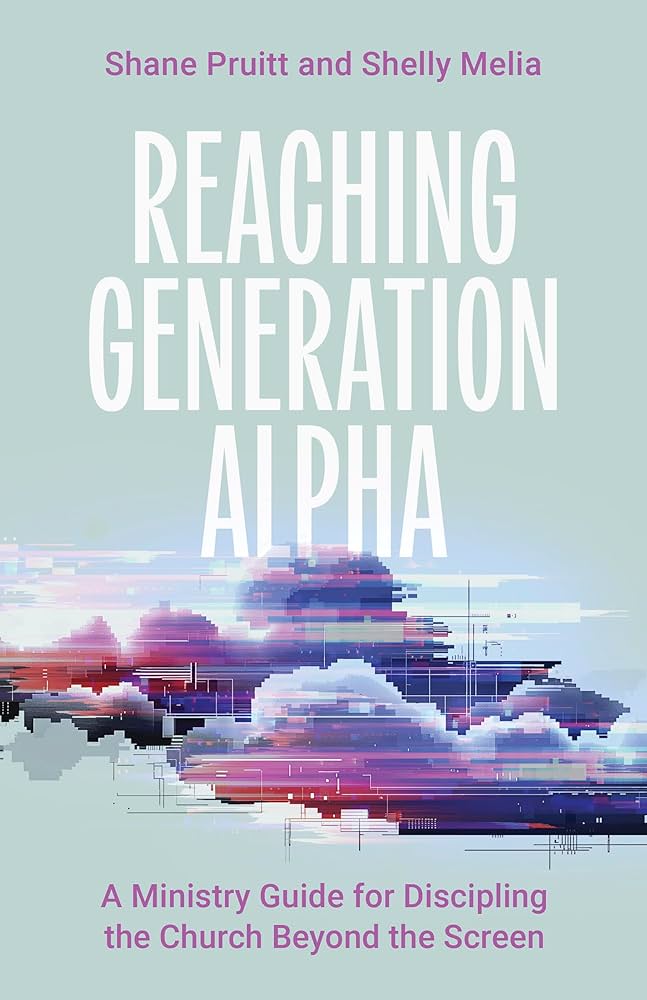
Editor’s note: The following is an excerpt from “Reaching Generation Alpha: A Ministry Guide for Discipling the Church Beyond the Screen,” by Shane Pruitt and Shelly Melia, released this week from B&H Publishing.
More important than a perfect parent, Gen Alpha needs parents who model authentic faith, who are willing to pass on their faith to their children, and are intentional in engaging them in conversations about hard issues with truth and grace.
Passing on the faith from generation to generation is one of the highest callings.

While perfection is not the goal (nor is it even possible), parents and guardians need to be encouraged to embrace their high calling to disciple their children. Christian parents want their children to have a personal relationship with Jesus Christ, and many parents look to the church to take the lead. In a 2022 Awana study, when parents were asked where discipleship should take place, just 49 percent said it should happen at home, with 51 percent saying it happens at church.1 Ironically, in that same study, when children’s ministers were asked the same question, 95 percent said it should happen at home, while only 5 percent said it should happen at the church. While both of these answers should be correct and work in unison with one another, there is clearly a miscommunication between ministers and parents over expectations.
There was also an important question asked about “the primary reasons why some children leave the faith by the time they become adults?” Forty-nine percent of children’s ministers said that children leave the faith because parents and guardians did not model discipleship to them at home, while 30 percent of parents said it was because children never felt a sense of belonging in a church home.2 Instead of pushing blame or responsibility off on each other, churches and parents should work together in discipling the next generation. This is the healthiest and most effective scenario for any child.
Christian Smith, a well-respected researcher in how faith is passed on from one generation to another, points to parents as the most effective disciple-makers: “What makes every other influence pale into virtual insignificance is the importance (or not) of the religious beliefs and practices of American parents in their ordinary lives – not only on holy days but every day, throughout weeks and years.”3 While the church can play a significant role, the influence of parents on their own children is absolutely crucial.
Deuteronomy 6 (The Shema) contains the command and the method for passing the faith from generation to generation:
“Listen, Israel: The Lord our God, the Lord is One. Love the Lord your God with all your heart, with all your soul, and with all your strength. These words that I am giving you today are to be in your heart. Repeat them to your children. Talk about them when you sit in your house and when you walk along the road, when you lie down and when you get up. Bind them as a sign on your hand and let them be a symbol on your forehead. Write them on the doorposts of your house and on your city gates.” – Deuteronomy 6:4-9
The Shema calls parents to a lifestyle of discipleship, but parents are not expected to do this alone. Moses is giving this command to all of Israel, and there is an understanding that the community of faith (Israel) is part of the plan for discipling the next generation. So, parents should look to the church (their community of faith) as a partner, and the church cannot push discipleship back to the home or retreat from the intergenerational (all hands on deck) responsibility to pass the baton to the next generation.
It’s easy for a ministry leader to post on social media or declare from the stage at a conference that “parents should be the primary disciplers, pastors, and ministers to their own kids.” Of course, this statement has strong validity, but the question remains, “How are parents and guardians being discipled, so that they can become disciple-makers themselves?” We have rarely ever heard a Christian parent or guardian retort, “Nah, I’m not interested in discipling my own kids!” Nearly every single time, they say instead, “I know I need to be discipling my kids. I want to! I just don’t know what to do, or where to start.” This is where families and the Family of God can work in tandem to invest in the souls of young people.
Parents and guardians should be discipling their own children, but the church should also be discipling the parents and guardians. How can we expect a whole generation of adults to disciple the next generation of young people if they have never been discipled themselves? The most effective children’s and student ministries are the ministries that are also empowering, equipping, and discipling parents and guardians. The church should be laser-focused on being more and more effective at doing this.
1Children’s Ministry in a New Reality: Building Church Communities That Cultivate Lasting Faith (Ventura, CA: Barna Research Group, 2022), 34.
2Children’s Ministry in a New Reality, 35.
3Christian Smith, “Keeping the Faith,” First Things, May 1, 2021, https://firstthings.com/keeping-the-faith/.