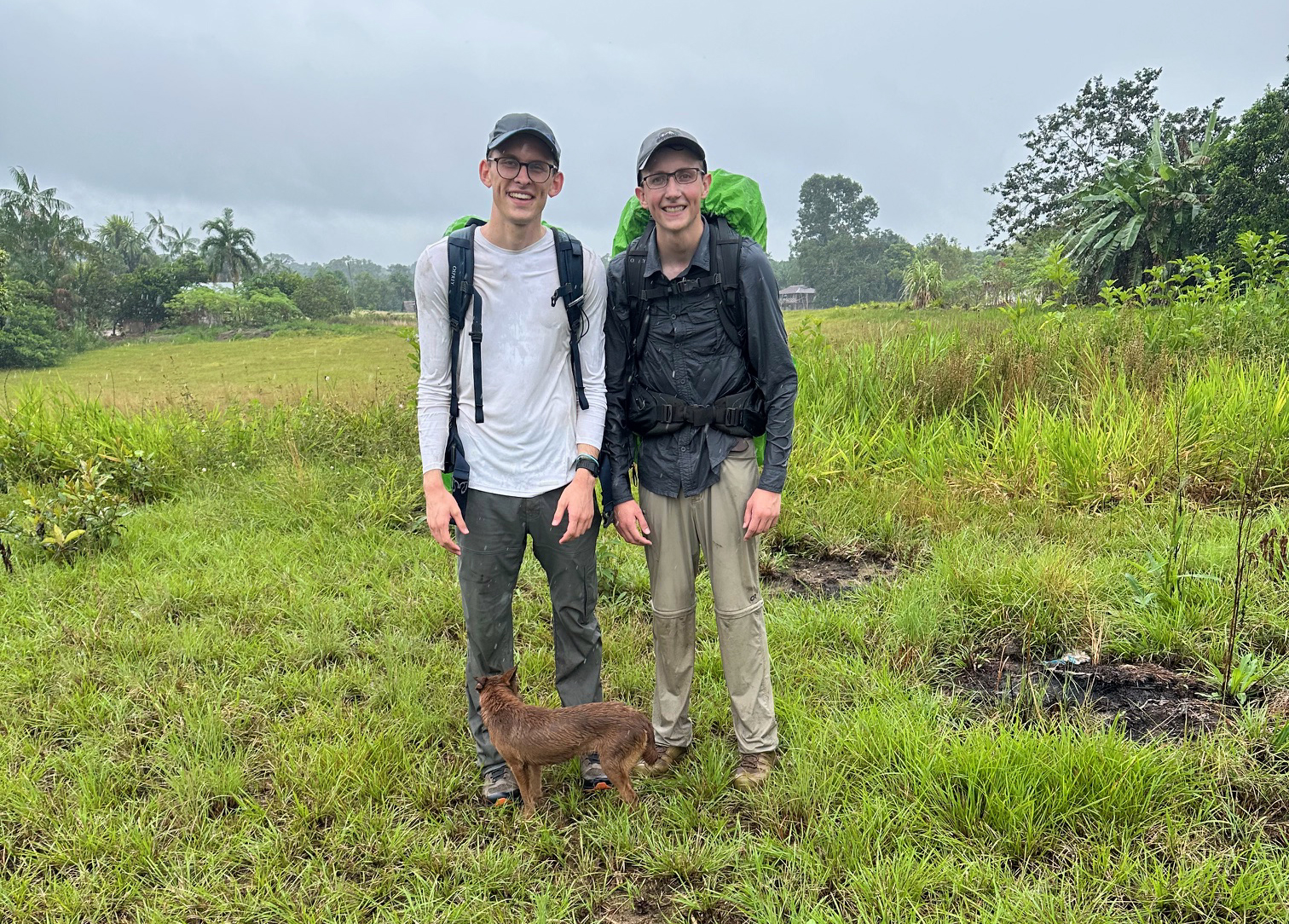

Colson Brooks learned the importance of taking just one step during the two years he spent as a Missionary Explorer for the International Mission Board.
He and his partner Missionary Explorer Caleb Spannagel – they returned home unscathed this summer – took countless steps as they traversed Colombia and Peru, searching for unengaged, unreached people groups, but each time it was just one step at a time.
“You don’t have to know all the details to take the first step,” Brooks told Baptist Press, referring to Psalm 119:105, Your Word is a lamp to my feet; a light to my path. (NASB) “A lamp gives just enough illumination for the next step. You just have to trust Him to guide you each step of the way.”
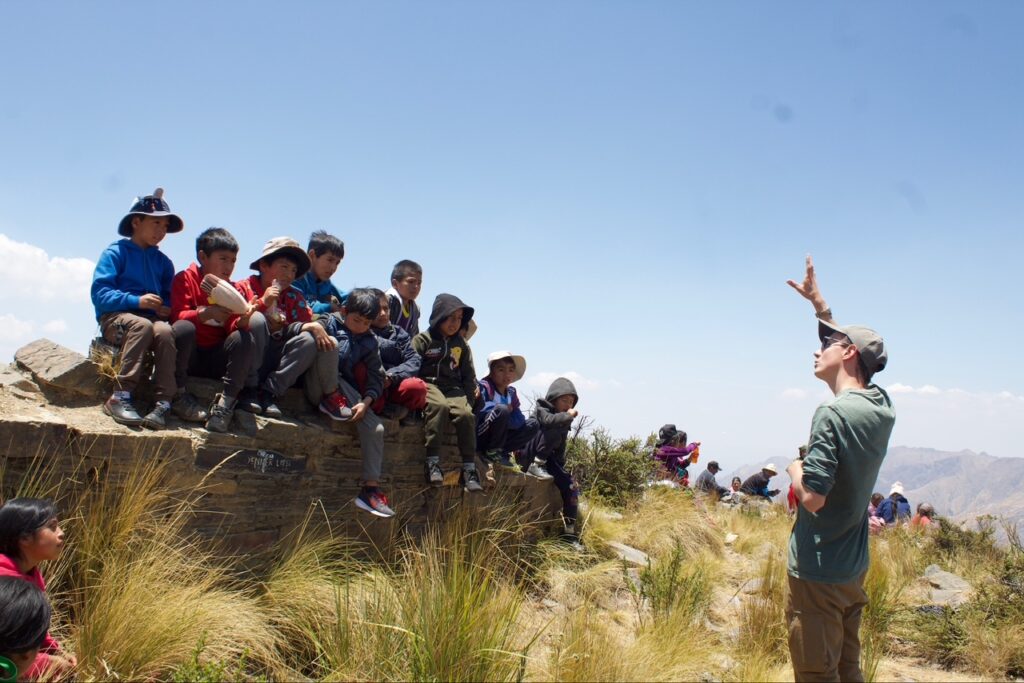
Brooks and Spannagel were recent college graduates when they separately were approved in 2023 for IMB service as two-year Missionary Explorers assigned together to the Amazon jungles of Colombia. In time, after their IMB missionary “boss” (unnamed for security reasons) learned they were in the hunting grounds of armed insurgents, Brooks and Spannagel looked south, to the Andes mountains of Peru.
The Explorers’ assignment: Find unreached people groups and engage them.
“I’d been a Christian six years and didn’t have a story of something God did in my life,” said Brooks after his return last July. An academic who was reared in an upper middle-class home in Kentucky, Brooks had “never put myself in a situation where I needed God to show up. I didn’t give God an opportunity to show up. But now I do have a story of God’s faithfulness.”
There were no known converts during the Missionary Explorers’ passage through a half-dozen villages, but they were able to achieve their objective.
“We were able to see the people group in person, share Bible stories and plant seeds, and now there is an open door for missionaries to follow up behind us,” Spannagel said. “Right now, there is a very small chance of that happening because there are very few people who feel called to work in these contexts.

“Our main challenge is we just don’t have people,” the Missionary Explorer continued, speaking with his “our” and “we” of the IMB. “We have the budget, knowledge, research and ability to be there, but we just are missing the people. As the Bible says, the harvest is plentiful but the laborers are few. My prayer is that God would raise up people who would be willing to step out in faith and continue to do the work God has prepared.”
The Explorers’ two-year term of service started with six months of preparation: two months at Field Personnel Orientation at the IMB’s Missionary Training Center near Richmond, Va.; three months of intensive Spanish language training in Bogotá, Colombia; and a one-month immersive experience at an indigenous training camp.
“This was to help us physically; get us in shape culturally by experiencing an indigenous lifestyle; and third, learn how to share the Gospel in an indigenous context,” said Spannagel, now a student at Canadian Baptist Theological Seminary near Calgary, Alberta.
“It’s an oral culture, so most learning is done by listening and repetition, Bible storying. Taking Bible passages and applying them to their context, repeating it over and over to them, so they memorize it and can tell it to others.”
In February 2024, Spannagel, Brooks, and their indigenous partner Josue took off for a place about 150 kilometers as the crow flies from Bogotá. They had found their destination by searching via satellite for a clearing or a patch of thatched huts, comparing that with other data and confirming the presence of an unreached people group with their IMB supervisor.
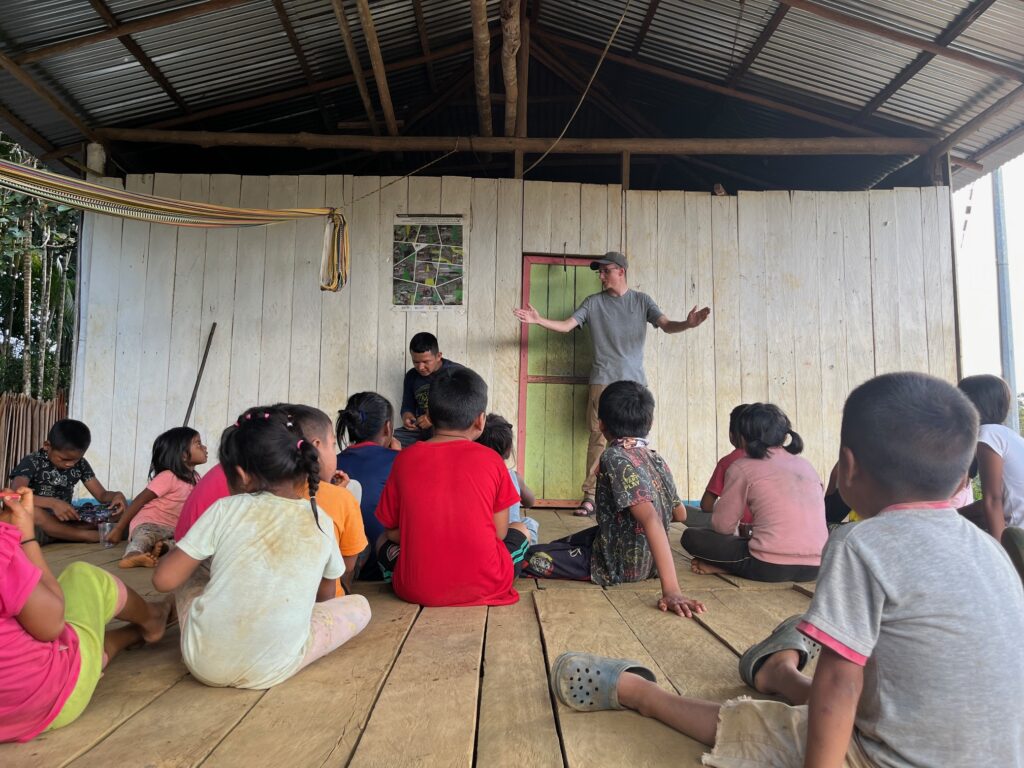
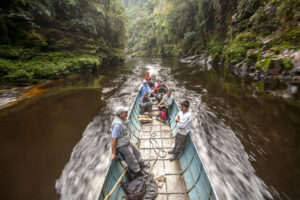
To get there, the three-person team traveled by air from Bogotá to a small town in the jungle next to a main river. Then, a moto taxi (3-wheeled motorbike) ride for six hours on dirt roads followed by a 7.5-hour hike through the jungle, a day-long boat ride and another 10-hour hike to the remote community they had discovered.
“One of our first nights in the jungle, we’d just hiked the whole day. We’re setting up hammocks and Josue’s looking real intently at our bags,” Spannagel said. “He says, ‘I can never live like you. You guys have so much stuff.’
“Here I am in the middle of the jungle having left my family, my job, all my stuff, and I’m living out of a backpack and this indigenous man tells me I have too much! I look at Josue’s pack. He’s got just a couple things: his hammock, rubber boots, a machete and two other items: a small wind-up flashlight and an old Bible.
“Every night Josue would lay in his hammock, wind up his flashlight and read his Spanish Bible, and he would ask us questions about the verses he was reading,” Spannagel continued. “Over the course of the five weeks, he read through the entire New Testament. After seeing that, how he relied entirely on the Lord, every single trip afterwards, Colson and I would take one less thing with us. Josue taught us to rely more on the Lord and less on ourselves. We went from a 70-lb. pack to a 15-lb., pack.”

At one point, Brooks said, the Explorers wanted to go to a village that involved a ride in a six-passenger Cessna after a 12-hour ride in a bus. They arrived late; no one was in the field they landed in to meet them, so they started walking. They came to a small town beside a river and sat, waiting to see who God would bring to them.
A couple hours later, a man walked by, carrying a dead rodent. “Hey! You selling?” Spannagel called out in Spanish – “!Oye! ¿Vendes?” – as a joke.
The response, in all seriousness: “!Si!” The man needed $20US to buy a prescription for his son. He would be back tomorrow in a bigger boat to take them to his village an hour upriver, he told them. It was the village the Explorers wanted to go to.
There the Explorers found a people eager to hear their stories.
“We were there a month,” Brooks said. “For me personally, I can’t start [going somewhere] not knowing where I am going. What I learned was that God is at work and God has connections we don’t have. I don’t have to know all the steps. I just have to take the first step, like Jeremiah 1:6-8 says.
“We went to a handful of places no white person has gone at least in the last 100 years and shared God’s goodness in harvest fields,” Brooks continued. “I had no qualifications except that the Holy Spirit called me to be there. I had never put on a backpack; been camping maybe four nights in my whole life. The people God calls are often afraid, and God’s response is, ‘I am with you,’ and where the Lord is, is a good place to be, even though it’s not always safe.”
Outdoorsy Spannagel talked about his lasting impression of the two years he spent between college and seminary.
“It opened our eyes to the lostness that still exists, for the great need there is to be sending missionaries. We learned to rely on God and how He goes before us, beside us and behind us. We experienced the importance of prayer and just how beautiful the people of God are around the world.”
Bookish Brooks talked about the need to keep praying, sending, going.
“It is not in vain. My encouragement to you is to look to the Lord, ask what the next step is, and pray. If we’ve been obedient to listen to God’s call, it’s enough. Just take that first step, and trust Him.”