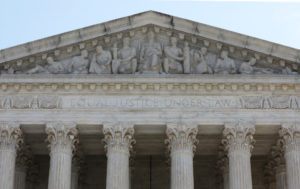
WASHINGTON (BP) – The U.S. Supreme Court heard oral arguments Nov. 10 in a case which will determine if a person can sue a government official in an individual capacity for damages caused by violating the person’s religious freedom.
The case, Landor v. Louisiana Department of Corrections and Public Safety, centers around a man named Damon Landor who had his hair forcibly shaved off while serving a five-month prison sentence in the Louisiana prison system.
Landor says the shaving of his head violated his free expression of religion, as he is a practicing Rastafarian and made a Nazarite vow to never cut his hair almost 20 years ago.
The question in the case is whether Landor is able to sue the prison officials who forcibly cut his hair both in their capacity as government officials and as individuals, therefore collecting monetary damages.
Before the oral arguments, the Ethics & Religious Liberty Commission (ERLC) joined several other religious organizations in filing an amicus brief supporting Landor.
Others filing briefs supporting the plaintiff included Sen. Ted Cruz (R-Texas) and multiple religious denominations.
Landor argues the officials violated the federal law known as the Religious Land Use and Institutionalized Persons Act (RLUIPA).
RLUIPA, enacted 25 years ago, applies to state prisons that receive federal funding and forbids the government from imposing a substantial burden on religious exercise unless the imposition in question is the least restrictive means of furthering a compelling government interest.

While serving his five-month sentence, Landor was held at two different locations before being transferred to Raymond Laborde Correctional Center just a few weeks before his sentence was set to end in 2020.
When he arrived at that facility, Landor attempted to explain his religious beliefs and provided a prison guard with a copy of a ruling by the 5th Circuit Court of Appeals stating that RLUIPA required the prison to allow him to keep his lengthy hair, styled with dreadlocks as per his religion.
Prison officials threw this copy of the opinion in the trash, handcuffed Landor to a chair, held him down and shaved his head bald. Louisiana has historically not allowed prisoners to have dreadlocks.
The prison warden allegedly demanded Landor provide proof of his religious belief and told him it was “too late for that” when he responded that he could get documentation from his lawyers.
After his release from prison, Landor sued the state and the prison officials in federal court. He pointed to a provision of RLUIPA that allows individuals to bring lawsuits for “appropriate relief,” against the government and government officials who violate the law.
The district court dismissed Landor’s claims against the prison officials in their individual capacities, ruling that RLUIPA does not allow private individuals to bring such claims seeking monetary damages.
The 5th Circuit upheld that ruling, pointing to its 2001 ruling that plaintiffs cannot sue government officials in their individual capacity for money damages. Landor then asked the Supreme Court to weigh in, which it agreed to do in June.
Monday’s oral arguments primarily focused on whether or not the prison officials in question had enough clear notice that they could be held liable to subject them to money damages under RLUIPA.
Zachary Tripp, lawyer for the plaintiff, argued the case is the “poster child for a RLUIPA violation,” and Landor should receive damages according to the law.
Crucial in Tripp’s argument is RLUIPA’s similarity to another law aimed at protecting religious expression known as the Religious Freedom Restoration Act (RFRA).
RFRA was enacted several years before RLUIPA, and was originally meant to apply to all levels of government, but the Supreme Court limited it to the federal government in 1997. The passing of RLUIPA in 2000 was Congress’ effort to strengthen state-level protections.
In its 2020 decision in Tanzin v. Tanvir, the Supreme Court held that “appropriate relief” under RFRA can include money damages in lawsuits brought against government officials in their individual capacities.
Tripp argued RLUIPA uses identical language as RFRA, describing the two laws as being like “twins separated at birth,” and therefore damages should be available under RLUIPA.
“RLUIPA is clear, it’s constitutional, and we’re asking the Court to reverse,” Tripp said in his opening statement.
Although justices acknowledged the gross mistreatment Landor suffered, they seemed divided on his arguments for seeking monetary damages.
Justice Brett Kavanaugh told Tripp that a clear statement was needed for the plaintiff to bring his claims against the prison officials, and RLUIPA’s use of the phrase “appropriate relief,” is “not as clear as it could be.”
Justices Neil Gorsuch and Samuel Alito seemingly agreed, questioning when the prison officials would have agreed to be bound to RLUIPA and pointing out that the High Court previously ruled RLUIPA’s reference to “appropriate relief” was not sufficiently clear to allow an inmate to sue for monetary damages.
Also speaking on behalf of the petitioner was Libby Baird, assistant to the U.S. solicitor general who argued on behalf of the Trump administration.
Baird told the justices that RLUIPA “puts states on clear notice” that government officials can be sued for damages in their personal capacity.
“Congress used materially identical text in RLUIPA to provide the same remedies as RFRA against state officials,” Baird said in her opening arguments. “Under the Spending and Necessary and Proper Clauses, Congress could create personal liability for state officials acting as agents of the state when they violate conditions on federal fund.”
Justices Elena Kagan and Ketanji Brown Jackson agreed with this argument, while Chief Justice John Roberts disagreed.
Benjamin Aguiñaga, solicitor general of Louisiana, argued on behalf of the defendants.
Aguiñaga admitted there are “valid” concerns about the lack of clarity on whether money damages can be gathered from state employees sued in their personal capacity, but the solution would simply be for Congress to pass additional clarifying legislation, which does not concern the High Court.
Justice Amy Coney Barrett shared this concern, but Justice Sotomayor appeared to lean more to the side of the plaintiff.
Miles Mullin, executive vice president and chief of staff for the ERLC, spoke to the ERLC’s support of Landor’s case.
“Just five years ago, the Supreme Court unanimously asserted that people who have suffered government infringement upon their religious liberties are entitled to monetary damages from those who violated their rights under the Religious Freedom Restoration Act (RFRA). Yesterday, the justices considered whether the Religious Land Use and Institutionalized Persons Act (RLUIPA) offers the same protections,” Mullin said.
“Though both RFRA and RLUIPA use near-identical language, RLUIPA’s grounding in Congress’ spending clause may cloud the clarity a majority of the justices are seeking to rule in Landor’s favor. The ERLC, anticipating this contention, filed a brief to the court arguing this difference should not matter as long the conditions and consequences of violation – personal liability – are clear.
“What is crystal clear is that Landor’s rights were egregiously violated by state employees who knew that his rights were protected but chose to violate them anyway. If the First Amendment means anything, this cannot stand. State employees cannot be permitted to act with impunity as they snatch a yarmulke off a Jewish man’s head, force an Adventist to eat pork and burn confiscated Bibles. That is precisely the sort of state-sponsored persecution our Founding Fathers sought to prohibit when the First Amendment was ratified.
“If current law does not provide the clarity needed, then Congress should address it as soon as possible by passing legislation that provides the clarity the justices are seeking. Since the assistant to the U.S. Solicitor General argued for the plaintiff on behalf of the Trump administration, the president would likely sign such legislation without hesitation. This move would be a definite win for religious liberty.”
A decision in the case is expected by summer 2026.
Related posts:
 Exoneration points to need for accuracy in criminal justice
  Biden’s State of the Union address a ‘boxing match,’ leaders say
  GOP candidates: ‘delay’ Supreme Court nomination
  Female military draft proposal critiqued
  Draper, Vines support pastors’ counsel to Trump
  Tennessee AG Skrmetti addresses faith, law and fight over gender ideology LifeSpring Church: Keeping Missions in the Forefront
  UCLA discriminated against Jews during Israel-Hamas war protests, judge rules