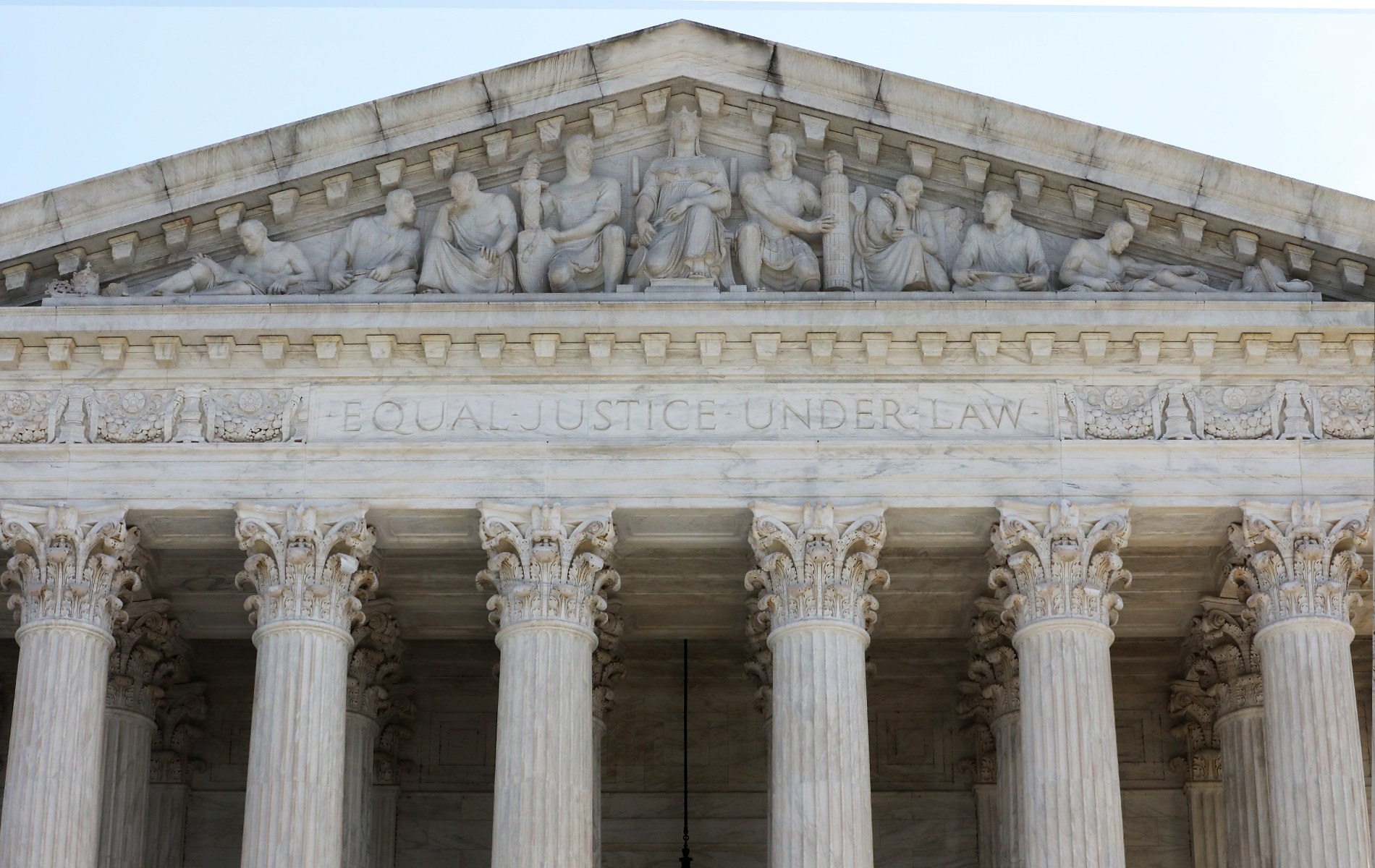

WASHINGTON (BP) – The U.S. Supreme Court heard oral arguments Tuesday (Jan.13) in two cases regarding state laws seeking to clarify competition in sports according to biological sex.
Both cases (West Virginia v. B.P.J. and Little v. Hecox) involve biological males challenging state laws which barred them from competing on female sports teams.
The latter involves Lindsay Hecox (24) who filed suit when seeking to join the women’s track and field and cross country teams at Boise State University. Idaho Gov. Bradley Little (along with Boise State and others) is named as the defendant in the original suit.
The former involves a 15-year-old high school student identified in court documents as B.P.J., who began identifying as a girl in the third grade and began taking puberty-blocking medication. B.P.J. competed only on girls’ athletic teams throughout elementary school. The state, West Virginia’s Board of education and other officials are defendants.
ERLC Interim President Gary Hollingsworth backed the states in both cases, saying they should be able to ensure fair athletic competition by enforcing their laws banning biological males in women’s athletics.
“It was a great privilege to stand on the steps of the Supreme Court as the justices heard oral arguments in two critical cases concerning the protection of women’s sports, joining fellow believers and advocates for biblical and biological truth as the proceedings began,” Hollingsworth said.
“We serve an infallible God. The same God who made the universe made humanity in His image with intentionality and purpose. He gave humanity two immutable genders, man and woman, as gifts reflecting His own nature. He instilled in us purposeful differences for our good and His glory. It should be common sense to know that men and women are different, yet our culture’s confused view of identity denies biblical truth and biological reality.
“States have a fundamental interest in ensuring fair and safe athletic competition by preventing physiologically advantaged biological men from competing in women’s sports. It is not discriminatory or unconstitutional to rightly separate men and women’s sports based on biology. We pray that reason will prevail and that the ruling from the High Court will affirm truth and protect women’s sports.”

Getting to the High Court
The laws at the center of the case are Idaho’s Fairness in Women’s Sports Act (enacted in 2020) and West Virginia’s Save Women’s Sports Act (enacted in 2021).
Idaho’s law imposes a ban on transgender women (i.e. biological males) participating on female sports teams in public schools of all levels, and West Virginia’s law bars transgender women from participating on female sports teams in public secondary schools and colleges.
Idaho’s law was the first of its kind to be passed in the United States.
After each lawsuit was filed, district courts temporarily barred the states from enforcing their laws. These rulings began a lengthy legal journey for each case through appeals courts and eventually to the High Court, which agreed to take up both cases after last summer’s ruling in United States v. Skrmetti. That case ruled that a Tennessee law banning gender transition medical treatments for minors is constitutional.
These cases involve Southern Baptists, in some ways very directly. Last September, the Ethics & Religious Liberty Commission joined several others religious groups in an amicus brief regarding both cases.
Even further, one Southern Baptist lost her spot on her middle school track team because of B.P.J.’s inclusion on the roster.
Adaleia Cross, a member of Simpson Creek Baptist Church in Bridgeport, W.Va., spoke up shortly after the U.S. Appeals Court for the 4th Circuit ruled in 2024 that the state’s law is discriminatory. Simpson Creek even wrote a letter to the local school board on Cross’ behalf.
Even more than losing her spot on the team, Cross said some of B.P.J.’s comments made her feel uncomfortable.
“In any other situation, I would report the comments to my school immediately. But since BPJ identifies as transgender, I was worried I would be labeled as transphobic, and it would make things awkward on my team,” she previously said.
More recently, Cross and another student, both now in high school, came forward alleging more details on attempts by B.P.J. to intimidate them. Those accusations include graphic comments in the locker room that were reported to the school. Representatives for B.P.J. say their client denies those allegations and that the school found them to be unsubstantiated.
Defining terms
An important factor in each case is the definition of the word “sex” in Title IX and how it refers to protecting participation in any federally-funded education program or activity – more to the point in this case, women’s sports. West Virginia, Idaho and about 27 other states say it refers to biological sex determined at birth. Those in opposition claim it includes gender identity.
Another important aspect is the Equal Protection Clause of the 14th Amendment, which lawyers for Hecox say Idaho’s law violates.
Hecox’s case was argued first, with arguments for both cases lasting more than three hours total. The Trump Administration also joined both cases on the side of the states.
Attorneys for Hecox did not argue to overturn Idaho’s law, instead arguing that the law violates the Equal Protection Clause because a small subgroup of people fall outside of it.
The small subset of people the attorneys are referring to are like Hecox, transgender athletes who have taken such a substantial amount of puberty blockers or gender-transitioning medications that their competitive advantage over women in essentially gone.
These attorneys say that Idaho’s law should be interpreted through intermediate scrutiny, which they say it violates because this small subgroup of transgender people do not fall under it. Intermediate scrutiny is often used in legislation related to gender discrimination.
Lawyers for the State of Idaho and the U.S. Department of Justice argued for the use of rational basis review, the lowest level of scrutiny used to examine laws, but added that the law could also satisfy intermediate scrutiny.
Because the law applies in their estimation to more than 99 percent of people, it easily passes either rational review or intermediate scrutiny.
Hecox’s case only slightly addressed the issue of sex according to Title IX, and Hecox’s attorney struggled when conservative Justice Samuel Alito directly asked her to define the term “sex” as used in the law.
Arguing Title IX
Title IX was a much more paramount argument in the subsequent West Virginia v. B.P.J. hearing, where plaintiff’s attorneys want to strike the state’s law as a whole because they view it as sex-based discrimination according to Title IX.
While Hecox has no desire to continue playing sports at the collegiate level, B.P.J. remains a high school student and is actively fighting to retain the ability to participate on the women’s team.
Alito again hit the attorneys with a direct question about the definition of sex according to Title IX.
“Title IX prohibits discrimination on the basis of sex,” Alito said.
“It’s a statutory term, it must mean something. You’re arguing here that there is discrimination on the basis of sex, and how can we decide that question without knowing what sex means in Title IX? It could mean biological sex. It could mean gender identity. It could mean whatever a state wants to define it to mean, but it has to mean something.”
Attorney Joshua Block responded: “I think there are a whole range of sex-based characteristics that can give rise to discrimination. I’m not saying that biological differences aren’t part of sex, but I’m saying that sex also has other broader connotations and there’s no reason to keep that out of the statute.
“Our argument is there are a group of people assigned male at birth for whom being placed on the boys’ team is harmful. We happen to have a word for those people as transgender girls, but I don’t think that means we’re elevating gender identity to be the new definition of sex.”
Alito didn’t seem to buy into this answer, responding: “The question then becomes not whether there is discrimination on the basis of sex but discrimination on the basis of whatever characteristic you think should be included in the definition of sex. When sex is used as a statutory term, I’m not sure you have that flexibility.”
Other conservative justices seemed to favor the arguments of the state in both cases.
In a press release, Liberty Counsel, a Christian ministry focused on strategic litigation, spoke to the importance of protecting the original meaning of Title IX.
“Biological reality dictates that men and women are different,” said Liberty Counsel Mat Staver. “These laws acknowledge reality so female athletes are not competitively, physically, and emotionally harmed by gender-confused males in their sports and private spaces. Title IX’s purpose is to provide more opportunities to women and girls. Permitting biological males in female sports would eviscerate the entire purpose of Title IX and erase women in athletics.”
A decision in each case is expected sometime this summer.
Related posts:
 Bombs will not deter Christian persecution in Nigeria, survivor tells USCIRF
  State of the Bible: Blacks register higher in holistic spiritual health
  Reformation: SBC entities celebrate 500th anniversary
  U.S. Olympic and Paralympic officials bar biological men from competing in Olympic women’s sports
  ‘MLK50’ conf. set on anniversary of King’s death
  SBC DIGEST: Disaster relief roundup; Psalm 139 dedicates two more ultrasounds in Tennessee
  ERLC letter to Trump transition team encourages policy changes
  GOP candidates: ‘delay’ Supreme Court nomination